Wedgwood’s Portland Vase copies and the illusion of glass, 1790
Josiah Wedgwood’s first-edition Portland Vase copies appeared in 1790. Reproducing Roman cameo glass in opaque jasperware demanded experiments in form, colour, firing and even painted illusions of translucency.
A celebrated ancient model
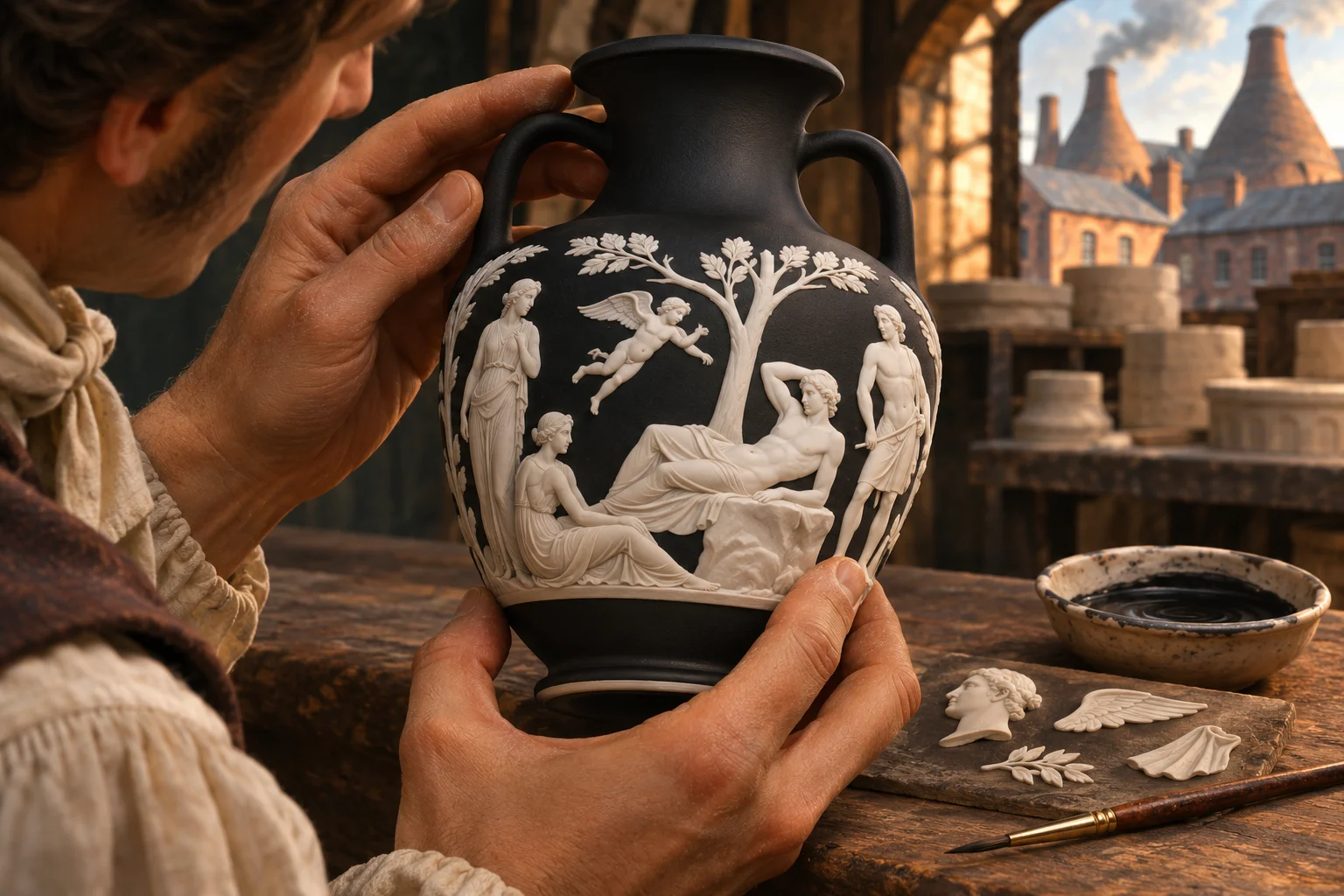
The Portland Vase was an admired Roman cameo-glass vessel in eighteenth-century Britain. Its pale figures stood against a dark background produced from differently coloured layers of glass. Josiah Wedgwood wanted to reproduce it in jasperware, the fine unglazed stoneware associated with his factory. The undertaking crossed a material boundary: ceramic clay would imitate an object whose appearance depended partly on the optical properties of glass. The ancient original’s exact date and imagery remain subjects of scholarly discussion.
The first edition in 1790
Wedgwood began the project in 1786, borrowing the original through its owner, the Duke of Portland. The V&A records first-edition copies ready for subscribers in 1790 after sustained experimentation. The factory shaped the body, modelled the handles and added the pale relief decoration before firing. Precision extended to the asymmetry of the original handles. Princeton’s collection account likewise identifies 1790 as the year of the first black-background edition, distinguishing it from later versions.
Making opacity suggest translucency
Reproducing the original involved more than matching its outline. Colonial Williamsburg’s catalogue explains that painted black slip was used on portions of the applied white decoration to suggest translucency. Slip is liquid clay: it changes the appearance of the ceramic surface without turning the vessel into glass. The visual effect depended on the relationship between dark and light tones. This small technical detail reveals the close connection between sculptural modelling and painterly illusion within the project.
Experiments that survived
Trial pieces and firing records preserve evidence of the difficulties. The V&A describes bubbles caused by gases expanding in the kiln and reliefs that failed to adhere to the body. Those failures help explain the achievement represented by the finished copies. Later editions continued the design’s fame, so an individual museum vase may carry an approximate date even when the first edition’s launch year is known. The accompanying illustration presents representative materials and an interpreted vase, rather than an archival record of a particular firing or craftsman.
Overture to Così fan tutte, K. 588
Olin Conductorless Orchestra; music by W. A. Mozart
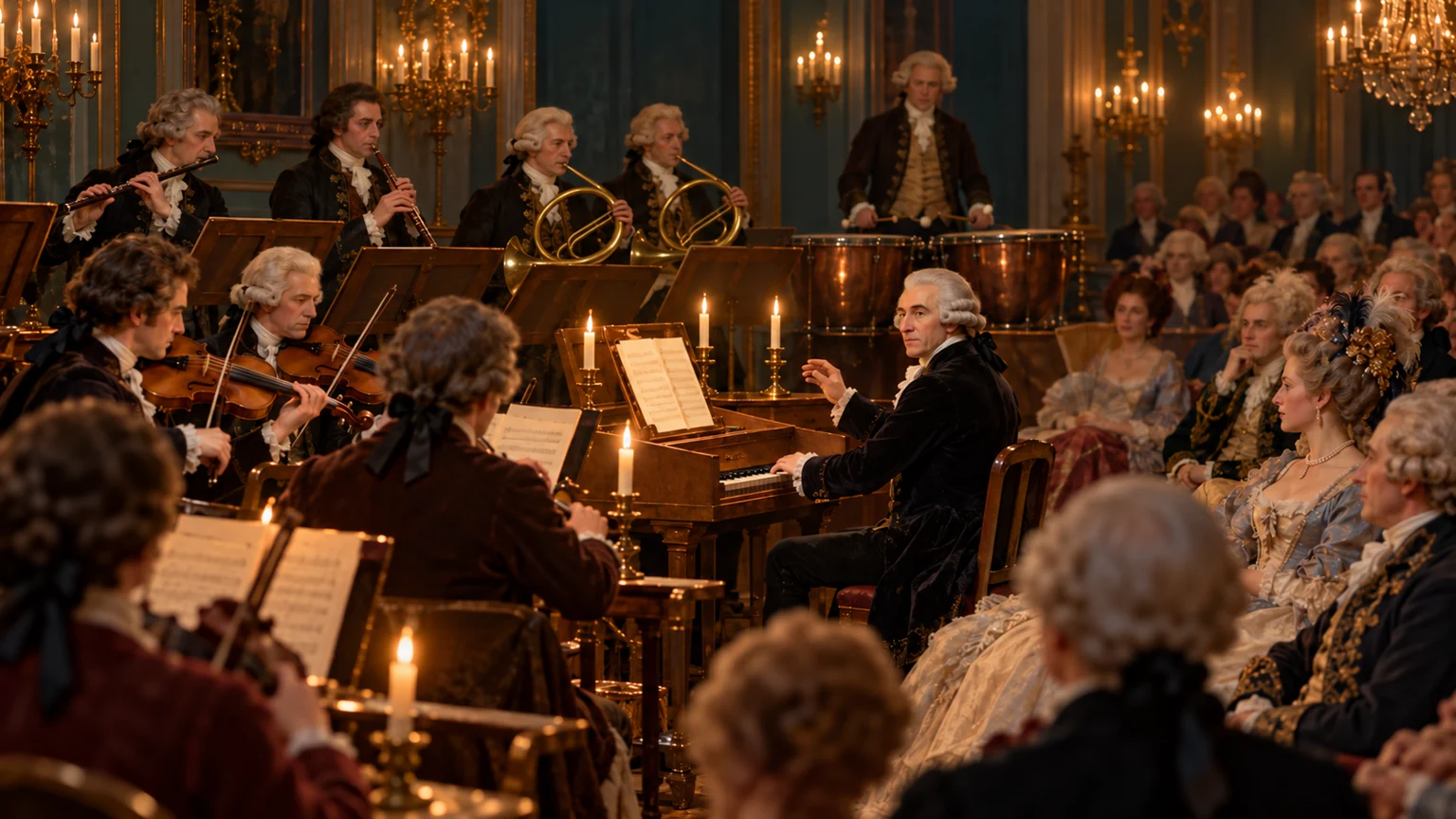
This modern orchestral performance links to 1790, the year Mozart’s opera premiered and Wedgwood’s first-edition vases appeared. It supplies a contemporary European musical context, not music documented at the vase’s exhibition.
Listen on SoundCloud ↗Follow the evidence.
- V&A: Josiah Wedgwood’s Portland Vase ↗
- Colonial Williamsburg: Portland Vase and black-slip technique ↗
- Princeton University Art Museum: First edition in 1790 ↗
- Mozarteum University: Così fan tutte’s 1790 premiere ↗
- SoundCloud: Olin Conductorless Orchestra ↗
AI-assisted writing, with institutional and primary sources. Illustration is a reconstruction, not an archival photograph. Published November 5, 2026; updated November 5, 2026. Our approach