Rediscovery of the Mexica Sun Stone in Mexico City
Found on December 17, 1790, the Sun Stone became a major subject of Mexican archaeological study. Its calendar signs belong to a wider vision of creation, solar movement and successive cosmic ages.
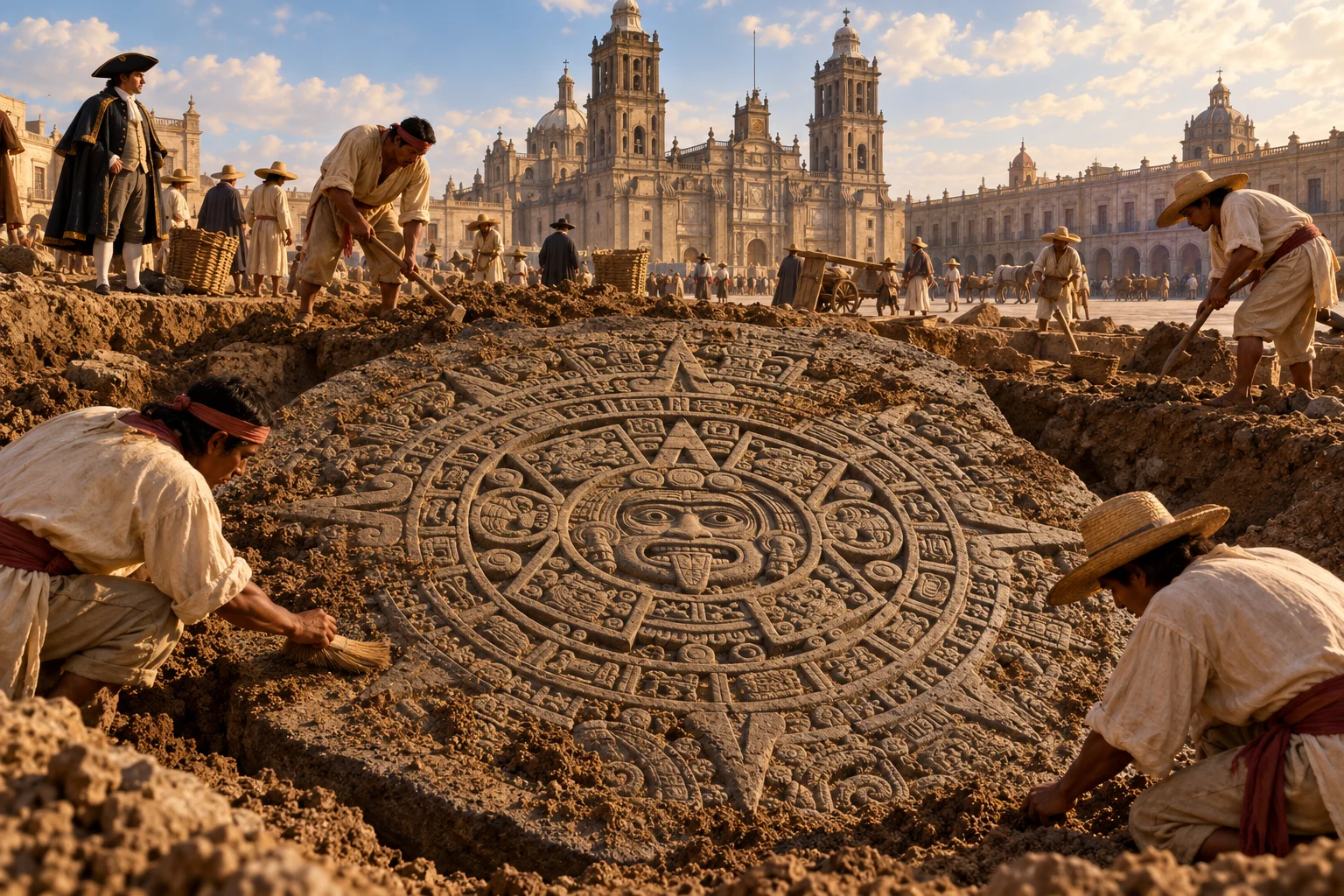
A monument beneath the colonial square
On December 17, 1790, work in Mexico City's Plaza Mayor uncovered the enormous carved disk now called the Sun Stone. The date concerns its rediscovery, not its original carving. Colonial Mexico City occupied the site of Mexica Tenochtitlan, so civic construction could expose material from an earlier city beneath it. Archaeologist Eduardo Matos Moctezuma places the find within works ordered by the viceroy, the second Count of Revillagigedo. An urban improvement project thus became an important archaeological encounter.
Why “calendar” is an incomplete description
The monument contains recognizable calendar signs, but its imagery reaches beyond a convenient device for listing dates. Around the central figure appear the signs of earlier world ages, or Suns. Together they express a Mexica understanding of creation, destruction and the current cosmic order. Solar rays and encircling fire serpents contribute to the composition. Reading the disk only as a calendar strips away the religious relationships that made its time symbols meaningful to the society that created it.
Interpretations developed after the discovery
Antonio de León y Gama began studying the find and emphasized astronomy and the reckoning of time. Further interpretations followed, including work by Alexander von Humboldt and generations of Mexican scholars. The stone was displayed beside the cathedral before its later museum setting. A Smarthistory discussion highlights its modern role as a Mexican cultural emblem. Its survival as a visible monument sustained inquiry, while successive studies show that preservation and interpretation are different tasks. Finding an object does not immediately settle its meaning.
What remains uncertain
Scholars have debated the stone's precise original purpose, orientation and the interpretation of particular figures. Some accounts connect it with a horizontal ceremonial or sacrificial setting; the familiar upright museum display does not by itself establish how it was originally used. Its creation date also should not be assigned the certainty of the documented 1790 rediscovery. The securely dated find opened a continuing investigation. The illustration imagines workers exposing the monument; their arrangement and the visible stage of excavation are reconstructed.
Estrellita — Manuel M. Ponce
Carlos Martín Vásquez, guitar
Vásquez plays Ponce’s much later Mexican composition in Cecilio Perera’s arrangement. This is a Mexican cultural association, not a reconstruction of Mexica music or a performance from 1790.
Listen on SoundCloud ↗Follow the evidence.
- Eduardo Matos Moctezuma: La Piedra del Sol, Arqueología Mexicana ↗
- Eduardo Matos Moctezuma: Archaeology in the Zócalo ↗
- Smarthistory: The Sun Stone, with Dr. Lauren Kilroy-Ewbank and Dr. Beth Harris ↗
AI-assisted writing, with institutional and primary sources. Illustration is a reconstruction, not an archival photograph. Published October 31, 2026; updated October 31, 2026. Our approach