Mozart buys a starling and records its song
On 27 May 1784, Mozart entered a starling in his household accounts and notated a tune resembling his recent G-major piano concerto. The entry connects an ordinary pet purchase with a remarkable example of musical mimicry.
An unusual household entry
On 27 May 1784, Wolfgang Amadeus Mozart recorded the purchase of a starling in the account book he had begun keeping that year. Beside the expense he set down a short musical phrase and an approving comment. The entry survives through documentary scholarship and is reproduced in the New Mozart Edition. A practical record of household spending thus preserves something more intimate: a composer's attention to the sound of his new companion. The page preserves an artistic response in a medium normally reserved for numbers.
A concerto heard in miniature
The phrase closely resembles the opening theme of the finale of Mozart's Piano Concerto No. 17 in G major, K. 453. He had written the concerto for his pupil Barbara Ployer and entered it in his catalogue in April, before buying the bird. The starling's version included a changed pitch and a prolonged note. University Musical Society programme notes discuss these small deviations. The melody is recognizable, but the recorded performance has its own irregularities.
The abilities of a starling
European starlings are accomplished vocal mimics. Their repertoire includes whistles, rattles and warbling, and they can incorporate the calls of other birds. The Cornell Lab of Ornithology describes this varied sound world. That biology makes the account-book observation plausible without requiring the bird to understand musical composition. Learning and reproducing a sequence of sounds is a different achievement from reading a score or recognizing the human meaning attached to it.
What the record cannot tell us
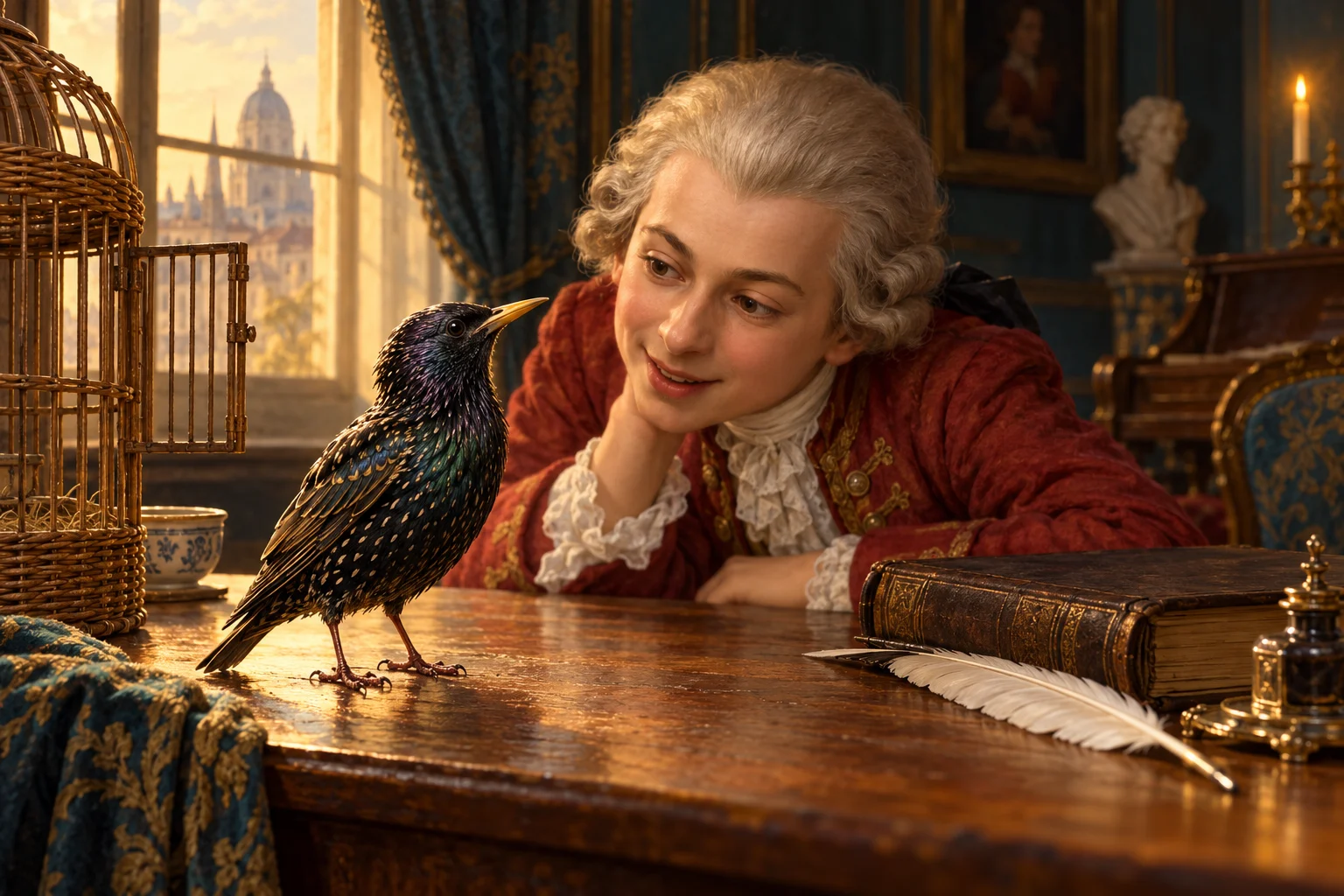
The entry establishes the purchase and Mozart's notation; it does not establish every step by which the starling learned the phrase. Claims that Mozart first heard it in a shop, taught it during earlier visits, or borrowed the concerto theme from it need separate evidence. The concerto's earlier completion is an important constraint on such stories. The accompanying illustration imaginatively places composer and bird together; its room, pose and furnishings are not a visual record of the transaction.
Mozart: Piano Concerto No. 17, K. 453 — III. Allegretto
Alexander Lonquich; Orchestra da Camera di Mantova
The finale contains the theme resembling the starling's notated song. This is Lonquich and the Mantova orchestra's May 2004 Rome performance, not an eighteenth-century recording.
Listen on SoundCloud ↗Follow the evidence.
- New Mozart Edition: piano concertos, documentary introduction ↗
- University Musical Society: Mozart concerto programme notes ↗
- Cornell Lab: European Starling sounds ↗
- SoundCloud: recording and performer credits ↗
AI-assisted writing, with institutional and primary sources. Illustration is a reconstruction, not an archival photograph. Published October 31, 2026; updated October 31, 2026. Our approach