William Herschel’s observation of Uranus on 13 March 1781
On 13 March 1781, William Herschel noticed an object that looked different from nearby stars. Its eventual identification as Uranus extended the known planetary system beyond Saturn and showed how observation and interpretation can unfold at different times.
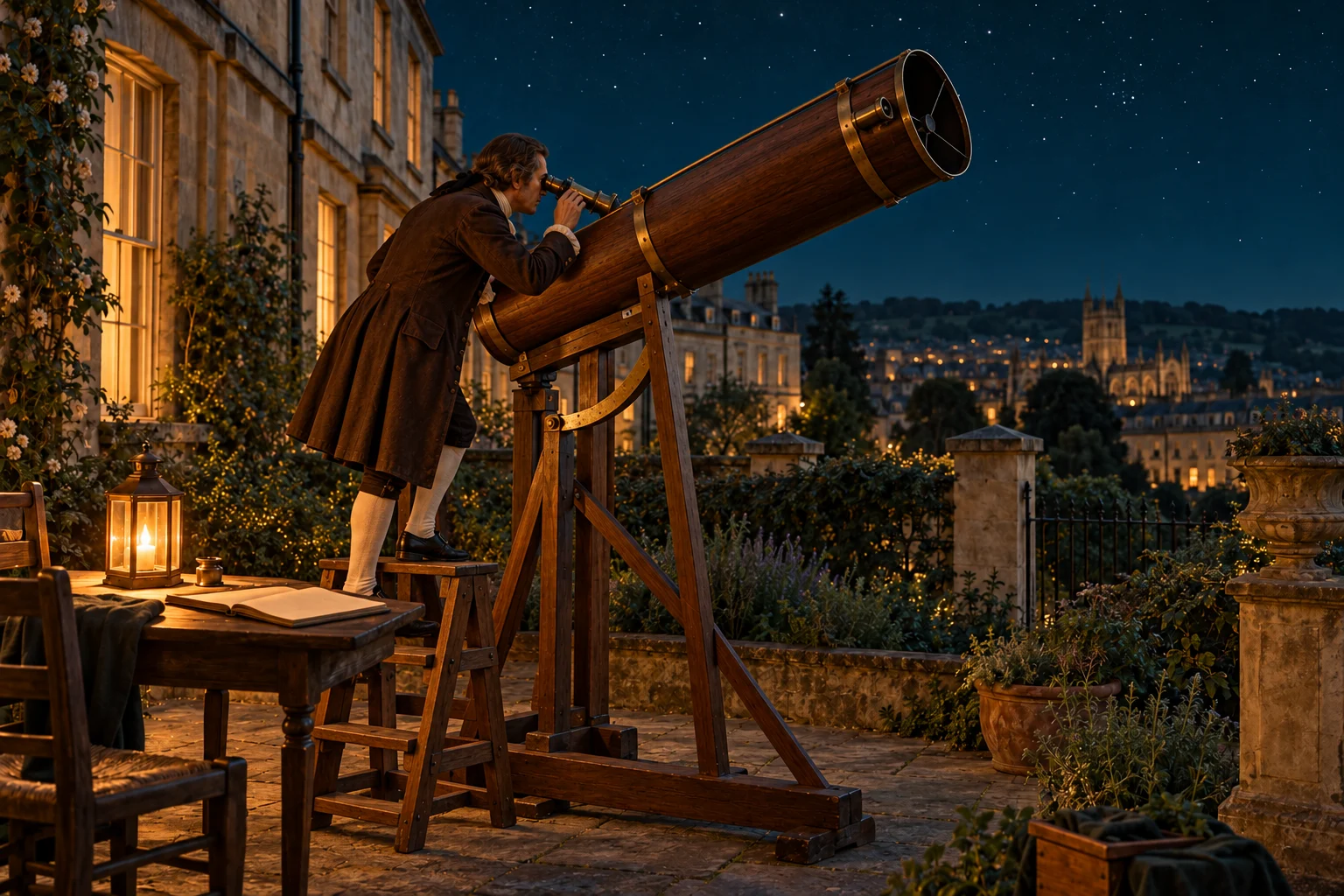
A musician who made telescopes
William Herschel came to Britain from Hanover as a musician and developed a deep interest in astronomy. Rather than relying only on purchased equipment, he built telescopes and improved their mirrors. By 1781 he was observing from his home in Bath. This combination of instrument making and patient observation mattered: detecting something unfamiliar required both an adequate telescope and the willingness to compare an apparently ordinary object with its neighbours. NASA’s historical account
The night of 13 March
On 13 March 1781, Herschel noticed an object that appeared larger than the surrounding stars when examined through his telescope. The Herschel Museum explains the distinguishing feature as a small disc, rather than a single point of light. His observing note, reproduced by the Royal Astronomical Society, entertained the possibility of a nebulous star or comet. The dated achievement was this recognition of an unusual object; the secure planetary interpretation emerged through further investigation. The museum’s explanation The observing note
From possible comet to planet
Further observations established movement against the background stars, and astronomers studied the object’s orbit. Its nearly circular path helped distinguish it from the comet Herschel had initially suspected. The result added a planet beyond Saturn, the outermost planet recognised since antiquity. Earlier observers had recorded Uranus without identifying its planetary nature. Discovery here means recognising what an object is, rather than necessarily being the first human being to see its light. Herschel Museum of Astronomy
A larger planetary neighbourhood
Herschel proposed a name honouring King George III, but Uranus eventually became the internationally accepted name. The naming debate reminds us that scientific discoveries circulate through institutions and national communities as well as telescopes. The March observation became a landmark because subsequent evidence changed the accepted map of the Solar System. The accompanying garden scene is an interpretive illustration of eighteenth-century observing, not a surviving image of that night or a precise record of Herschel’s posture. NASA on identification and naming
Symphony No. 14: Andante in D major (swing-rhythm arrangement)
Michael G. Morris
Herschel was also a composer. Michael G. Morris presents a modern jazz-trio arrangement of Herschel’s own Andante, connecting the astronomer with his musical profession. This is a later arrangement and recording.
Listen on SoundCloud ↗Follow the evidence.
- Herschel Museum — Frequently asked questions ↗
- NASA — Herschel identifies Uranus ↗
- Royal Astronomical Society — Discovery of Uranus ↗
- Michael G. Morris — Symphony No. 14 arrangement ↗
- Michael Morris — Herschel Andante in swing rhythm ↗
AI-assisted writing, with institutional and primary sources. Illustration is a reconstruction, not an archival photograph. Published October 31, 2026; updated October 31, 2026. Our approach