André-Jacques Garnerin’s parachute descent over Paris
On 22 October 1797, Garnerin descended beneath a silk parachute over Paris. An eyewitness described him riding back to the park on horseback.
Balloons create a new problem
Ballooning made it possible to carry people high above the ground before powered aircraft existed. It also raised a practical question: could someone descend independently of the balloon? Parachute ideas had older precedents, and experimental drops had already involved animals. The Royal Air Force Historical Society’s survey places Garnerin within this longer sequence of designs, trials and demonstrations, rather than treating the concept as an invention without predecessors. The balloon supplied the height; the canopy had to make its loss survivable. Observers could watch the result without needing to understand every construction detail. Historical survey
The descent of 22 October
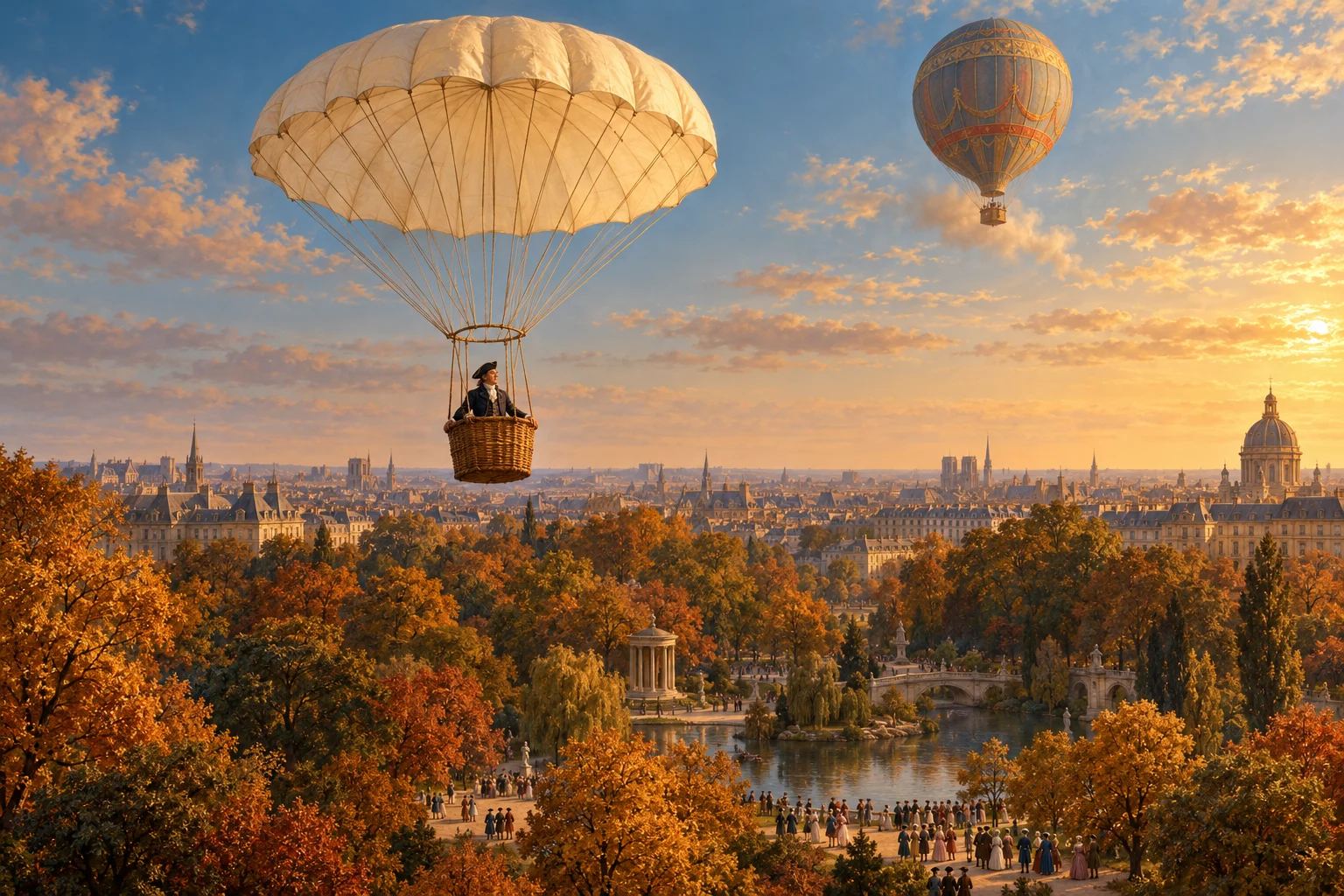
On 22 October 1797, André-Jacques Garnerin made a pioneering high-altitude parachute descent over Parc Monceau in Paris. A basket hung beneath his silk canopy, which was released from a balloon. The descent involved pronounced swinging, but he landed safely. Published accounts give different heights, so an exact altitude is not necessary to establish what happened: a person returned from a balloon using a separate parachute.
The return on horseback
The Smithsonian’s account reproduces an eyewitness description of the landing’s aftermath. Garnerin mounted a horse where he came down and rode back to the park, accompanied by an admiring crowd. That detail connects an unfamiliar aerial experiment with familiar ground transport. It also gives the story a human scale: the novel technology handled the descent, while a horse completed the public return. The horseback episode belongs to the contemporary account, rather than a modern comic embellishment. Smithsonian account
A demonstration with a long afterlife
Garnerin and his wife made further descents, and parachuting became a public spectacle during the nineteenth century. Later aviation would give it additional purposes, including emergency escape. The 1797 demonstration did not resemble modern sport parachuting: its basket and canopy formed a distinct arrangement. Its importance was the successful separation of ascent from descent. The accompanying illustration presents that arrangement in a period setting; it is not an archival photograph or an exact reconstruction of the recorded altitude.
Mozart: Symphony No. 40, first movement — string-orchestra arrangement
Alessio Benvenuti, conductor and arranger, with string orchestra
This 2024 Rome performance of Mozart’s 1788 symphony evokes Garnerin’s late-eighteenth-century European context. It is a later arrangement and was not documented at the parachute display.
Listen on SoundCloud ↗Follow the evidence.
- Smithsonian Air & Space: The First Parachute Jump ↗
- RAF Historical Society Journal 37: The Evolution of Parachutes for Aircrew ↗
AI-assisted writing, with institutional and primary sources. Illustration is a reconstruction, not an archival photograph. Published October 31, 2026; updated October 31, 2026. Our approach