The Gunpowder Plot and the State Opening planned for 5 November 1605
On 5 November 1605 Parliament recorded the discovery of a plot to attack its ceremonial opening. The intended gathering of the king, Lords and Commons explains why the occasion presented such a dangerous target.
A gathering of political authority
The State Opening planned for 5 November 1605 would bring King James I, the House of Lords and members of the Commons together in the Lords chamber. The Gunpowder Plot targeted this particular concentration of authority. Destroying a building was only the means: the conspirators intended to kill the monarch and much of the governing establishment at once. The ceremonial arrangement is essential to understanding why the planned opening mattered. The intended victims included people whose offices embodied different branches of royal government.
The conspiracy and its setting
Robert Catesby was central to the conspiracy, with Guy Fawkes taking responsibility for guarding the gunpowder. The plot developed amid religious conflict and the frustration of Catholics who had hoped for better treatment after James’s accession. The conspirators obtained access to an undercroft beneath the House of Lords. Parliament’s historical account describes the accumulation of gunpowder there and repeated postponements of the opening before the November date was fixed.
Discovery and the record of 5 November
A warning letter received by Lord Monteagle helped prompt official suspicion and searches. Fawkes and the gunpowder were discovered during the night of 4–5 November. Accounts differ in how they place the searches around midnight, so a precise arrest time should not be inferred. Parliament’s chronology records that the Commons met briefly on 5 November and entered the discovery in its journal. The king’s fuller address followed on 9 November.
Consequences and historical caution
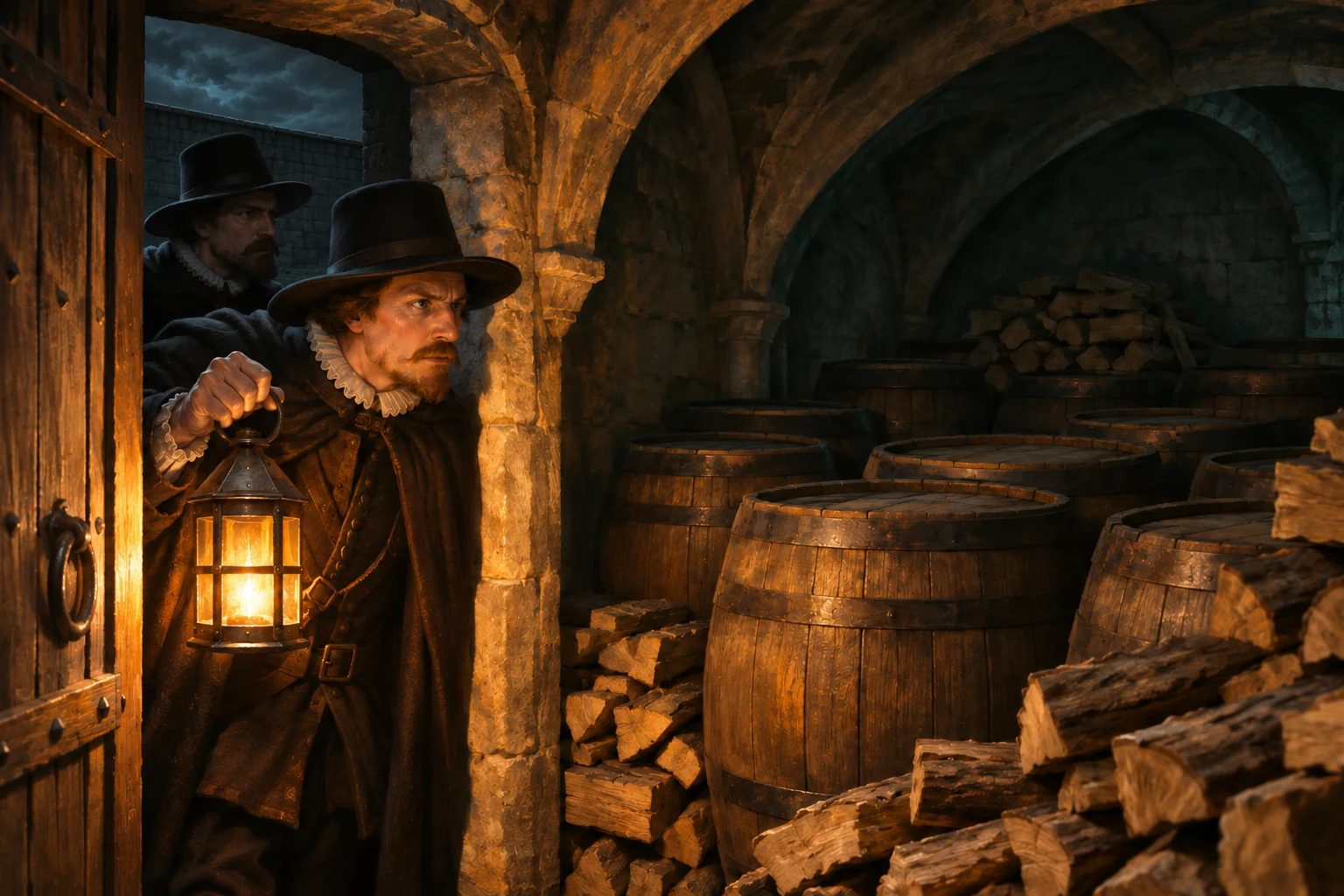
The failure of the plot led to a pursuit of the conspirators, interrogations, trials and executions. Commemoration subsequently gave 5 November a long public afterlife. Understanding the event requires separating that later tradition from the aims and evidence of the conspiracy itself. Official narratives and confessions also need to be read in the context of the authorities who produced them. The accompanying undercroft illustration evokes the documented setting and concealed barrels without claiming to reconstruct an exact moment of discovery.
Lachrimae Pavan
Lucas Finney; music by John Dowland
A modern performance of Dowland’s lute music evokes the musical culture of Jacobean England. No link to the conspirators or a performance on 5 November 1605 is claimed.
Listen on SoundCloud ↗Follow the evidence.
- UK Parliament: Gunpowder Plot chronology ↗
- UK Parliament: Gunpowder Plot frequently asked questions ↗
- UK Parliament: The plot and its planned target ↗
- SoundCloud: Lucas Finney performs Dowland ↗
AI-assisted writing, with institutional and primary sources. Illustration is a reconstruction, not an archival photograph. Published November 5, 2026; updated November 5, 2026. Our approach