Euridice’s Florentine Wedding Performance of 1600
The performance of Euridice on 6 October 1600 joined musical experiment to court celebration. Its treatment of the Orpheus myth shows how the demands of a wedding audience could shape an emerging art form.
Opera within a court celebration
Euridice was performed in Florence on 6 October 1600 during celebrations for the marriage of Maria de’ Medici and Henry IV of France. Ottavio Rinuccini supplied the words, while Jacopo Peri was the principal composer. This was an intimate court entertainment rather than a modern public opera-house opening. Scholarship treats the event within the culture of Medici patronage, where spectacular performances entertained distinguished visitors and presented an image of cultivated power. Kelley Harness’s study
A myth with a different destination
The familiar Orpheus story ends with the musician losing Eurydice again after bringing her towards the world of the living. Rinuccini’s version instead permits a successful return. His dedication explains that an altered ending suited an occasion of exceptional happiness. The adaptation was therefore a deliberate choice, not an accidental misunderstanding of classical mythology. It lets a wedding celebration close with restoration and reunion rather than renewed bereavement. The social setting shaped the drama’s destination. Libretto and its interpretation
More than one composer
The music heard that evening cannot simply be equated with one printed score. Giulio Caccini contributed sections performed by members of his musical circle, including music for Euridice herself. Peri composed and sang Orfeo. Studies of the surviving material distinguish Peri’s version, Caccini’s version and the combined performance. That distinction matters when describing what the wedding audience actually heard. A later performance of one composer’s complete setting need not reproduce the mixture presented in 1600. Study preserved by Slovenia’s national library
Art shaped by its supporters
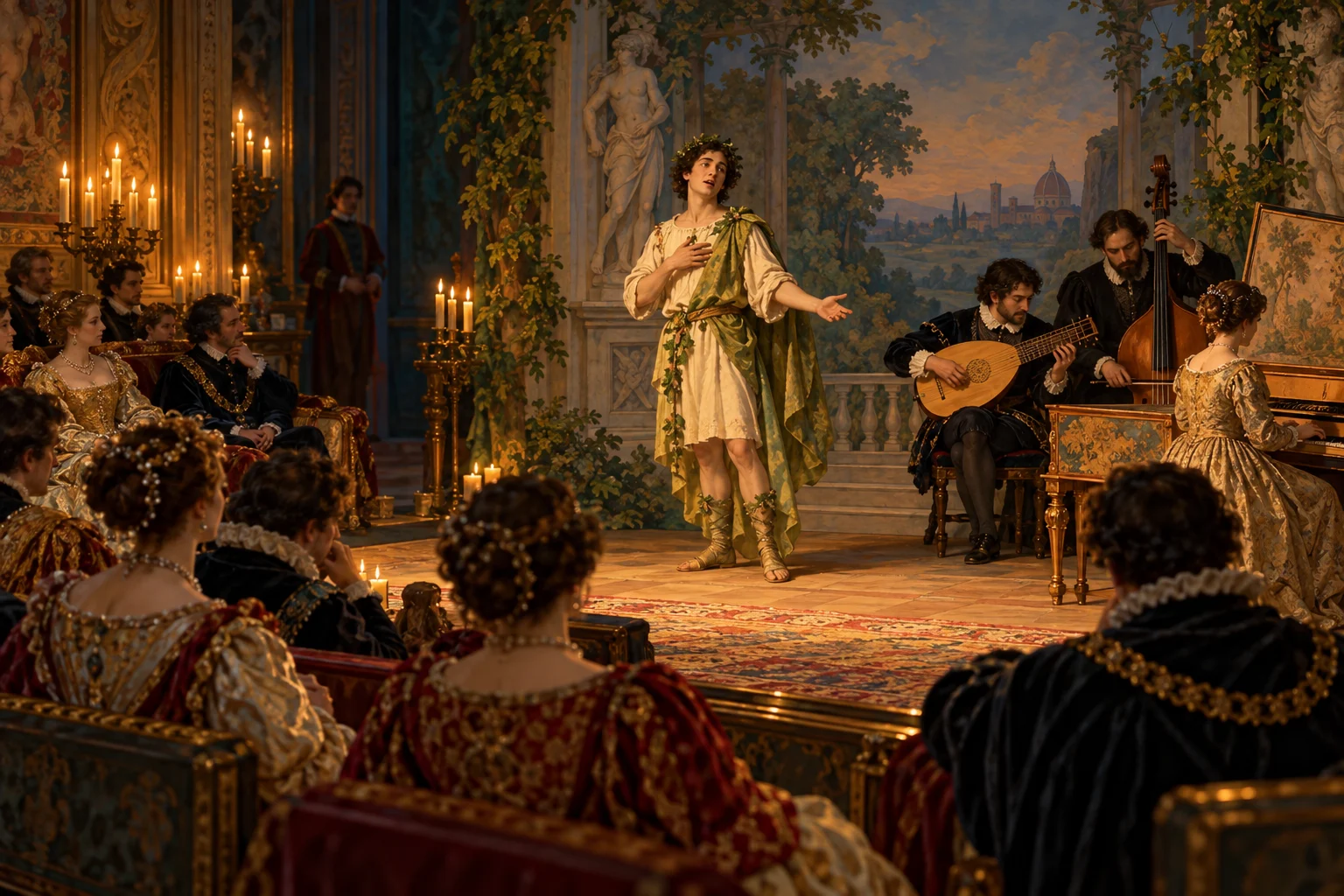
Early court opera depended on wealthy patrons rather than on the ticket income associated with later commercial theatres. Tim Carter places Euridice within this economy of princely display, while noting the involvement of Florentine patron Jacopo Corsi. Carter also cautions that the wedding performance was not the work’s first staging. Its artistic importance does not require imagining it as a modern premiere in miniature. Music, poetry, performers and a particular social occasion came together in a developing theatrical form. The accompanying illustration suggests that setting without asserting an exact reconstruction of the original staging. Tim Carter on opera and patronage
Dafne aria - Peri “Euridice”
Lesia Mackowycz
A modern performance of Dafne’s aria from the opera, uploaded by singer Lesia Mackowycz. This is a complete uploaded performance of that selection, not a recording from 1600.
Listen on SoundCloud ↗Follow the evidence.
- Kelley Harness: The three Euridices, Journal of Seventeenth-Century Music ↗
- National and University Library of Slovenia: Euridice study ↗
- Tim Carter: What Is Opera?, Oxford Handbook excerpt at CUNY ↗
AI-assisted writing, with institutional and primary sources. Illustration is a reconstruction, not an archival photograph. Published October 31, 2026; updated October 31, 2026. Our approach