John Harington’s 1596 Ajax: a flushing toilet and a verbal joke
John Harington’s 1596 publication combined a flushing-toilet design with learned humour. Its name, Ajax, made a pun on a jakes, or privy, while the machinery used a cistern, pipe and valve.
A practical subject in a comic book
In 1596 Sir John Harington published A New Discourse of a Stale Subject, Called the Metamorphosis of Ajax. Harington was a writer as well as an inventor, and the work’s language belonged to that double identity. Its classical-sounding title concealed a pun on a jakes, the contemporary term for a privy. The University of Victoria’s Internet Shakespeare Editions places the publication within the inventive intellectual world of Elizabethan England.
How the mechanism worked
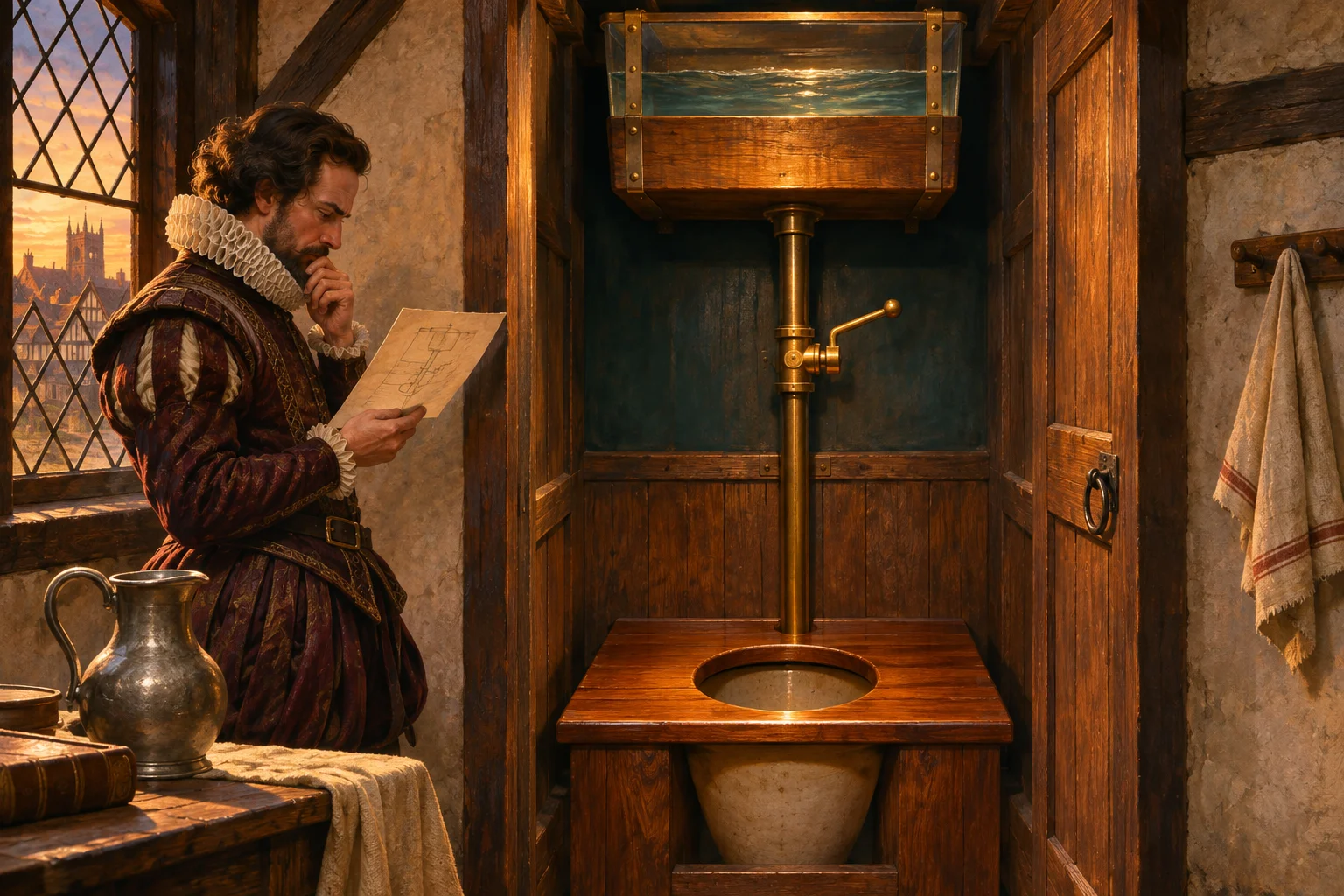
The design used water stored above the seat to wash a pot through a pipe. A valve controlled the opening at the bottom, allowing waste to enter a receptacle below. The Toilet Timeline exhibition describes the turning key, sloping pot and cistern in the published diagram. These are recognizable components of later flushing toilets, though their presence did not make the installation equivalent to a modern bathroom or a complete sewerage system. His instructions included leaving water in the pot, showing that operation and maintenance mattered alongside the initial construction.
An invention needs supporting systems
The Science Museum notes the substantial water requirement and the lack of suitable plumbing and sewers as possible obstacles to wider adoption. A device can work as an individual mechanism while remaining difficult to maintain across many homes. Reliable water, waste storage and protection from smells were all practical problems. Later inventors improved different parts of the system, including the water trap associated with Alexander Cumming’s eighteenth-century design.
What survives and what does not
Harington installed examples at his home near Bath and at Richmond Palace for Elizabeth I, but neither survives. The printed description is therefore more secure evidence than any confident reconstruction of the original rooms or fittings. The publication year is supported; a precise publication day is not supplied by these sources. The illustration interprets the documented elements in a period chamber. The enduring detail is the union of a serious engineering proposal with a joke hidden in its name.
Galliard (Holborne)
Richard Carver, guitar
A modern guitar performance of an Anthony Holborne galliard supplies English Renaissance musical context for Harington’s publication. It is not a recording from 1596 or music known to accompany the invention.
Listen on SoundCloud ↗Follow the evidence.
- Science Museum: A flushing story ↗
- University of Victoria: Harington and the water closet ↗
- Toilet Timeline: earliest flushing water closets ↗
- SoundCloud: Galliard (Holborne) ↗
AI-assisted writing, with institutional and primary sources. Illustration is a reconstruction, not an archival photograph. Published November 3, 2026; updated November 3, 2026. Our approach