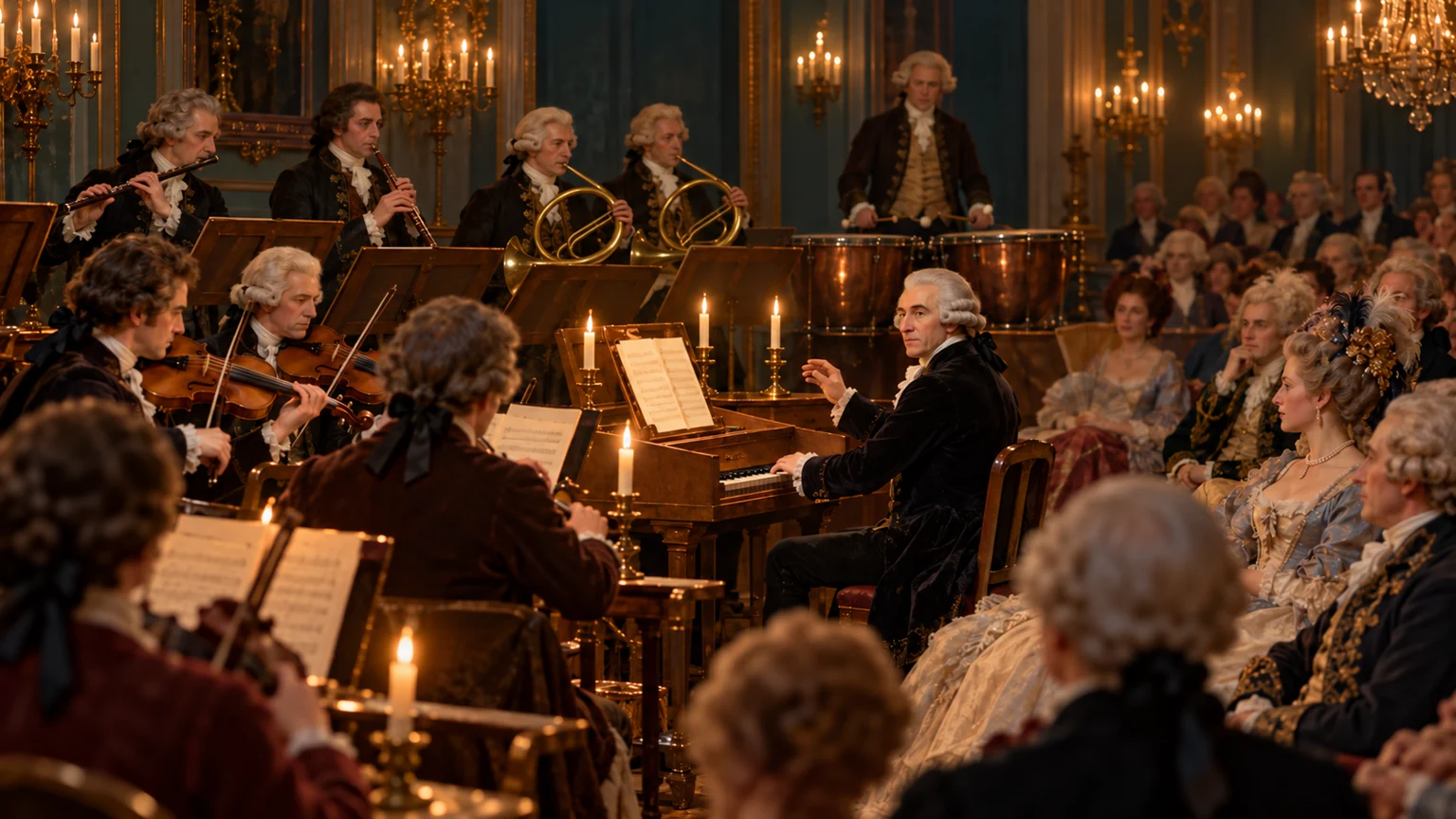
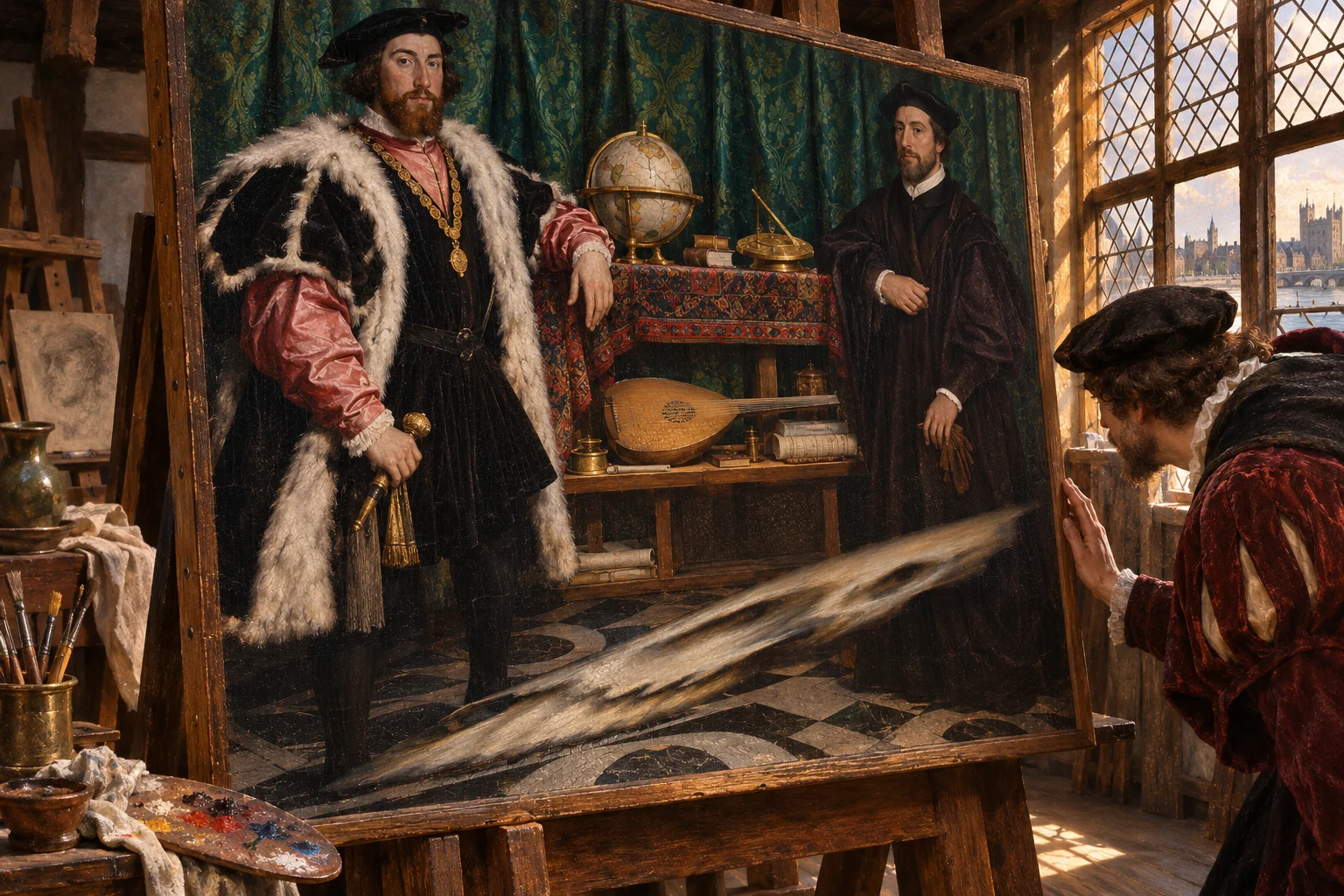
Holbein’s The Ambassadors and its distorted skull, 1533
Hans Holbein the Younger’s 1533 double portrait The Ambassadors includes a deliberately stretched skull. Viewed from near the right edge, the strange shape resolves, making a change in the spectator’s position part of the work’s meaning.
Two sitters and a world of objects
Hans Holbein the Younger painted The Ambassadors in 1533. The sitters are Jean de Dinteville, a French diplomat serving in England, and his friend Georges de Selve, Bishop of Lavaur. Between them stand shelves containing instruments, books and other costly objects. The National Gallery’s collection entry identifies the painting and its date. Its rich surfaces display both the sitters’ status and the painter’s ability to render metal, textiles, wood and other materials.
The shape that changes with viewpoint
Across the foreground lies an elongated pale form that seems incompatible with the otherwise convincing space. From a position close to the painting’s right side, however, it becomes recognizable as a skull. The technique is anamorphosis: a deliberately distorted image appears proportionate from a particular viewpoint. No device is needed for this direct viewing method. The National Gallery’s scholarly catalogue discusses both its geometry and the history of interpreting the unusual form.
An image with more than one register
The skull introduces mortality into a display of learning, wealth and worldly accomplishment. It can be understood as a reminder that those achievements are temporary. The objects elsewhere in the portrait have also attracted symbolic interpretations, including references to harmony and discord. Such readings should be distinguished from the directly observable optical effect. A viewer can demonstrate the skull’s transformation, while proposals about the complete intended meaning depend on historical interpretation and comparison with other evidence.
A spectator becomes part of the design
The work asks the spectator to do something a reproduction can easily conceal: move. Looking straight ahead and looking obliquely produce different experiences of the same surface. That makes the painting an especially vivid example of perspective as an active relationship between image and viewer. The exact original placement and framing cannot be reconstructed with certainty. The accompanying illustration imagines an encounter with the work in a studio; it is not a record of its original installation.
Tant que vivray — guitar arrangement
Stu Mayes
A modern guitar performance of Claudin de Sermisy’s French Renaissance chanson evokes the courtly musical world of the portrait’s French sitters and its depicted instruments. It is a later arrangement, not music documented at the painting’s making.
Listen on SoundCloud ↗Follow the evidence.
- National Gallery: Holbein’s The Ambassadors, 1533 ↗
- National Gallery scholarly catalogue: The Ambassadors ↗
- Stu Mayes: Tant que vivray guitar performance ↗
AI-assisted writing, with institutional and primary sources. Illustration is a reconstruction, not an archival photograph. Published November 4, 2026; updated November 4, 2026. Our approach