Dürer’s Melencolia I of 1514: geometry, melancholy and a magic square
Albrecht Dürer’s 1514 engraving Melencolia I combines a brooding winged figure with tools, measuring instruments and a magic square. Its exact numerical order forms part of an image whose broader meaning remains deliberately difficult to resolve.
An engraving about the creative mind
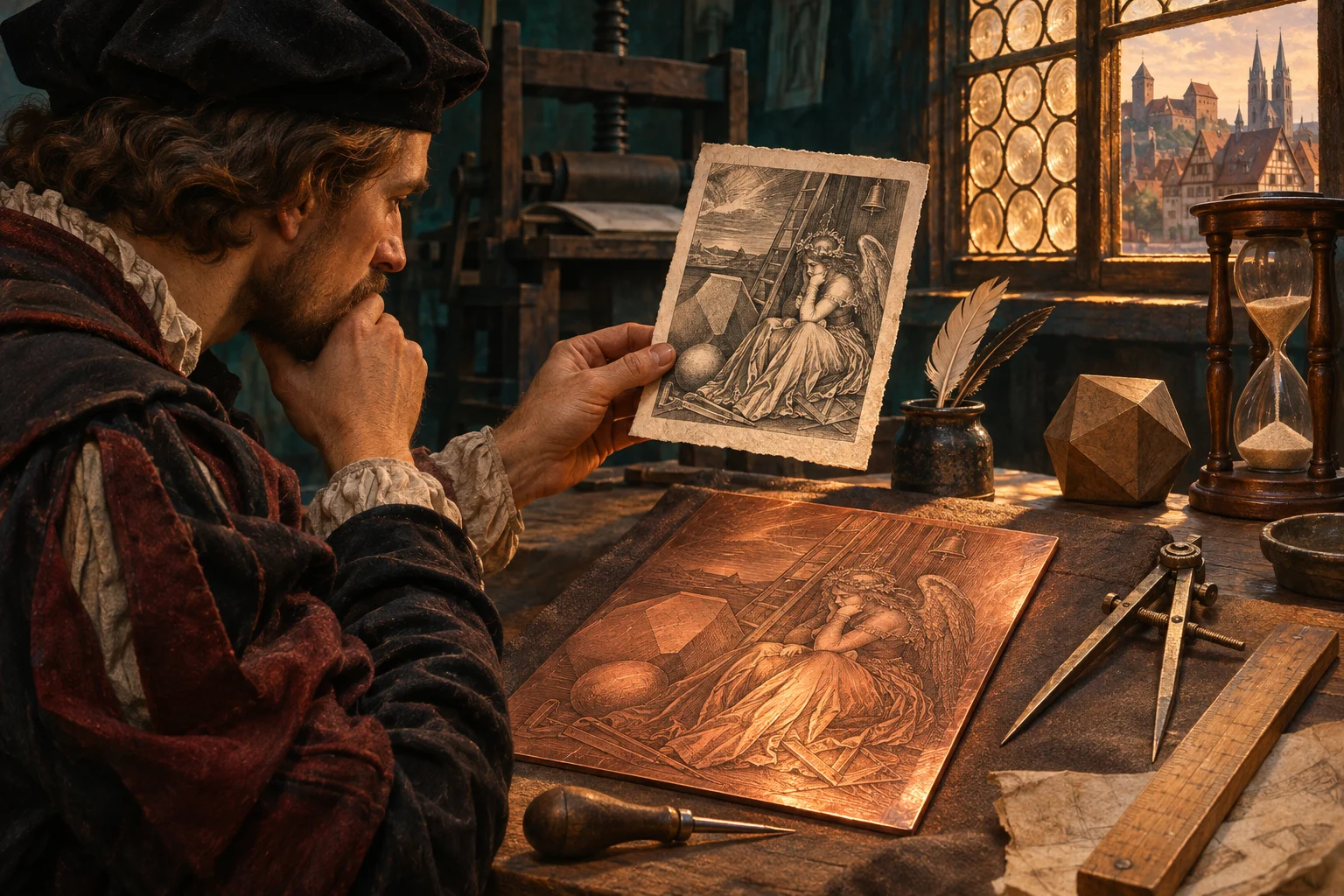
Albrecht Dürer made Melencolia I in 1514. The engraving presents a seated, winged female figure surrounded by tools and objects associated with measurement and making. Her withdrawn posture contrasts with the equipment available around her. Museum interpretations connect the figure with melancholy, a condition understood through the old theory of humors or temperaments. Renaissance thought could link melancholy with unusual creative ability as well as distress. The image therefore addresses a tension familiar to artists: possessing knowledge and technical means does not guarantee the power to create at every moment.
Mathematical order within the composition
On the wall appears a numbered square. Its rows, columns and main diagonals each add to thirty-four. This is a magic square, a numerical arrangement in which several different paths produce the same total. The feature belongs to a larger world of geometry in the print, including measuring instruments, a sphere and an imposing geometric solid. These objects show that mathematical knowledge was part of the intellectual equipment of artistic production. They also introduce a contrast: ordered forms occupy an image whose central figure seems unable to turn the surrounding means into purposeful activity.
The craft of making the print
Melencolia I is an engraving, not a drawing reproduced by modern photography. Dürer used carefully cut lines and small marks to create a range of textures and tones. The Hammer Museum emphasizes the sophistication of this engraved network. The Cleveland Museum draws attention to the different treatment of light across objects such as the transparent hourglass and solid stone. Technical mastery is thus visible in an image concerned with the limits of mastery.
Interpretation without a single key
Scholars have proposed many readings of the print’s individual details. Princeton’s account treats the title’s numeral as probably connected with a contemporary classification of melancholy, rather than a certainty. No short explanation settles every object or symbol. The useful approach is to distinguish the observable design from interpretations built around it. The accompanying workshop illustration is an original evocation of printmaking and the work’s imagery, not a surviving picture of Dürer producing this plate.
John Dowland: Flow My Tears
Paula Bär-Giese, soprano; Hans Meijer, lute
This modern voice-and-lute performance of Dowland’s later Renaissance song offers a thematic connection to melancholy. The song postdates Dürer’s engraving; it is not music documented at the work’s creation.
Listen on SoundCloud ↗Follow the evidence.
- Cleveland Museum of Art: Melencolia I ↗
- Princeton University Art Museum: Melencolia I and its interpretation ↗
- Hammer Museum: Engraving technique and geometry ↗
- SoundCloud: Paula Bär-Giese and Hans Meijer ↗
AI-assisted writing, with institutional and primary sources. Illustration is a reconstruction, not an archival photograph. Published November 7, 2026; updated November 7, 2026. Our approach