Public unveiling of Michelangelo’s David in Florence
Michelangelo’s David was unveiled on September 8, 1504. The celebrated statue was carved from a block already partly worked and abandoned by two earlier sculptors.
The marble before Michelangelo
The material that became David had a history before Michelangelo received it. A huge marble block belonging to Florence's cathedral works had been roughly shaped into a standing figure by Agostino di Duccio and then Antonio Rossellino. Both abandoned the undertaking. The Opera di Santa Maria del Fiore describes this unfinished Giant as the starting point for Michelangelo's work. He inherited an existing and restrictive piece of material, with decisions already cut into it.
A cathedral commission changes setting
Michelangelo received the commission in 1501, and the work developed over the following three years. The original intention was to place the figure high on a cathedral buttress. Its eventual setting was different. In January 1504, prominent artists and officials discussed a suitable location, and the statue was assigned a place beside Palazzo Vecchio. Moving from a cathedral scheme to the city's governmental square changed the public setting in which the biblical figure would be understood.
The unveiling on September 8
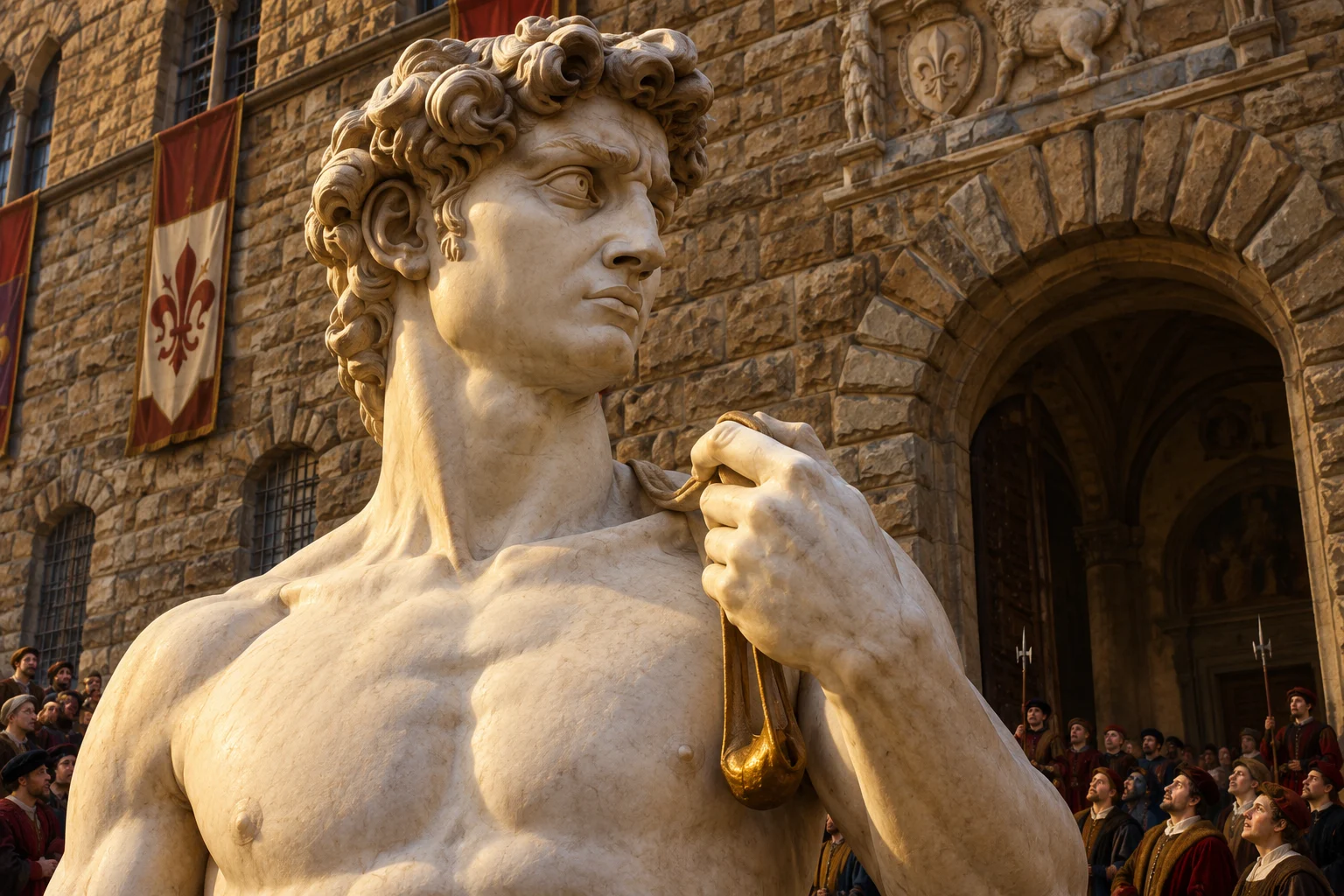
The Galleria dell'Accademia dates the unveiling to September 8, 1504. It identifies the statue as an emblem of Florentine strength and independence and gives its height, including the carved base, as 517 centimetres. Some details were originally gilded, including the sling. This was a carefully presented civic monument as well as an extraordinary carving. Its immense scale and confident human form made the earlier abandoned block difficult to imagine behind the finished result.
Constraint and invention
Carving removes material; a sculptor cannot freely restore stone that a predecessor has already taken away. That makes the block's earlier treatment more than an amusing footnote. Michelangelo had to achieve a coherent figure within inherited limits. The result also shows how a commission can acquire a different public role without losing its original subject. The illustration emphasizes the statue's face and hand in its outdoor setting. It imagines the reception of the work rather than preserving the appearance of an actual unveiling crowd.
Mille Regretz
Ensemble Kô, directed by Tiphaine Legrand
This 2012 concert performance of a Renaissance chanson traditionally attributed to Josquin offers a musical parallel to Renaissance visual art. It is not music documented at David’s unveiling.
Listen on SoundCloud ↗Follow the evidence.
- Galleria dell'Accademia: David ↗
- Opera di Santa Maria del Fiore: Michelangelo and Florence Cathedral ↗
AI-assisted writing, with institutional and primary sources. Illustration is a reconstruction, not an archival photograph. Published October 31, 2026; updated October 31, 2026. Our approach