The hidden acrostic in Hypnerotomachia Poliphili, 1499
The Venetian edition of Hypnerotomachia Poliphili, printed in 1499, united elegant typography with woodcut images. Its chapter-opening capitals also concealed a Latin declaration naming Francesco Colonna and his love for Polia.
A remarkable Venetian book
Aldus Manutius published Hypnerotomachia Poliphili in Venice in 1499. The book follows a dreamlike pursuit of love through imagined buildings, gardens and encounters drawn from classical culture. The Walters Art Museum describes its unusual mixture of languages and its narrative of Poliphilo’s search for Polia. Its physical pages offered a striking visual attraction. The Metropolitan Museum dates its edition to December 1499 and emphasizes the balanced relationship between typography and illustration. No exact publication day is asserted here.
Letters with a second purpose
Thirty-nine decorated chapter-opening capitals can be read in sequence as a Latin acrostic. The resulting declaration says that Brother Francesco Colonna loved Polia deeply. The Fondazione Cerruti’s catalogue documents the message. An element that initially looks ornamental therefore performs a second task, supplying a name and a statement of love. Readers must change the scale of their attention, moving from individual pages to a pattern extending through the whole volume.
Typography and woodcuts working together
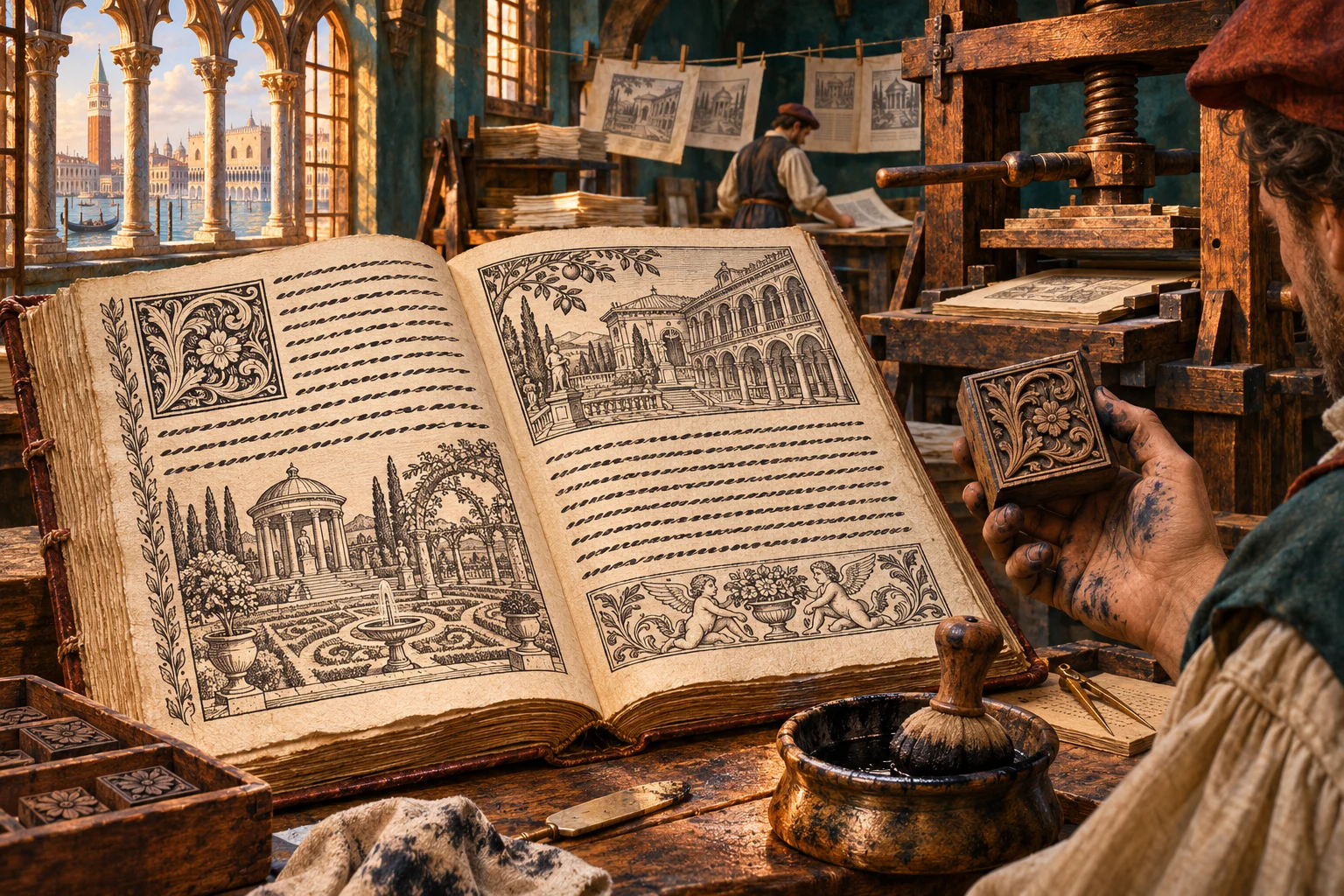
The edition uses Roman type associated with Francesco Griffo and a large sequence of woodcuts. Classical architecture, figures and carefully organized spaces contribute to the book’s visual identity. The Metropolitan Museum highlights the illustrations’ interest in ancient art and linear perspective. The Fondazione Cerruti also records full-page illustrations among its woodcuts. Rather than functioning only as added decoration, images and letterforms shape the rhythm of reading and the presentation of the imaginary world.
What the hidden name cannot settle
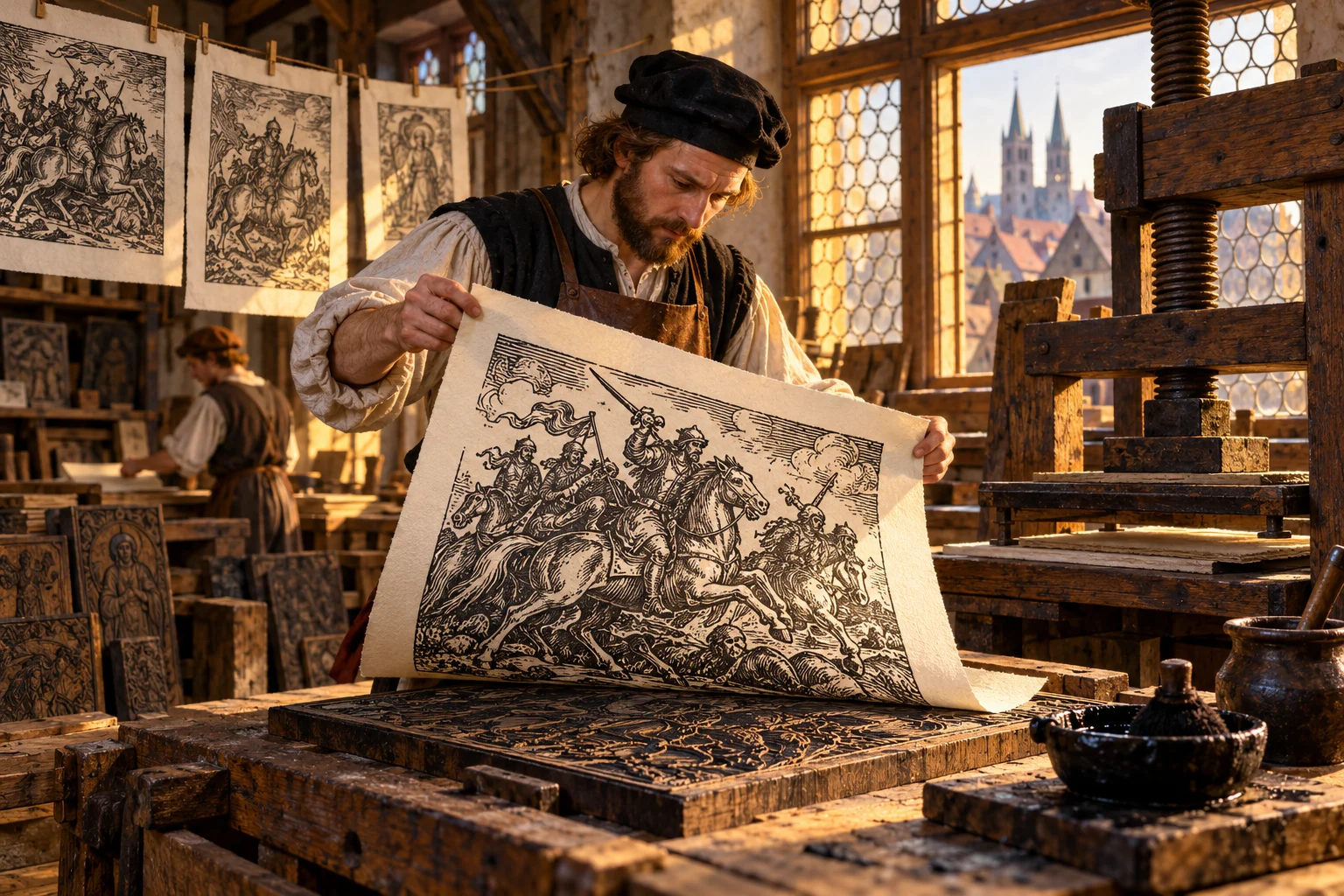
The acrostic is firmer evidence than the identification of every person involved in producing the book. The precise identity of the author and the attribution of the woodcut designs have attracted competing proposals. It is therefore safer to distinguish the name encoded in the capitals from a complete, settled biography. The illustration accompanying this article is an imagined printing workshop. Its deliberately indistinct marks do not reproduce the acrostic or claim to show a specific surviving copy.
El Grillo
LA BIM
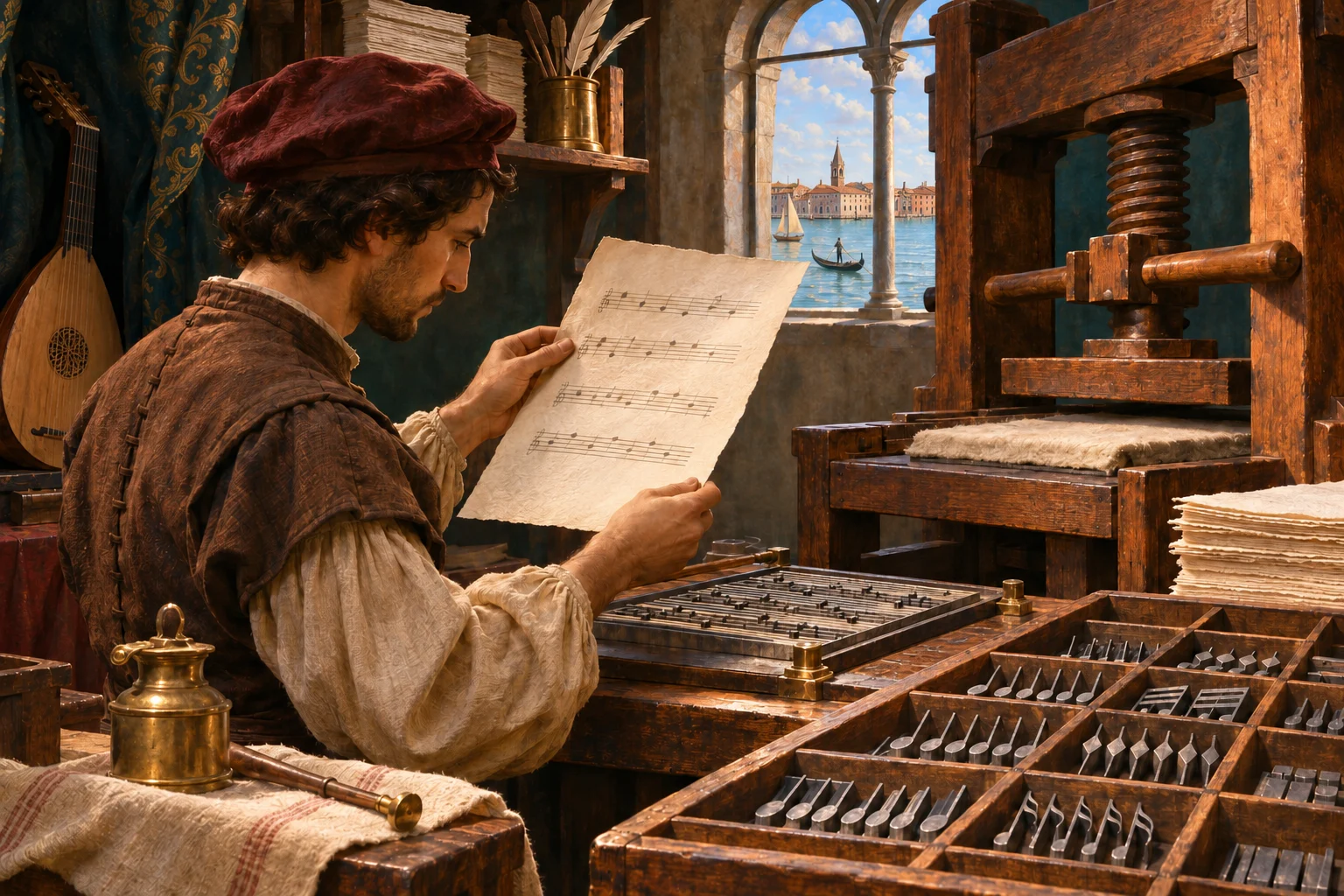
A modern a cappella performance of the Italian Renaissance song traditionally attributed to Josquin. Its surviving early source is Petrucci’s Venetian print of 1505, connecting it to the city’s flourishing culture of beautifully printed books, a few years after this 1499 edition.
Listen on SoundCloud ↗Follow the evidence.
- Fondazione Cerruti: Hypnerotomachia Poliphili and its acrostic ↗
- Metropolitan Museum: Hypnerotomachia Poliphili, December 1499 ↗
- Walters Art Museum: Hypnerotomachia Poliphili, 1499 ↗
- Musica International: El grillo, Petrucci’s 1505 print ↗
- LA BIM: El Grillo ↗
AI-assisted writing, with institutional and primary sources. Illustration is a reconstruction, not an archival photograph. Published November 4, 2026; updated November 4, 2026. Our approach