Albrecht Dürer’s Apocalypse Book of 1498
Dürer’s Apocalypse appeared in German and Latin editions in 1498. Its large woodcuts occupied entire pages, with text printed on the reverse, giving the images an unusually commanding role in the illustrated book.
Nuremberg and the printed image
Albrecht Dürer grew up in Nuremberg, a major artistic and commercial center. His training included work with Michael Wolgemut, whose workshop produced woodcut illustrations for books. Printmaking offered a different kind of reach from a painting fixed to one place: multiple impressions could travel to readers and collectors. Dürer used that possibility with exceptional ambition in the Apocalypse, a sequence drawn from the final book of the New Testament. Artist and training.
What appeared in 1498
The Apocalypse was published in 1498 in German and Latin editions. Its fifteen major narrative woodcuts gave the biblical visions a forceful visual sequence. Instead of fitting small illustrations around columns of words, the book presented large pictures on one side of the paper and text on the reverse. Readers could encounter the image as a complete composition. The National Gallery of Art identifies its surviving set with the 1498 Latin edition. Collection record and publication format.
A reproducible drama
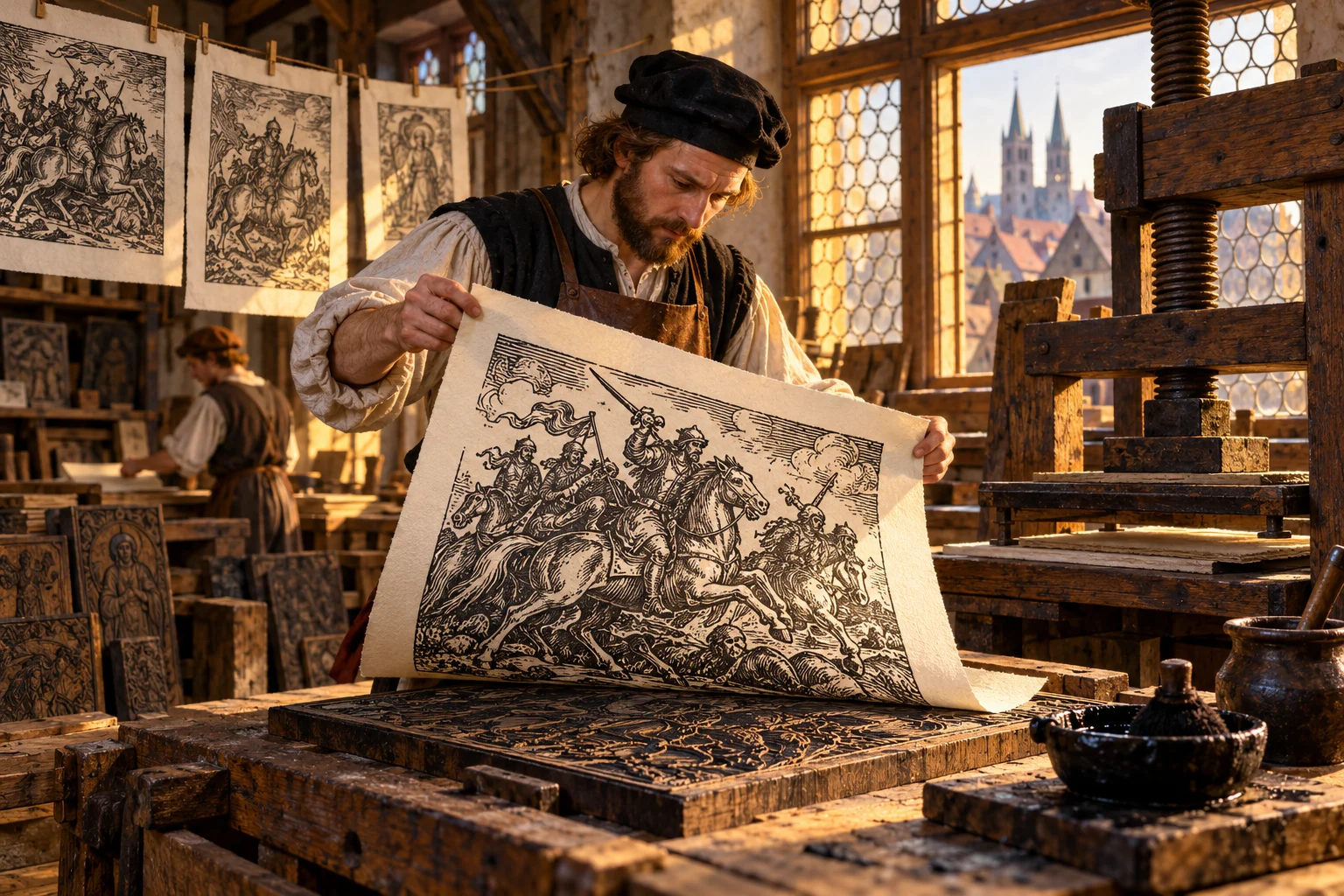
Woodcut uses a carved relief surface: the parts left standing receive ink and print onto paper, while cut-away areas remain light. In Dürer’s compositions, dense networks of lines build movement, texture and contrasts without depending on painted color. The Four Horsemen is especially famous for driving its figures across the sheet with overwhelming momentum. The artistic achievement was not the invention of woodcut itself, but the expressive complexity and authority brought to a reproducible medium.
A book’s design changes how it is read
Page design is part of meaning. Giving an illustration an uninterrupted surface allows viewers to follow gestures, movement and relationships before returning to the accompanying words. Offering editions in two languages also placed the same visual sequence before different reading publics. The museum accounts support the year of publication, but no particular release day is claimed here. The workshop illustration evokes the labor of relief printing; its freshly lifted sheet is an interpretation, not a photograph of a surviving fifteenth-century printing session.
Innsbruck, ich muss dich lassen
Texas Early Music Project
This modern performance of Heinrich Isaac’s Renaissance song offers a German-speaking print-culture parallel. The performers cite a Nuremberg music edition of 1539, later than Dürer’s book; no 1498 performance or direct collaboration is implied.
Listen on SoundCloud ↗Follow the evidence.
- National Gallery of Art: Apocalypse of Saint John, 1498 Latin edition ↗
- Pushkin Museum: Albrecht Dürer and his prints ↗
- Metropolitan Museum of Art: Albrecht Dürer ↗
AI-assisted writing, with institutional and primary sources. Illustration is a reconstruction, not an archival photograph. Published November 1, 2026; updated November 1, 2026. Our approach