The return of Vasco da Gama’s first India expedition in 1499
The surviving ships of Vasco da Gama’s first India expedition returned to Portugal in 1499. Their return demonstrated an ocean route around Africa, while its difficulties exposed the human and logistical costs of sustaining that connection.
The route the expedition demonstrated
Vasco da Gama’s first India expedition connected a Portuguese departure and return with a voyage around southern Africa into the Indian Ocean. When surviving ships reached Portugal in 1499, they demonstrated that such a round trip could be completed. The achievement concerned a particular long-distance connection, not the discovery of an empty ocean. Indian Ocean ports, pilots and commercial networks already existed. European newcomers were entering a maritime world in which other societies had accumulated extensive knowledge of winds, routes and trade. Portuguese Parliament
A return in several parts
The expedition did not arrive home as a single intact fleet. RTP’s account describes surviving ships reaching Lisbon separately, while da Gama travelled apart from them during the final stages. Illness, losses among the crews and the death of his brother Paulo shaped the journey. These details complicate the familiar picture of a triumphant navigator leading every vessel into port at once. The return was a sequence of arrivals and reports, which helps explain why different accounts attach different timings to the expedition’s homecoming. RTP Ensina
Why the year is secure
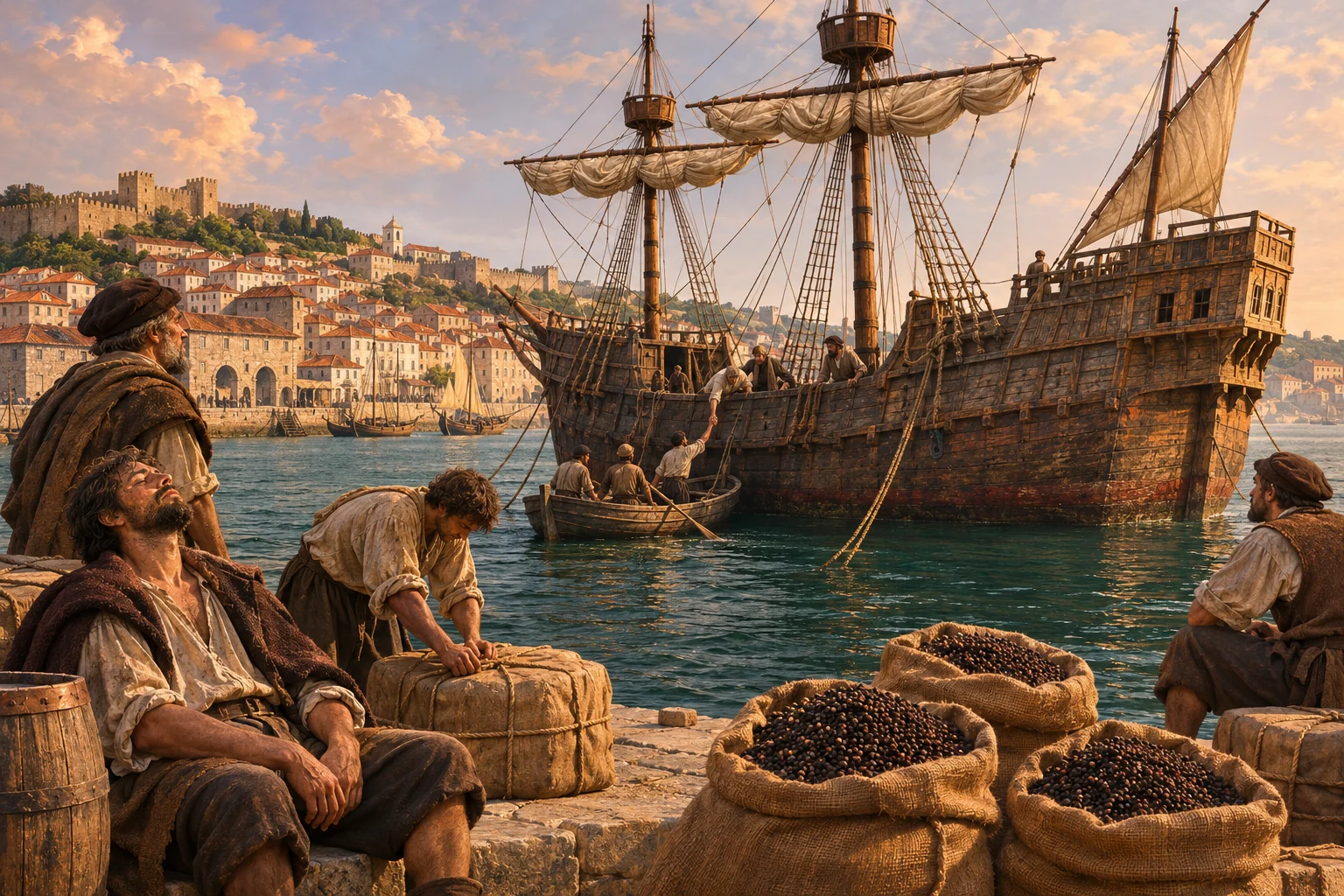
Portuguese institutional accounts agree on 1499 but differ over the precise timing of da Gama’s personal return. RTP explicitly treats a proposed arrival day as uncertain, whereas the parliamentary biography gives another timing. A year-only date preserves what the sources share without choosing an unsupported level of precision. It also keeps the event focused on the expedition’s completion. The illustration shows a generalized returning ship and waterfront; it does not identify an exact recorded docking, surviving vessel arrangement or moment when da Gama stepped ashore. RTP Ensina
From a voyage to a wider transformation
The return encouraged the Portuguese crown to send further expeditions and pursue a larger role in Asian trade. Those ambitions soon involved armed coercion as well as diplomacy and commerce, so the route should not be remembered only as a neutral shortening of a journey. It created new possibilities for European oceanic power within an already inhabited and contested commercial world. The useful historical insight is the difference between proving a navigable connection and controlling it: a completed voyage opened opportunities, but it did not by itself establish stable relationships, safe supply chains or peaceful access to markets. Portuguese Parliament
O Mar é Lindo — Paúl do Mar, 1977
Orfeão Paulense
This documented 1977 Portuguese choral recording from Madeira evokes maritime life through a song about the sea. It is a later cultural association, not a song documented aboard the returning ships in 1499.
Listen on SoundCloud ↗Follow the evidence.
- RTP Ensina: the separate returns of the expedition in 1499 ↗
- Portuguese Parliament: Vasco da Gama and the first voyage ↗
- Vasco da Gama Tower: the voyage and its return ↗
AI-assisted writing, with institutional and primary sources. Illustration is a reconstruction, not an archival photograph. Published November 2, 2026; updated November 2, 2026. Our approach