Four-seasons chess in Alfonso X’s Book of Games of 1283
Alfonso X’s Book of Games, completed in 1283, includes a four-player chess variant whose coloured armies represent the seasons. The playful design turns ideas about nature into rules for a shared board.
A royal book about play
The Book of Games commissioned by Alfonso X of Castile was completed in Seville in 1283. It brings together chess, dice and tables games in a richly illustrated manuscript. Its interest extends beyond royal leisure: the pictures show people of different backgrounds engaging with one another across a board. Cambridge historian Krisztina Ilko’s research emphasizes how such images can complicate assumptions about hierarchy and intellectual exchange in medieval society.
When the year became a chessboard
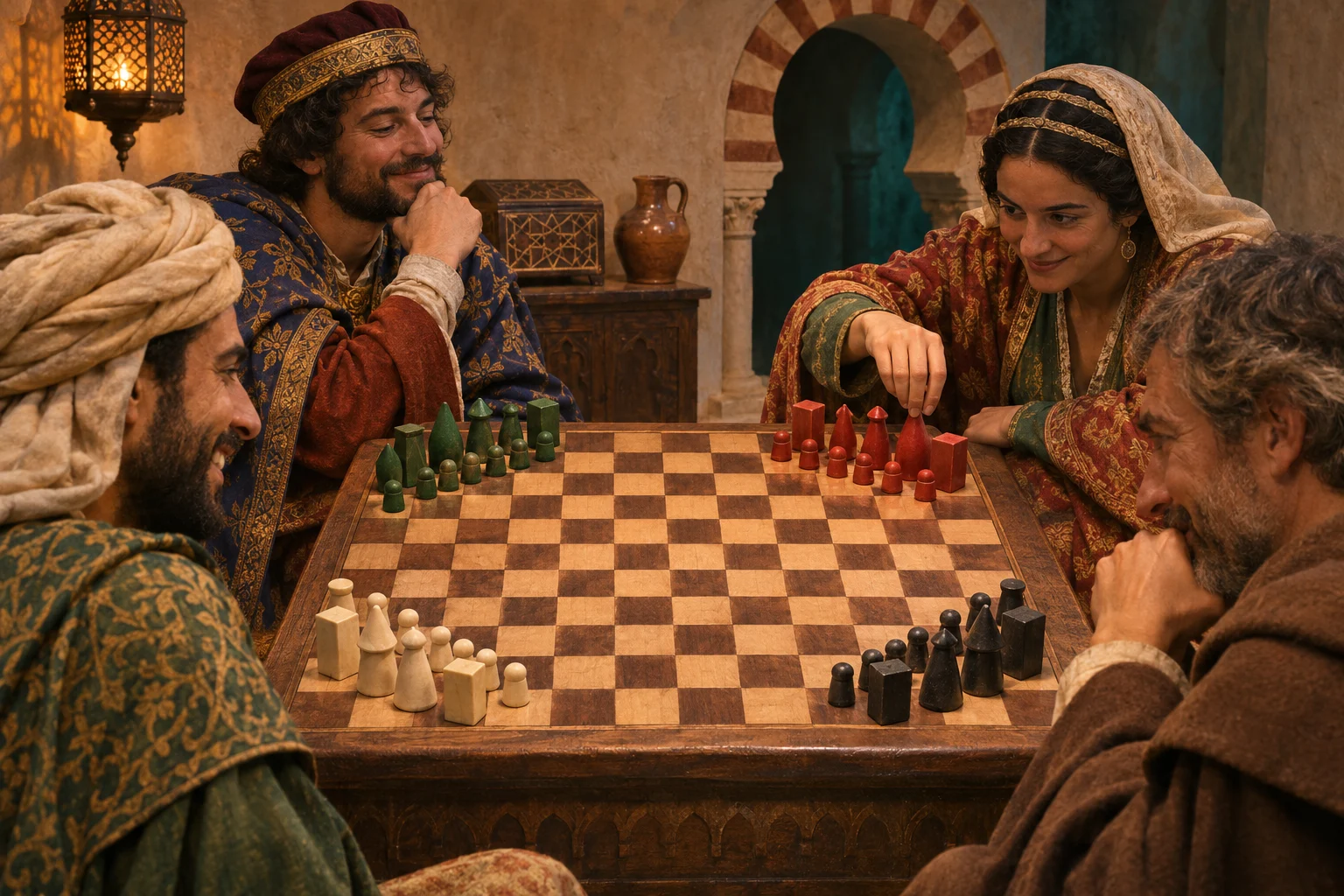
One section describes chess for four participants, with each army representing a season. Spring receives green pieces, summer red, autumn black and winter white. The board retains eight squares on each side, while the armies begin in its corners. Each starts with a king, rook, knight, fil and four pawns. The translated text makes the seasonal symbolism explicit. Four people can thus share a contest usually associated with two opposing sides.
Rules tied to a medieval model of nature
The seasons were linked in the text with the four elements and the bodily humours of contemporary learned medicine. Those correspondences explain the chosen colours and give the game a place within a larger account of the world. They are historical beliefs, not modern scientific explanations of the body. The variant is memorable because abstract natural cycles become something players can handle: coloured pieces, directions of movement and competing interests on a tabletop. The rules also describe wagers, reminding modern readers that medieval board games could involve money as well as intellectual display.
A compilation rather than a single invention
The book preserves and adapts a wide inheritance of gaming knowledge. Sonja Musser Golladay’s study traces much of its chess-problem tradition to earlier Arabic collections. Completion in 1283 therefore does not establish that every included game was invented that year or personally devised by Alfonso. The illustration interprets the four-colour arrangement and a period setting; it is not a reproduction of a manuscript miniature or evidence for the identities of a particular group of players.
Cantiga De Santa Maria No. 266
Woodwose — Katy Marchant, Steve Tyler and Ricardo de Noronha
A modern arrangement built around a melody from the Cantigas de Santa Maria, the song collection associated with Alfonso X’s court. Bagpipes, hurdy-gurdy and percussion supply a later interpretation of that related medieval repertoire, not a recording of a chess game.
Listen on SoundCloud ↗Follow the evidence.
- University of Cambridge: the 1283 Book of Games ↗
- Sonja Musser Golladay: translated Book of Games ↗
- Mirabilia: origins of the chess problems ↗
- SoundCloud: Cantiga De Santa Maria No. 266 ↗
AI-assisted writing, with institutional and primary sources. Illustration is a reconstruction, not an archival photograph. Published November 3, 2026; updated November 3, 2026. Our approach