Al-Jazari’s 1206 book and the elephant water clock
Al-Jazari’s illustrated engineering book, completed in 1206, preserved a clock that turned a slow hydraulic process into a display of moving animals and human figures.
Engineering at an Artuqid court
Al-Jazari worked as an engineer at the Artuqid court in Diyarbakir, in northern Mesopotamia. His work combined practical machines with devices intended to impress and entertain wealthy patrons. Water could raise a load, regulate an interval or start a sequence of movements. These were related engineering problems, even when one machine supplied water and another appeared to make an elephant announce the time. Courtly spectacle provided a setting in which careful mechanical design could become a visible performance. Europeana and the Khalili Collections
The book completed in 1206
In 1206 al-Jazari completed the work commonly known in English as the Book of Knowledge of Ingenious Mechanical Devices. The year dates the written compilation; it should not be treated as a securely documented day on which every individual mechanism was invented. Illustrated instructions allowed later readers to examine designs for clocks, water-raising equipment and automata. The book records knowledge in a form that could outlast a particular workshop, patron or physical machine, and its subsequent copying was essential to that survival. Europeana and the Khalili Collections
A bowl beneath the spectacle
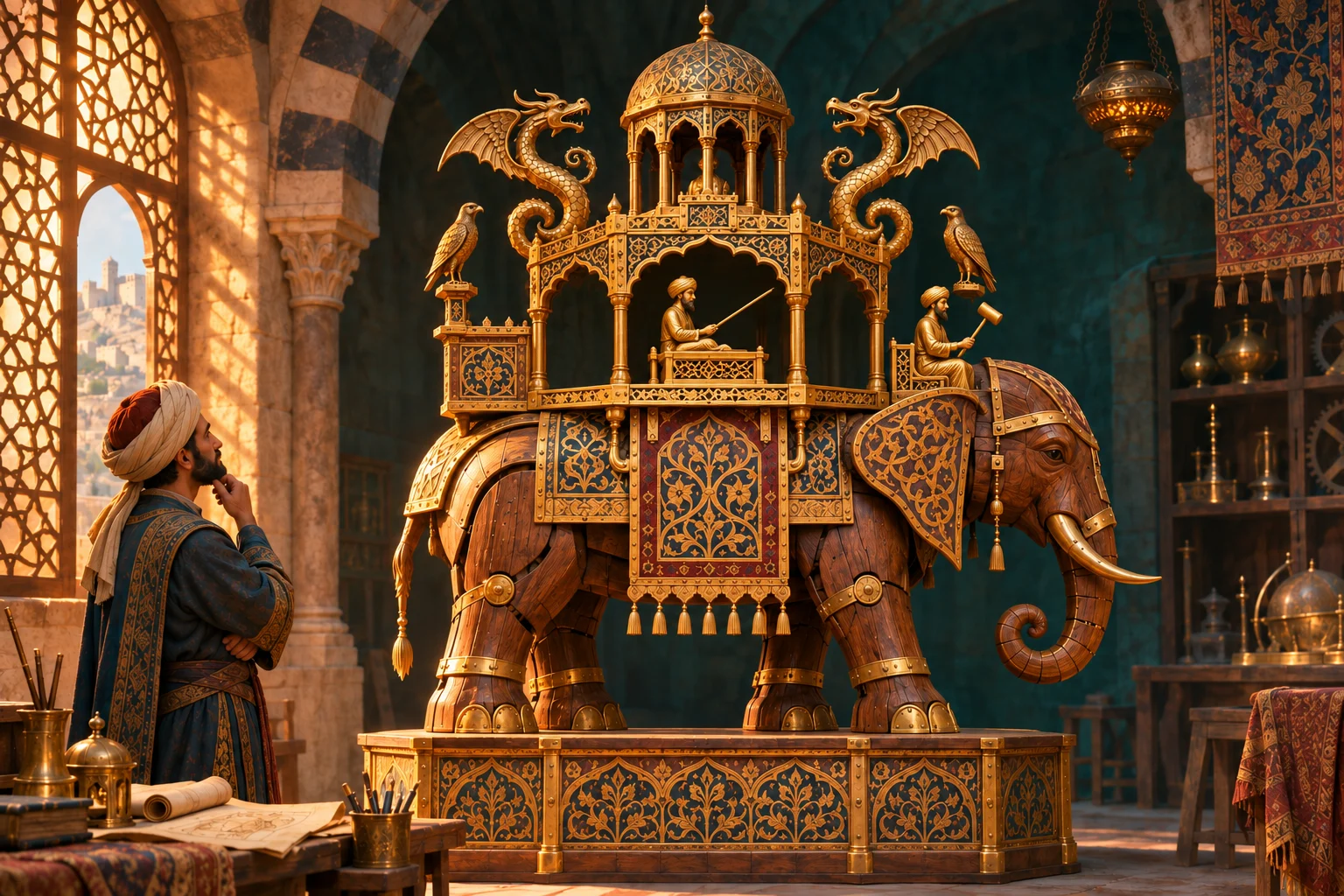
The elephant clock concealed a water reservoir and a bowl with a small opening. Water entered the floating bowl slowly until it sank. This movement pulled a cord and set other parts of the mechanism in motion. Mechanical figures and animal forms converted the interval into an audible and visible announcement, after which the mechanism could reset. The clever contrast was between the elaborate display above and the simple, repeatable hydraulic action within. It was a timekeeping system built around controlled change, rather than an oscillating pendulum. Lehigh County Authority
Reading the surviving evidence
The Metropolitan Museum preserves an elephant-clock design in a manuscript dated 1315, more than a century after the original compilation. That sheet is evidence for the transmission of al-Jazari’s work, not a contemporary photograph of a surviving machine. Drawings, descriptions and later reconstructions therefore need to be distinguished. The accompanying illustration is an interpretive scene based on the documented device, rather than an exact archaeological reconstruction. Its ornate exterior helps convey the intended sense of wonder, while the historical explanation identifies the hidden process that made the spectacle possible. Metropolitan Museum
03 Samai Hijaz
Callen Clarke
Clarke plays all instruments in this later recording of an Ottoman/Arabic classical form. It evokes the wider regional musical context, rather than reconstructing music heard at al-Jazari’s court in 1206.
Listen on SoundCloud ↗Follow the evidence.
- Europeana and the Khalili Collections: al-Jazari’s book in 1206 ↗
- Metropolitan Museum: elephant-clock design in a later manuscript ↗
- Lehigh County Authority: the sinking-bowl mechanism ↗
AI-assisted writing, with institutional and primary sources. Illustration is a reconstruction, not an archival photograph. Published November 2, 2026; updated November 2, 2026. Our approach