Al-Azhar’s opening in 972: a Fatimid mosque and its scholarly afterlife
Al-Azhar opened for congregational prayer in Cairo in 972. Founded under the Fatimids, the mosque later developed into a major center of teaching. Its history connects religious architecture, changing dynasties and a long scholarly tradition.
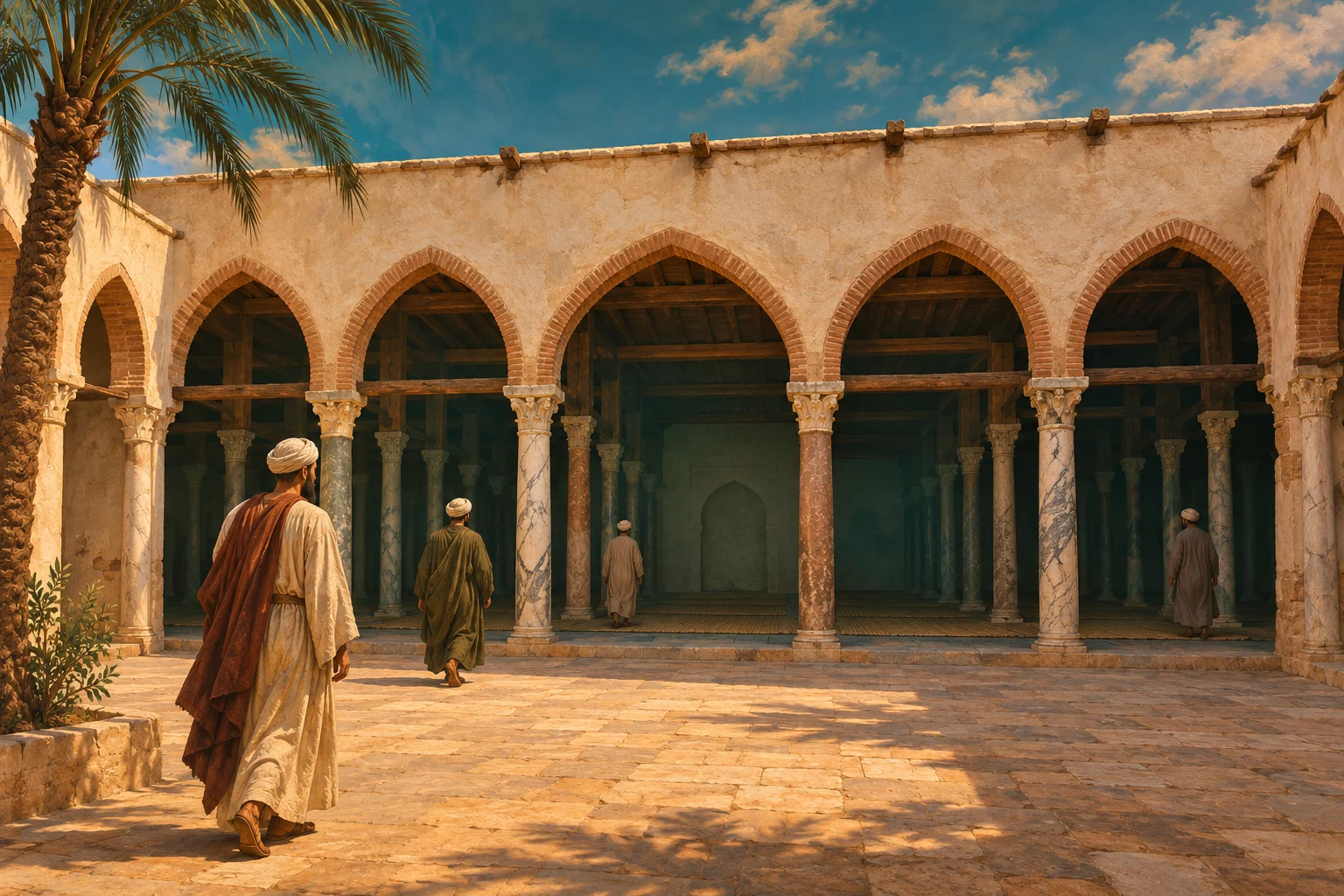
A mosque for the new capital
Al-Azhar was established after the Fatimid foundation of Cairo. The commander Jawhar al-Siqilli began its construction in 970 on the orders of the caliph al-Mu‘izz. The institution’s anniversary account identifies the opening for prayer as Friday, 7 Ramadan 361 AH, given there as June 21, 972 CE. This event concerns the functioning congregational mosque. It should not be treated as the simultaneous creation of every later school, college or administrative body associated with the name Al-Azhar. The building stood within a new political and religious capital and served the community assembled for worship.
The early architectural core
Egypt’s cultural-heritage documentation describes a rectangular open courtyard surrounded by arcades. It also records water cisterns beneath the courtyard and notes that the original mosque occupied roughly half its later area. Successive patrons enlarged the building and added architectural elements. The many minarets, entrances and schools visible in later views therefore represent an accumulated history. Reading the monument requires distinguishing an early core from additions made under different rulers. The illustration accompanying this article evokes that modest Fatimid setting rather than presenting the present complex as if it had appeared fully formed at its opening.
Teaching across changing religious regimes
Al-Azhar was initially associated with the Fatimids’ Shi‘i religious program. Its later identity as a major center of Sunni learning emerged through a history of changing rule and patronage. The institution’s own account highlights the Mamluk period as an especially important phase of support for scholars, students and architecture. Over time the mosque became a gathering place for teachers and learners from a wider world. Religious instruction and other fields of knowledge were part of that developing role.
A long history, not a single unchanged institution
The continuity of a famous name can conceal changes in organization. Al-Azhar’s modern university structure and expanded colleges belong to much later reforms, including legislation in 1961. Describing its medieval origins remains valuable, provided those later developments are not projected backward. The opening in 972 marks a secure point in the history of the mosque; the scholarly institution grew through subsequent generations. Its significance lies in that combination of place, recurring teaching and repeated adaptation.
Longa Riad — Riad al-Sunbati
Knud Stüwe
Stüwe’s oud performance of a piece by Egyptian composer Riad al-Sunbati provides a later Egyptian musical connection. It is secular twentieth-century repertoire in a modern performance, not Fatimid music or sound from Al-Azhar’s opening.
Listen on SoundCloud ↗Follow the evidence.
- Al-Azhar: Institutional anniversary account of the opening ↗
- Al-Azhar: About the mosque and its institutional history ↗
- CULTNAT: Al-Azhar’s construction and architectural development ↗
- SoundCloud: Knud Stüwe’s Longa Riad ↗
AI-assisted writing, with institutional and primary sources. Illustration is a reconstruction, not an archival photograph. Published November 7, 2026; updated November 7, 2026. Our approach