The foundation of Heian-kyō in 794 and Kyoto’s Chinese-inspired street grid
Heian-kyō became Japan’s imperial capital in 794. Its planned streets drew on Chang’an in Tang China, creating an urban framework that helped shape Kyoto’s later development and its enduring role as a cultural center.
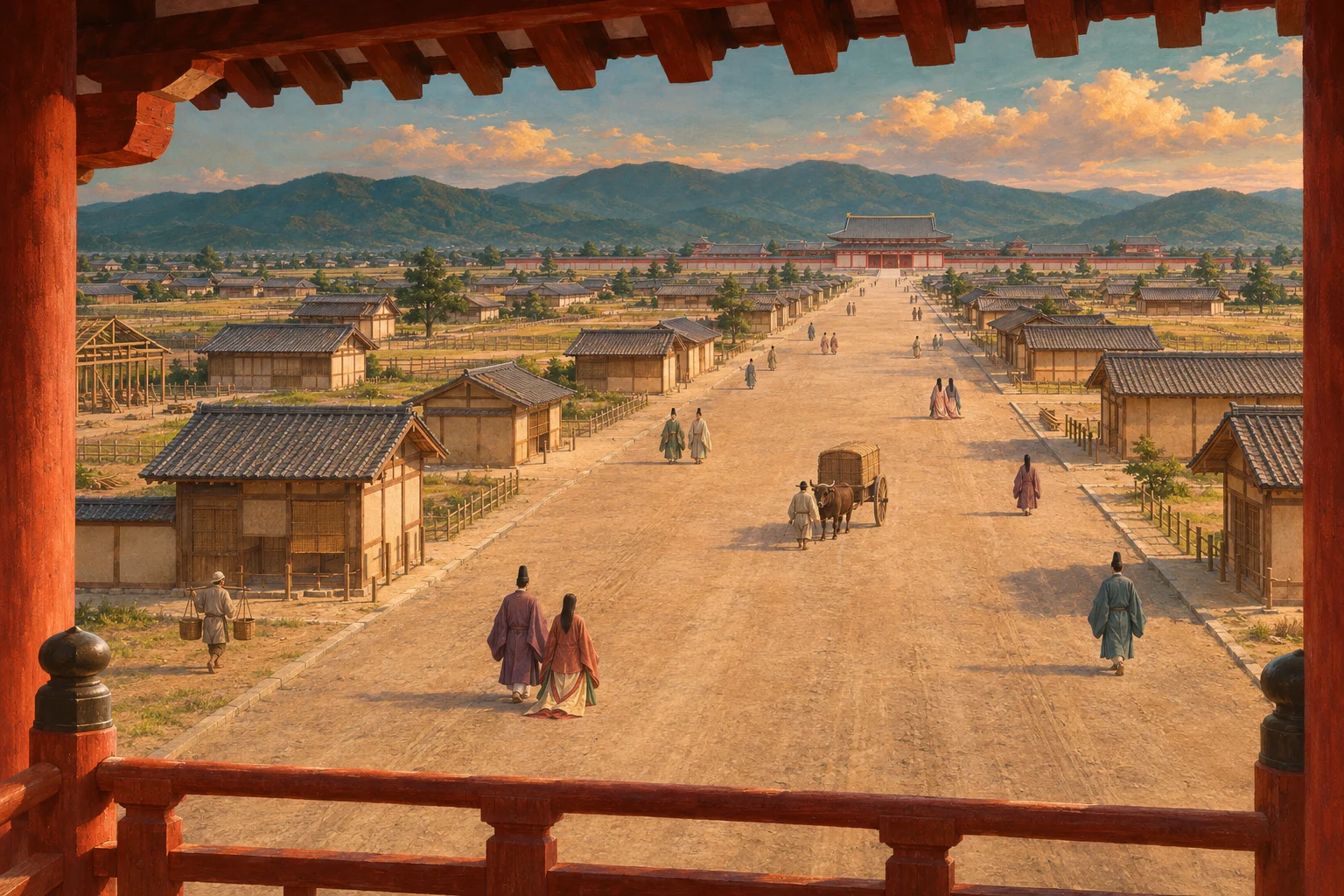
Establishing an imperial city
In 794, Japan’s imperial court established its new capital at Heian-kyō, the city later known as Kyoto. Emperor Kanmu’s transfer placed the court in a basin surrounded by mountains on three sides. The foundation belongs to a longer history of Japanese engagement with continental institutions and culture. Rather than simply allowing a settlement to spread around an existing palace, planners gave the capital an ordered framework. Kyoto City identifies this foundation as the beginning of its history as an imperial city, while UNESCO emphasizes the Chinese models that informed its creation.
Chang’an as an urban model
The principal model was Chang’an, the capital of the Tang dynasty. Heian-kyō adopted an orderly arrangement of streets running east to west and avenues running north to south. The result was a rectangular grid, a large-scale plan that connected movement through the city with the organization of the imperial center. Borrowing a model did not mean that the two cities were identical. Local terrain, subsequent building and changing patterns of occupation shaped the Japanese capital. The important relationship is a documented transfer of planning ideas, rather than a claim that Kyoto was a complete replica of Chang’an.
A framework that outlived the court
Kyoto remained the imperial capital for more than a millennium, until the nineteenth century. Its cultural importance included the development of wooden religious architecture and Japanese gardens. The UNESCO property associated with that history consists of seventeen component sites in Kyoto, Uji and Otsu. Most surviving buildings in that group belong to later centuries; they should not be mistaken for untouched remains of the original city.
Reading the foundation in the city
The early grid nevertheless remained a prototype for Kyoto’s townscape. Streets can preserve an inherited order even when the structures beside them have been replaced. This makes urban history a matter of relationships and patterns as well as individual monuments. The accompanying illustration reconstructs an early planned avenue and palace setting. Its buildings and people are interpretive, not a claim that a particular view from 794 survives in a contemporary picture.
Etenraku
Kunaichō Gakubu, Imperial Household Agency Court Ensemble
This later recording of Japanese gagaku evokes the imperial court culture associated with Kyoto. The uploader traces it to the Court Ensemble’s Toshiba TH-9020 LP, first released in 1964; it is not a recording from the city’s foundation.
Listen on SoundCloud ↗Follow the evidence.
- Kyoto City: Overview and history of Kyoto ↗
- UNESCO: Historic Monuments of Ancient Kyoto ↗
- Kyoto Travel: Discover Kyoto ↗
- SoundCloud: Etenraku recording ↗
- Recording provenance: Kunaichō Gakubu, Toshiba TH-9020 ↗
AI-assisted writing, with institutional and primary sources. Illustration is a reconstruction, not an archival photograph. Published November 7, 2026; updated November 7, 2026. Our approach