Tōdaiji’s Great Buddha consecration and silk cords in 752
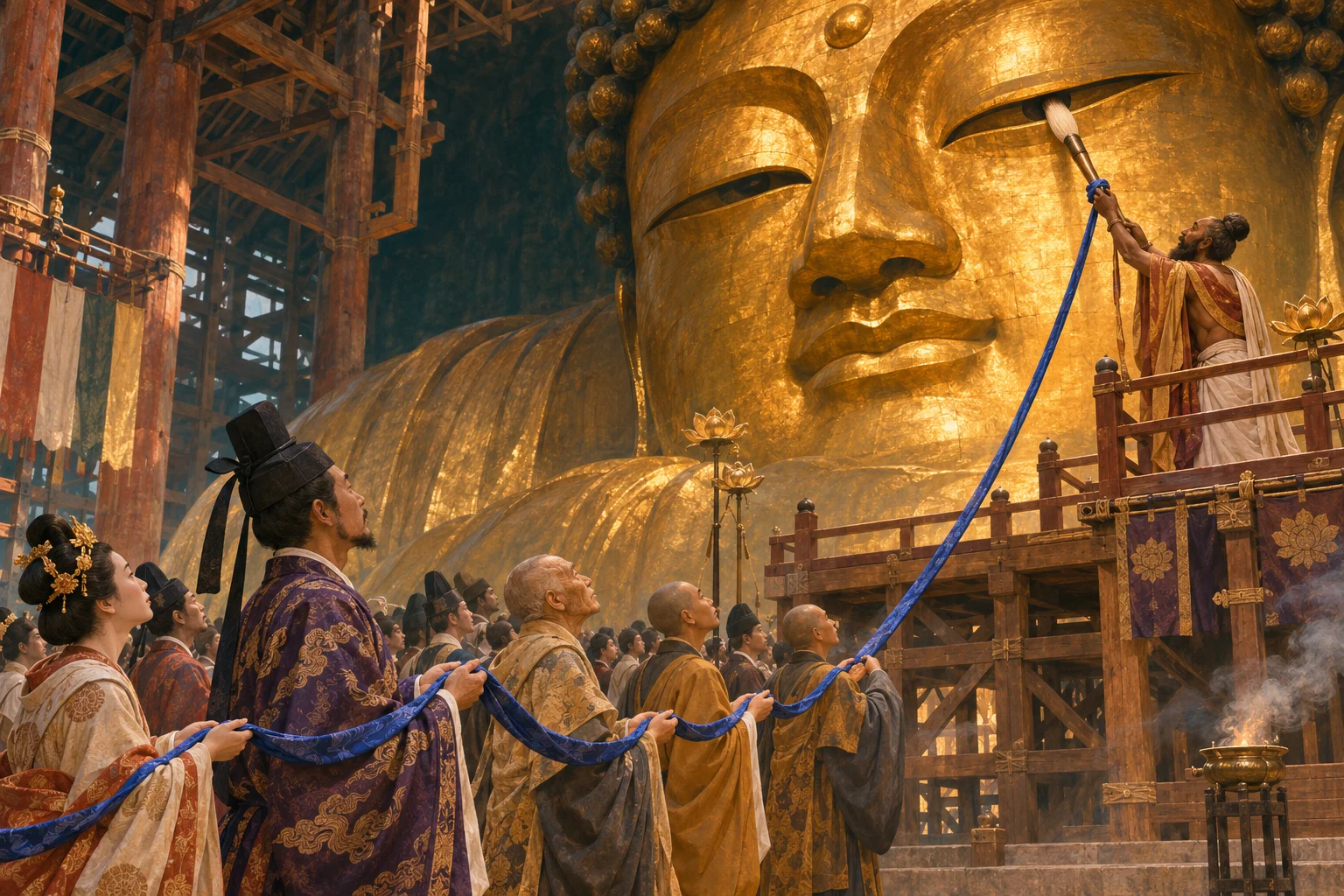
The Great Buddha at Tōdaiji was consecrated in 752. Long silk cords connected worshippers to the brush used to paint its pupils, allowing a great gathering to participate in a ritual performed physically by one officiating monk.
A national Buddhist center at Nara
Tōdaiji developed as a major religious center in the Japanese capital of Nara. Emperor Shōmu promoted Buddhism as a means of supporting peace and stability, alongside a wider network of provincial temples. The colossal image at its center represented Vairocana Buddha. The Nara City Tourism Association places the project within this religious and political setting. Its scale made construction a collective undertaking, while its dedication brought court, clergy and overseas cultural traditions together.
Opening the eyes of the image
The consecration ceremony took place in 752. Bodhisena, a monk from India, officiated in the ritual painting of the pupils, an act associated with opening the completed image’s eyes. The Nara National Museum identifies Shōmu and Empress Kōmyō as central participants and describes a gathering including thousands of priests. Music and dance formed part of the occasion. The year is used here without converting the source’s traditional Japanese calendar date into an assumed modern month and day.
A physical connection for many people
A brush could be held by one person, but cords extended participation far beyond that individual. The National Diet Library’s reference database explains that imperial figures, officials and monks held the indigo silk connection and thereby joined the eye-opening act. The material object made collective participation tangible. Japan Search also identifies a long blue silk cord among the surviving evidence. This was a religious connection through touch, rather than equipment for moving the enormous statue.
Objects surviving beyond the ceremony
Brushes, silk ropes, costume elements and other ceremonial objects were preserved in the Shōsō-in. Their survival allows the event to be studied through material evidence as well as written accounts. The Buddha and its hall underwent major damage and rebuilding in later centuries, so today’s monument should not be treated as an unchanged eighth-century scene. The accompanying illustration is an interpretation of the ritual relationship between brush, cord and participants, not a reconstruction of every original architectural detail.
Etenraku — gagaku court music
Kunaichō Gakubu, Imperial Household Agency court ensemble
A later performance from the ensemble’s 1964 Toshiba LP recalls the court-music tradition associated with Nara’s international ceremonial culture. This particular piece and recording are not claimed to have been performed at the 752 consecration.
Listen on SoundCloud ↗Follow the evidence.
- Nara National Museum: Great Buddha consecration ceremony ↗
- National Diet Library reference: who performed the eye-opening ↗
- Nara City Tourism Association: the Great Buddha ↗
- Japan Search: indigo silk cord used in 752 ↗
- MusicRepublic: Kunaichō Gakubu recording identification ↗
- Kunaichō Gakubu: Etenraku recording ↗
AI-assisted writing, with institutional and primary sources. Illustration is a reconstruction, not an archival photograph. Published November 4, 2026; updated November 4, 2026. Our approach