The Chinese seated Buddha dated 338 and its casting
A gilded bronze Buddha bearing an inscription equivalent to 338 CE is an important landmark in Chinese Buddhist sculpture. Its form combines connections to Central Asian imagery with established Chinese bronze-working methods.
An unusually firm chronological anchor
An inscription on the back of this small seated figure supplies a year equivalent to 338 CE and refers to the Later Zhao ruler Shi Hu. The sculpture is now in the Asian Art Museum in San Francisco. The University of Washington’s Silk Road exhibition identifies it as the earliest known dated Buddha made in China. That distinction concerns surviving dated objects, rather than claiming it was the first Buddha image ever produced there.
A religion crossing cultural boundaries
Buddhism had reached China before this sculpture was made. The Later Zhao kingdom was one of several northern states ruled by peoples with connections to the Central Asian world. Such contacts helped religious ideas and images move between regions. Small devotional figures could travel with people as well as serve local worshippers. The sculpture therefore records more than a change in religious belief: it provides material evidence of how a traveling image acquired a new setting and audience.
Making a bronze image
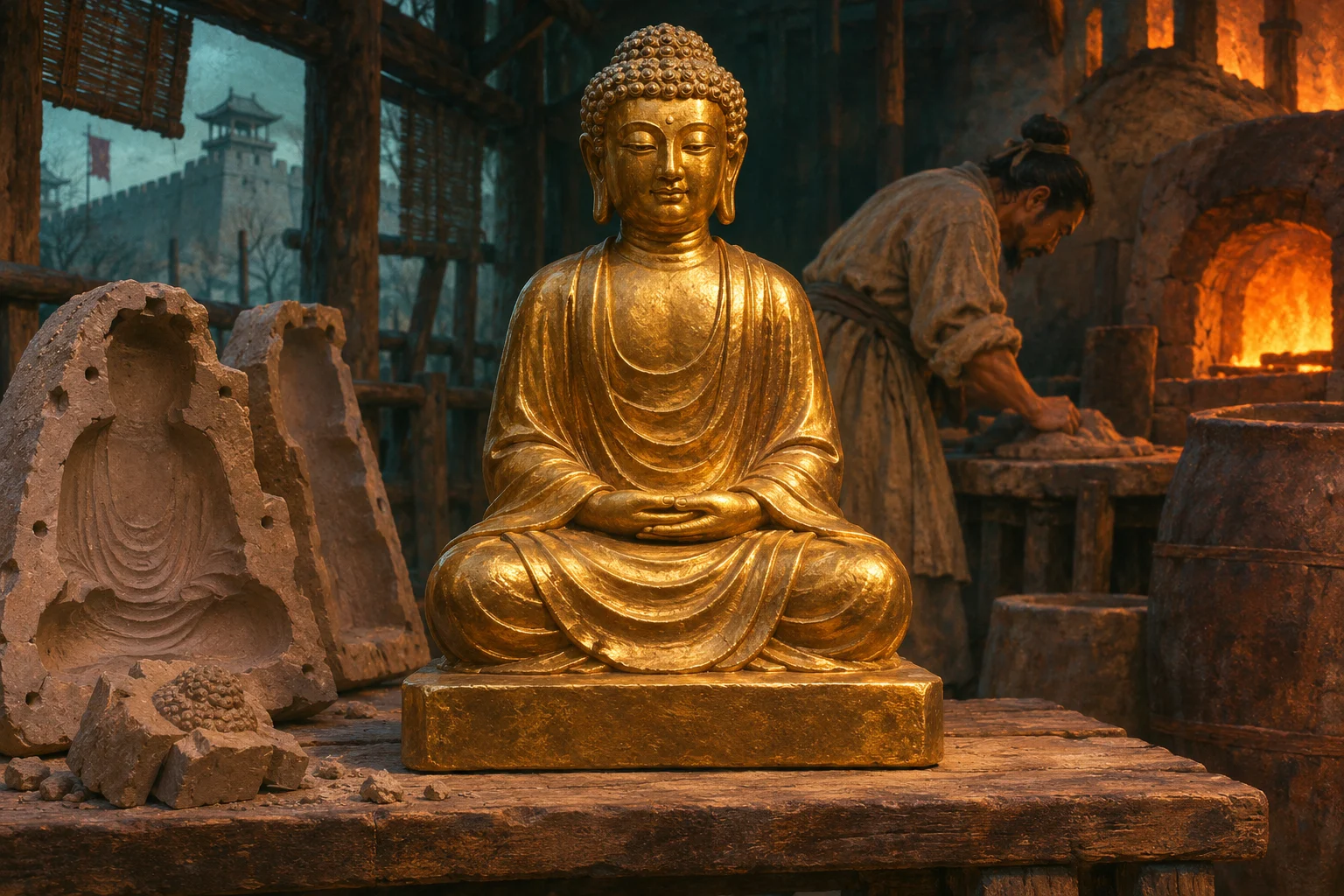
According to the Asian Art Museum, the figure was cast in leaded bronze using the piece-mold technique. In this approach, fitted mold sections define the form into which molten metal is poured. Gilding subsequently gave the surface its brilliant appearance. The crossed legs and draped robe have parallels in Gandharan sculpture, while other features reflect Chinese conventions. Its importance lies in this combination of established craft knowledge and imagery arriving through wider networks.
Survival and reconstruction
The bronze is roughly forty centimeters high, substantial among surviving metal figures of its period. Holes and projections show that its present appearance is incomplete: additional ornaments or figures were once attached. Proposed reconstructions vary, so the missing elements should not be treated as certain. The museum’s educational presentation explores that original appearance. The workshop illustration accompanying this article is interpretive; it does not document the original artisan, workshop or patron.
Heart Sutra (Sanskrit)
Imee Ooi
A modern Buddhist devotional setting by the Chinese-Malaysian musician Imee Ooi. It connects with the sculpture’s religious tradition, not its particular ceremony or fourth-century soundscape; this later text and recording are not presented as music from 338.
Listen on SoundCloud ↗Follow the evidence.
- Asian Art Museum: Buddha dated 338 ↗
- University of Washington: Later Zhao seated Buddha ↗
- Asian Art Museum: interpreting the Buddha’s original appearance ↗
- IMM Musicworks: Imee Ooi ↗
- Imee Ooi: Sanskrit Heart Sutra recording ↗
AI-assisted writing, with institutional and primary sources. Illustration is a reconstruction, not an archival photograph. Published November 4, 2026; updated November 4, 2026. Our approach