Dedication and narrative design of Trajan’s Column
Inaugurated in Rome on 12 May 113 CE, Trajan’s Column combined monumental engineering with a continuous sculpted account of the emperor’s Dacian wars. Its design offered several different ways to experience imperial power.
A monument in the imperial capital
Trajan’s Column was inaugurated on 12 May 113 CE within the emperor’s forum in Rome. The Uffizi’s account of its construction places the dedication in the context of an extraordinary engineering project. Heavy marble blocks travelled from the quarries at Luni by sea and up the Tiber before being raised into position. The completed structure commemorated the emperor’s victories while also displaying the capacity to organise materials, transport and skilled labour.
The story on the exterior
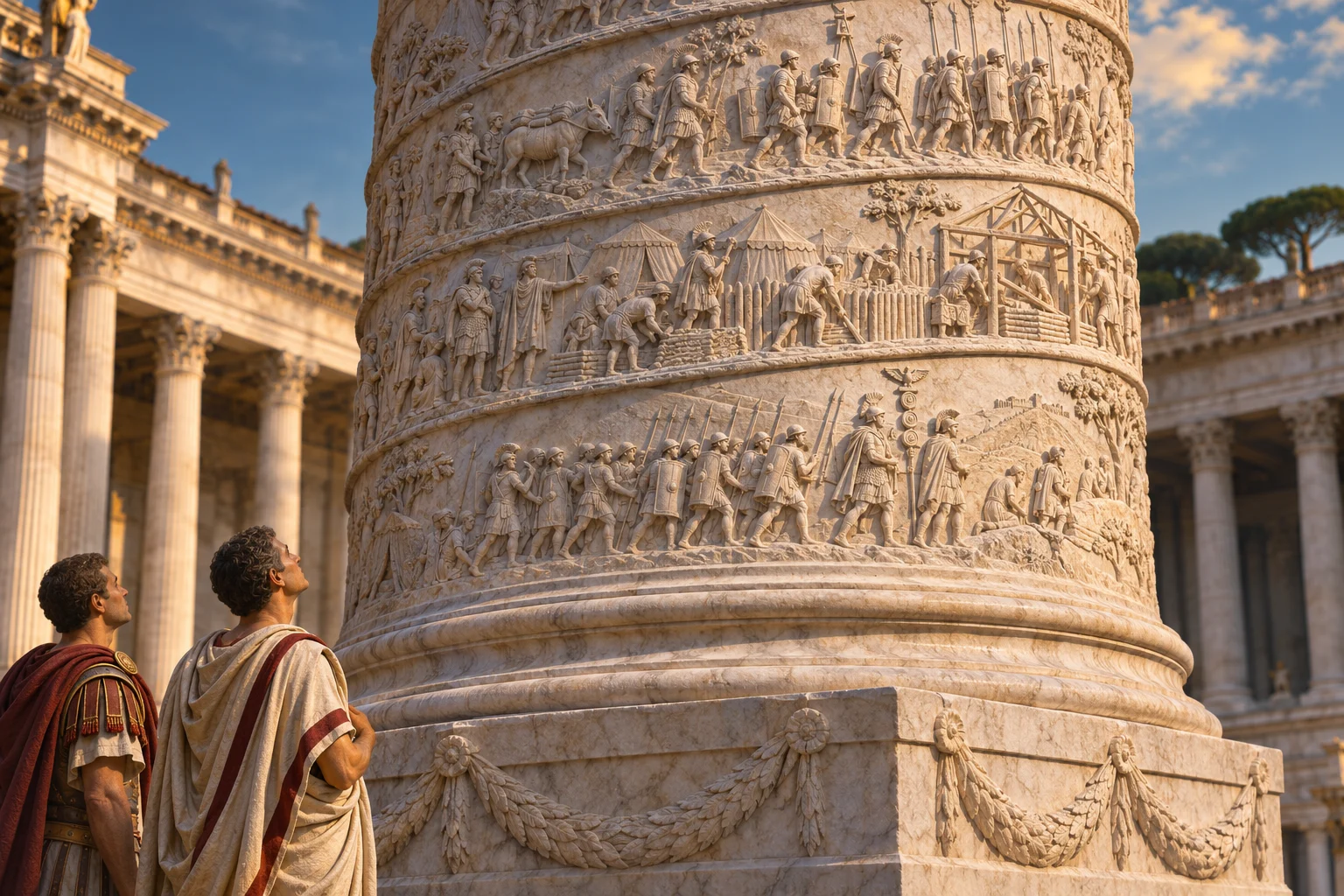
A sculpted band winds continuously around the shaft, commemorating the first and second Dacian wars. The same monument therefore combines an architectural silhouette with an extended sequence of images. The reliefs are a Roman presentation of conquest, selected and arranged to honour the victorious emperor. They should be approached as a commemorative narrative rather than as an impartial visual transcript. The continuous band turns the cylindrical surface into a distinctive vehicle for telling history.
Experiencing the whole structure
McMaster University’s study emphasises how difficult it would have been to examine the entire frieze from the small surrounding court. Only the lower spirals could readily be studied in detail from ground level. Suggested viewing positions on neighbouring buildings cannot fully solve that problem. Inside, a spiral staircase led to a viewing platform. The column offered an experience of height and the surrounding city alongside the detailed story carved on its exterior. Its exterior makes twenty-two turns, while the internal stair contains 185 steps.
Survival and interpretation
The monument later housed Trajan’s ashes in its base. Its original crowning statue disappeared, and a statue of Saint Peter was installed much later. Renaissance drawings recorded the ancient structure while surrounding buildings and accumulated ground levels changed its setting. Sir John Soane’s Museum preserves one such study, helping distinguish the Roman monument from later alterations. The accompanying illustration presents an imagined ancient viewing scene; its figures, lighting and reconstructed surroundings are interpretive rather than surviving evidence.
Sacred Flame Of Vesta
Michael Levy
Levy’s modern composition for a replica lyre evokes Roman religious culture. It is an imaginative companion to the Roman setting, not surviving music from the column’s dedication.
Listen on SoundCloud ↗Follow the evidence.
- Uffizi Galleries: Building a Masterpiece ↗
- McMaster University: Trajan’s Column introductory essays ↗
- Sir John Soane’s Museum: Trajan’s Column ↗
- SoundCloud: Michael Levy’s Roman-inspired composition ↗
AI-assisted writing, with institutional and primary sources. Illustration is a reconstruction, not an archival photograph. Published November 5, 2026; updated November 5, 2026. Our approach