Cai Lun’s recorded report on papermaking in 105 CE
Chinese records associate Cai Lun with a papermaking report to the imperial court in 105 CE. His importance lies in improving and promoting an affordable writing material, although paper itself is archaeologically older.
What the year records
The year 105 CE is traditionally associated with Cai Lun’s report on papermaking to the Chinese imperial court. The Robert C. Williams Museum of Papermaking explicitly distinguishes this written record from the archaeological origins of the material. Historian T. H. Barrett likewise describes a presentation of an improved form of writing paper. The event can therefore be dated by year without pretending that the evidence supplies an exact day, a surviving demonstration transcript or the moment when the first sheet of paper was made. T. H. Barrett
Turning fibres into a sheet
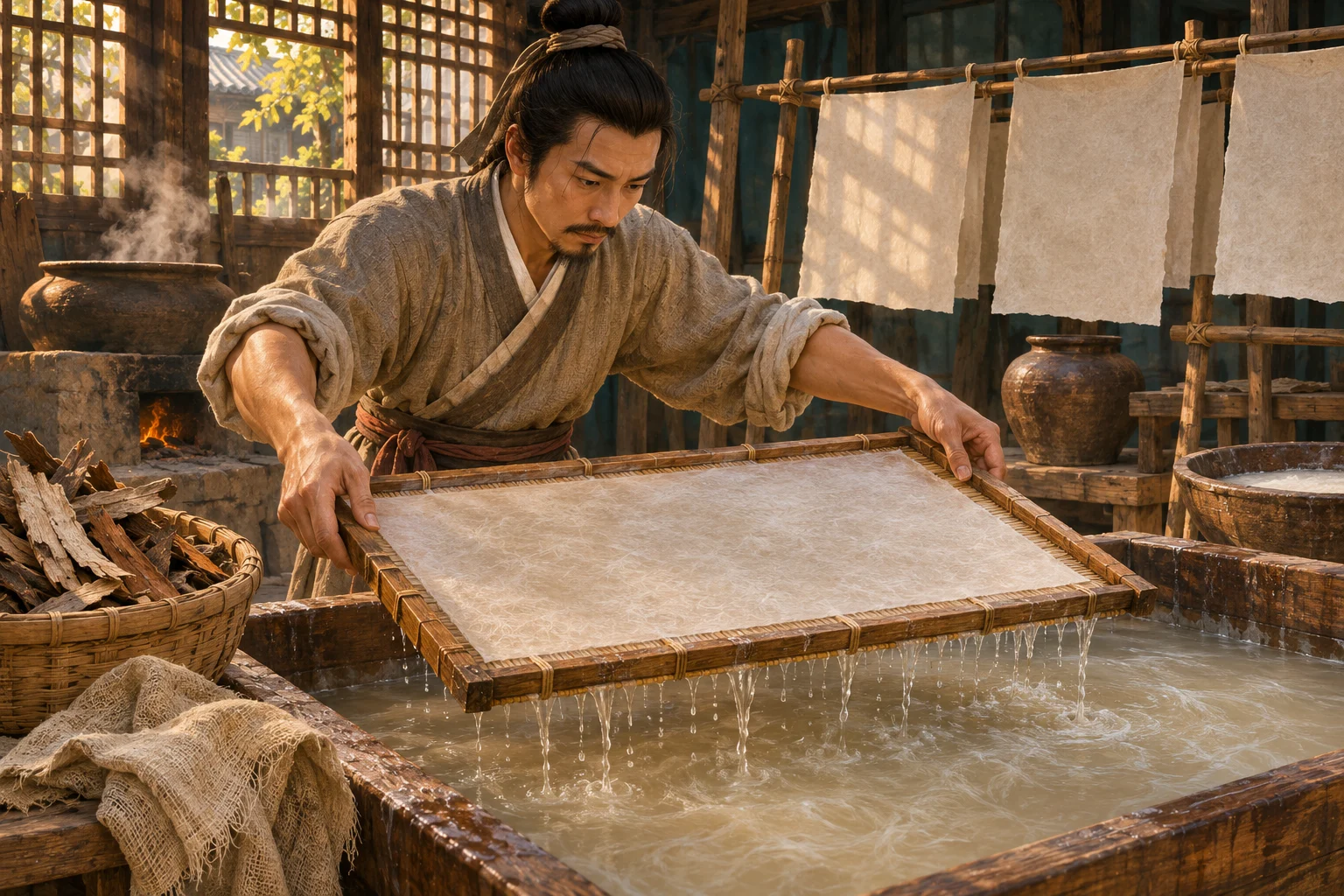
Early Chinese papermaking involved separating plant fibres in water and beating them into pulp. A mould lifted a thin layer of the suspended fibres, which dried into a connected sheet. Hemp waste and, in the developing tradition, bark and other plant materials supplied the raw material. Accounts of Cai Lun’s improvement also associate it with textile scraps and old nets. The essential distinction is that fibres were broken up and recombined, unlike a sheet made by simply placing intact strips of a plant next to one another. Robert C. Williams Museum
Why the material mattered
Silk offered a flexible surface for writing but was expensive. Wooden or bamboo strips could be cheaper, yet assembling many of them produced a bulky object. Paper offered another combination of cost, weight and usable surface. Barrett’s discussion notes the significance of its price compared with silk for people writing at their own expense. Its historical importance therefore extends beyond official administration. A more accessible material helped support literary and artistic work, including forms of poetry, painting and calligraphy that later generations came to associate closely with paper. T. H. Barrett
Improvement rather than a solitary invention
Archaeological paper fragments predate Cai Lun’s report by a substantial interval. This does not make the report irrelevant: a named official’s presentation can be significant in the adoption or refinement of an existing process. It does mean that the familiar story of one person inventing paper from nothing is too simple. The workshop illustration offers a general view of handmade sheet formation, rather than a documented portrait of Cai Lun or a claim that every depicted tool can be assigned specifically to his workshop. The supported historical precision remains the year of the recorded report. Robert C. Williams Museum
High Mountain, Flowing Water 高山流水
Man Wah Leung (guzhengman)
Leung’s own later guzheng performance supplies Chinese musical context. This version and recording are not presented as music from the Eastern Han court or from 105 CE.
Listen on SoundCloud ↗Follow the evidence.
- Robert C. Williams Museum: early papermaking and the report of 105 CE ↗
- T. H. Barrett: the recorded presentation of improved paper ↗
- University of Sydney: paper’s historical and artistic uses ↗
AI-assisted writing, with institutional and primary sources. Illustration is a reconstruction, not an archival photograph. Published November 2, 2026; updated November 2, 2026. Our approach