The Colosseum’s opening in 80 CE on the site of Nero’s lake
Completed under Titus in 80 CE, the Flavian Amphitheatre occupied the former artificial lake of Nero’s Domus Aurea. Its location connected monumental engineering with the political transformation of a private imperial landscape into a place of public spectacle.
The landscape before the amphitheatre
After the great fire of 64 CE, Nero developed an extensive palace estate known as the Domus Aurea, or Golden House. It was not simply one building. Pavilions, gardens, woods and an artificial lake formed a broad imperial landscape in central Rome. The lake occupied the valley where the Colosseum would later stand. Rome’s official tourism account describes palace rooms opening toward views of the water and gardens. Understanding that earlier setting changes the meaning of the later monument: the amphitheatre replaced a conspicuous feature of the emperor’s private enjoyment.
A Flavian building in a central valley
Vespasian commissioned the amphitheatre, and construction was completed under his son Titus in 80 CE. Its formal association with the Flavian dynasty distinguishes it from the later familiar name Colosseum. Replacing the lake required the site to be reclaimed for a massive building. The choice also carried a political message. An area identified with Nero’s palace became a destination for crowds attending spectacles. That public use did not make the new dynasty democratic, but it presented the ruler as a provider of shared urban amenities rather than only private magnificence.
Managing a large audience
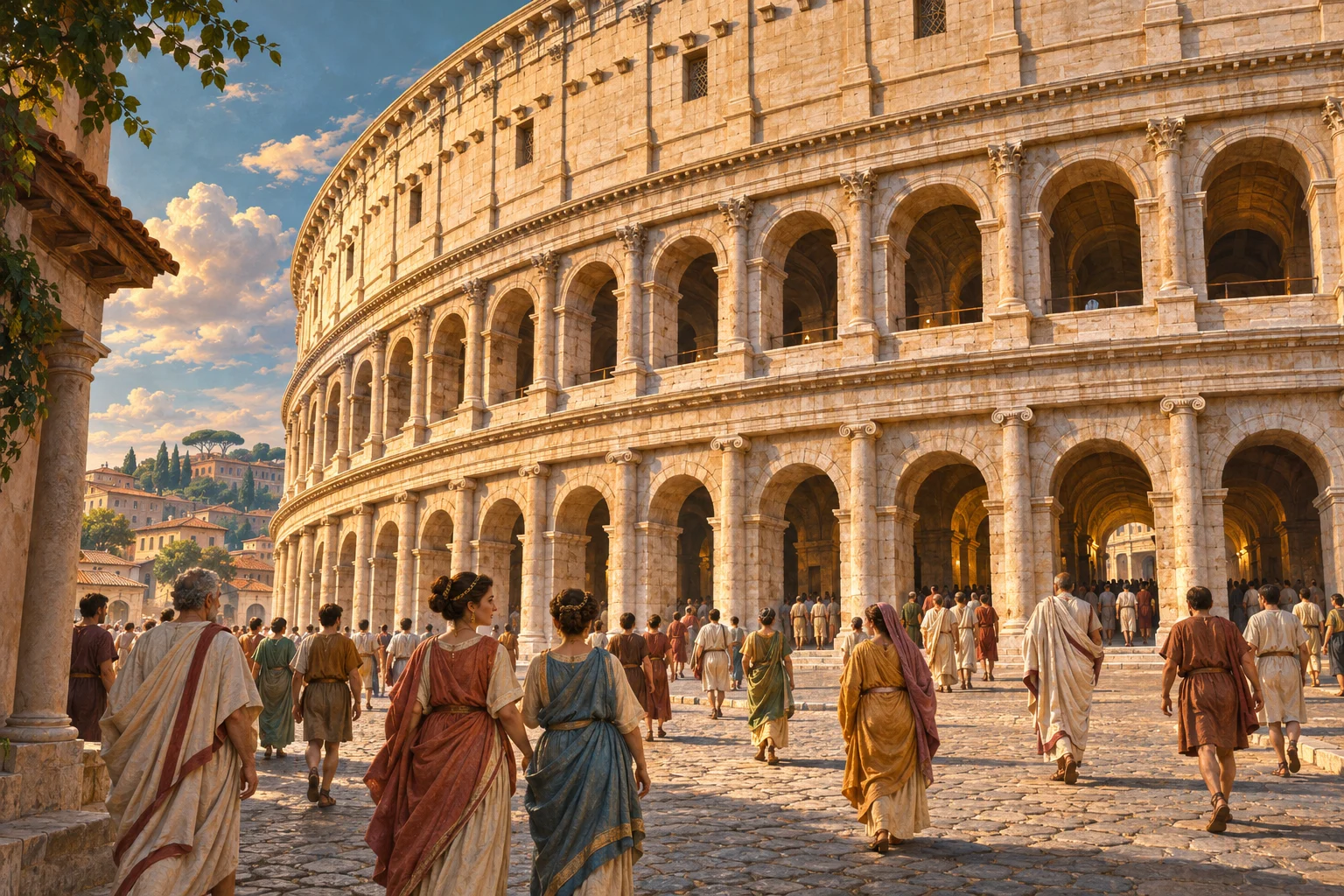
The building’s repeated arcades and successive levels gave the enormous structure an organized exterior. Inside, the arena and surrounding seating accommodated tens of thousands of spectators. Performances included gladiatorial combat and animal hunts, activities inseparable from coercion and violence in Roman society. The engineering should therefore be understood alongside the human and animal costs of the entertainment. Its capacity and urban presence made the amphitheatre an instrument of imperial visibility as well as a construction achievement.
Reading different periods carefully
The Colosseum changed after its inauguration. Later alterations, underground installations, damage and reuse mean that its surviving fabric is not a single unchanged snapshot of 80 CE. Likewise, the nearby surviving portions of the Domus Aurea belong to a larger estate whose lake has disappeared. The illustration presents an interpretive view of the newly built exterior and approaching pedestrians. It does not claim to reproduce a witnessed scene or the precise appearance of every surrounding structure.
Skolion of Seikilos
Michael Levy
Levy’s modern lyre arrangement of an ancient Greek song evokes the wider musical world of the Roman imperial Mediterranean. It is a historically related listening atmosphere, not a reconstruction of music played at the Colosseum’s inauguration.
Listen on SoundCloud ↗Follow the evidence.
- Turismo Roma: The Flavian Amphitheatre ↗
- Turismo Roma: The Domus Aurea ↗
- Michael Levy: Skolion of Seikilos, performance notes ↗
AI-assisted writing, with institutional and primary sources. Illustration is a reconstruction, not an archival photograph. Published November 7, 2026; updated November 7, 2026. Our approach