G.A. Smith’s Santa Claus and its family cast in 1898
G.A. Smith’s Santa Claus, made in 1898, featured the filmmaker, his wife and their children. Its brief Christmas story also demonstrated how an image within an image could connect simultaneous action in separate places.
A small domestic production
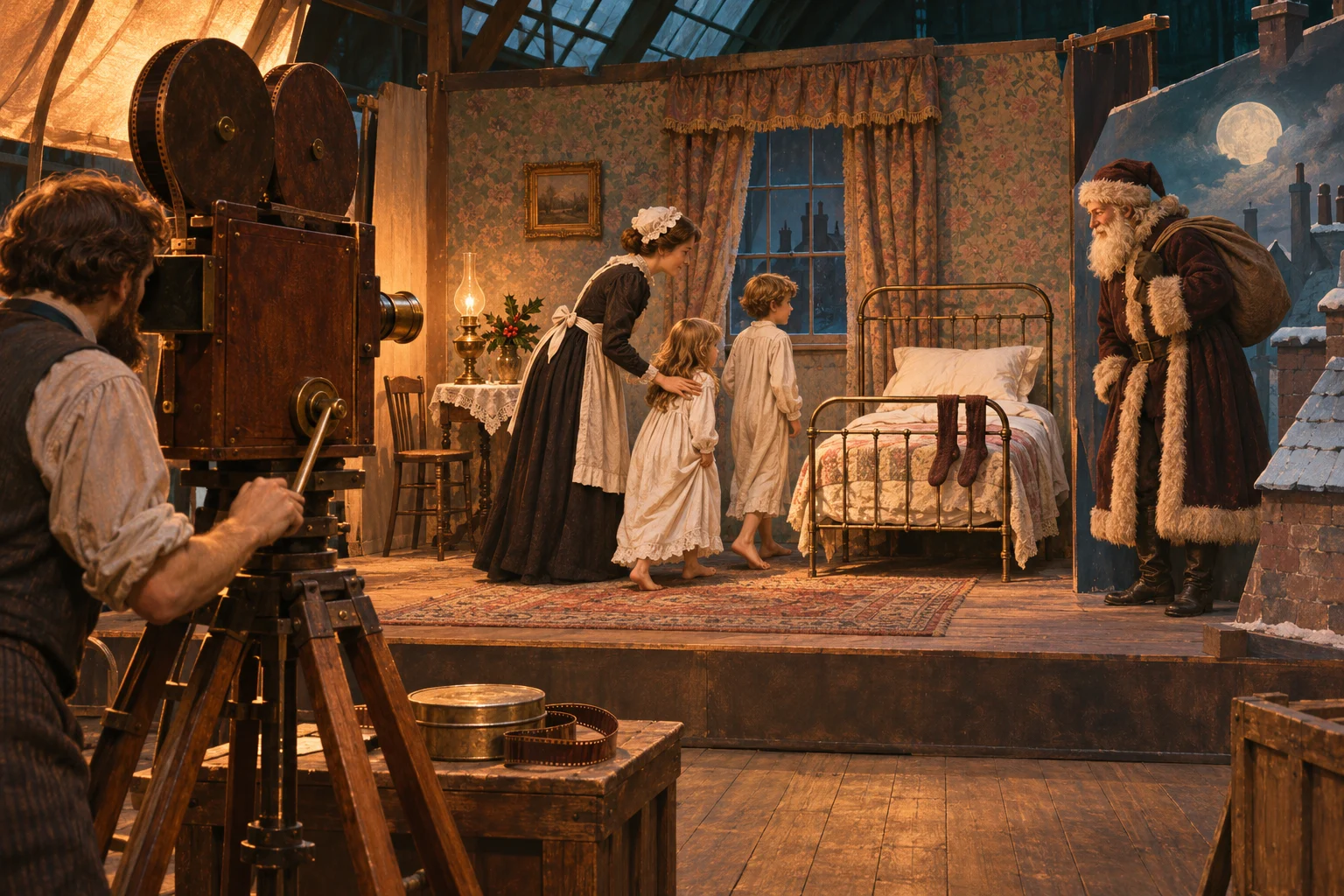
Santa Claus was made in 1898 by the British film pioneer George Albert Smith. Its cast was unusually close to home. According to the British Film Institute, Smith took the role of Father Christmas, his wife Laura Bayley appeared as the maid, and their children Harold and Dorothy played the excited youngsters. The combination gives the surviving film a particular intimacy: a family performs a familiar seasonal story while the filmmaker experiments with what the camera and film stock can make an audience see. British Film Institute
The visit on screen
The children begin in a bedroom before the maid settles them into bed. When the room darkens, the surrounding set is concealed and an additional image appears, showing Santa on the roof. He descends through the chimney and subsequently appears in the bedroom to leave presents. His sudden disappearance supplies another moment of visual magic. The children awaken to discover the gifts. Screen Archive South East’s detailed description makes it possible to follow these actions without treating the film as merely an undifferentiated example of early cinema. Screen Archive South East
A trick that tells a story
The superimposed rooftop scene lets viewers understand that something elsewhere is happening while the children sleep. It is an early use of parallel action within a single frame. That is more than a decorative special effect: it directs attention between linked places and gives the audience knowledge unavailable to the sleeping characters. The BFI places the film within the tradition of trick filmmaking, while emphasizing its contribution to storytelling. Its ingenuity lies partly in making a familiar fantasy legible with very little screen time or physical space. British Film Institute
Dates, survival and reconstruction
The institutional sources establish 1898 as the production year. No exact day is needed to tell the story, and a catalogue’s default day should not be mistaken for a verified filming date. The preserved moving image is the principal visual evidence for the action and effects. The accompanying workshop illustration imagines the act of making such a film; it is not a recovered studio photograph. Modern seasonal music similarly creates an association for today’s viewer, rather than documenting what a particular audience heard during a screening in the production year. Screen Archive South East
Jingle Bells (Jazz Version)
Simon Reich
Reich’s later piano-led jazz arrangement supplies a Christmas association. It is not claimed as an original accompaniment to Smith’s silent film, and its jazz style postdates the production.
Listen on SoundCloud ↗Follow the evidence.
- British Film Institute: Santa Claus and its family cast ↗
- Screen Archive South East: Santa Claus, 1898 ↗
- BFI Replay: preserved Santa Claus film ↗
AI-assisted writing, with institutional and primary sources. Illustration is a reconstruction, not an archival photograph. Published November 2, 2026; updated November 2, 2026. Our approach