Scott Joplin’s Maple Leaf Rag publishing contract of 1899
On 10 August 1899 Scott Joplin signed a contract with John Stark to publish Maple Leaf Rag. A royalty of one cent per copy connected the composer’s income to the continuing sale of his music.
The agreement in Sedalia
Scott Joplin and music publisher John Stark entered their agreement for Maple Leaf Rag on 10 August 1899. The City of Sedalia’s historic preservation plan identifies both the date and the building associated with the transaction. The event belongs to a period when printed sheet music was a crucial means of distributing compositions. A purchaser could take the pages home and perform the piece, making the written score a commercial product in its own right rather than simply a supplement to a sound recording. City of Sedalia Historic Preservation Plan
A payment attached to each copy
Accounts of the contract specify a royalty of one cent for each copy sold. The amount sounds small in isolation, but its structure is the important feature: additional purchases could continue to generate income for the composer. It tied Joplin’s financial interest to the life of the edition. That differs from receiving only a single payment when handing over a manuscript. It also differs from being paid each time somebody performed the piece; the documented royalty concerned sales of the printed music. EBSCO Research Starters
A partnership in the ragtime business
Joplin’s work gave Stark material with substantial commercial appeal, while publishing gave the composer access to readers and players beyond the places where he could personally perform. Their relationship became important to the growth of classic ragtime. The Library of Congress preserves copies of Maple Leaf Rag submitted in 1899, connecting the familiar composition to tangible evidence of its printed circulation. The score’s survival also lets later performers learn the work from notation, independently of claims about how an original audience might have heard it. Library of Congress Magazine
Success without an instant-riches legend
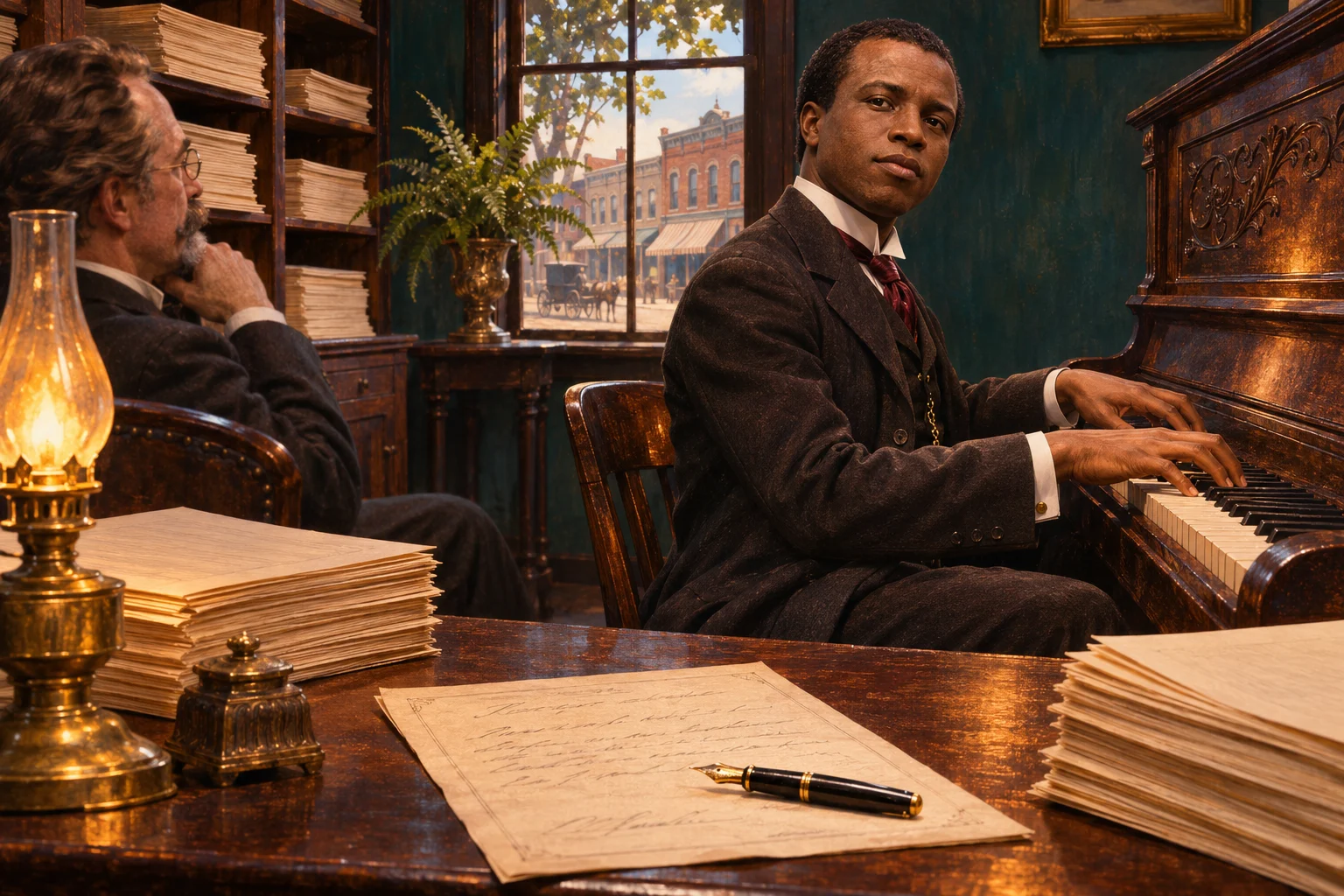
Retellings differ over how quickly sales grew and sometimes compress the commercial story into an immediate triumph. A careful account can recognize the work’s eventual success without inventing precise early sales or treating a royalty clause as guaranteed wealth. The durable insight is the relationship between creative labour, publication and repeated payment. The illustration imagines a music-shop setting around the agreement; it is not a photograph of the signing. The soundtrack is a later pianist’s performance, making the published work audible while leaving the historical contract, rather than the tune’s identity, as the subject of the event. University of Florida LibraryPress
Scott Joplin’s Maple Leaf Rag — piano performance
Luke Freeman (Freemondo)
Freeman’s own later digital-piano performance presents the composition covered by the publishing agreement. It is not a recording of Joplin, the contract signing or an 1899 performance.
Listen on SoundCloud ↗Follow the evidence.
- City of Sedalia Historic Preservation Plan: contract signed on 10 August 1899 ↗
- University of Florida LibraryPress: Scott Joplin, chapter on Sedalia ↗
- EBSCO Research Starters: Scott Joplin and the royalty agreement ↗
- Library of Congress Magazine: the 1899 deposited Maple Leaf Rag copies ↗
AI-assisted writing, with institutional and primary sources. Illustration is a reconstruction, not an archival photograph. Published November 2, 2026; updated November 2, 2026. Our approach