The announcement of radium on 26 December 1898
Pierre Curie, Marie Curie and Gustave Bémont announced evidence for radium in a paper dated 26 December 1898. Radioactivity measurements and a previously unknown spectral line revealed an element present in minute quantities among chemically similar material.
Following an unexpectedly strong signal
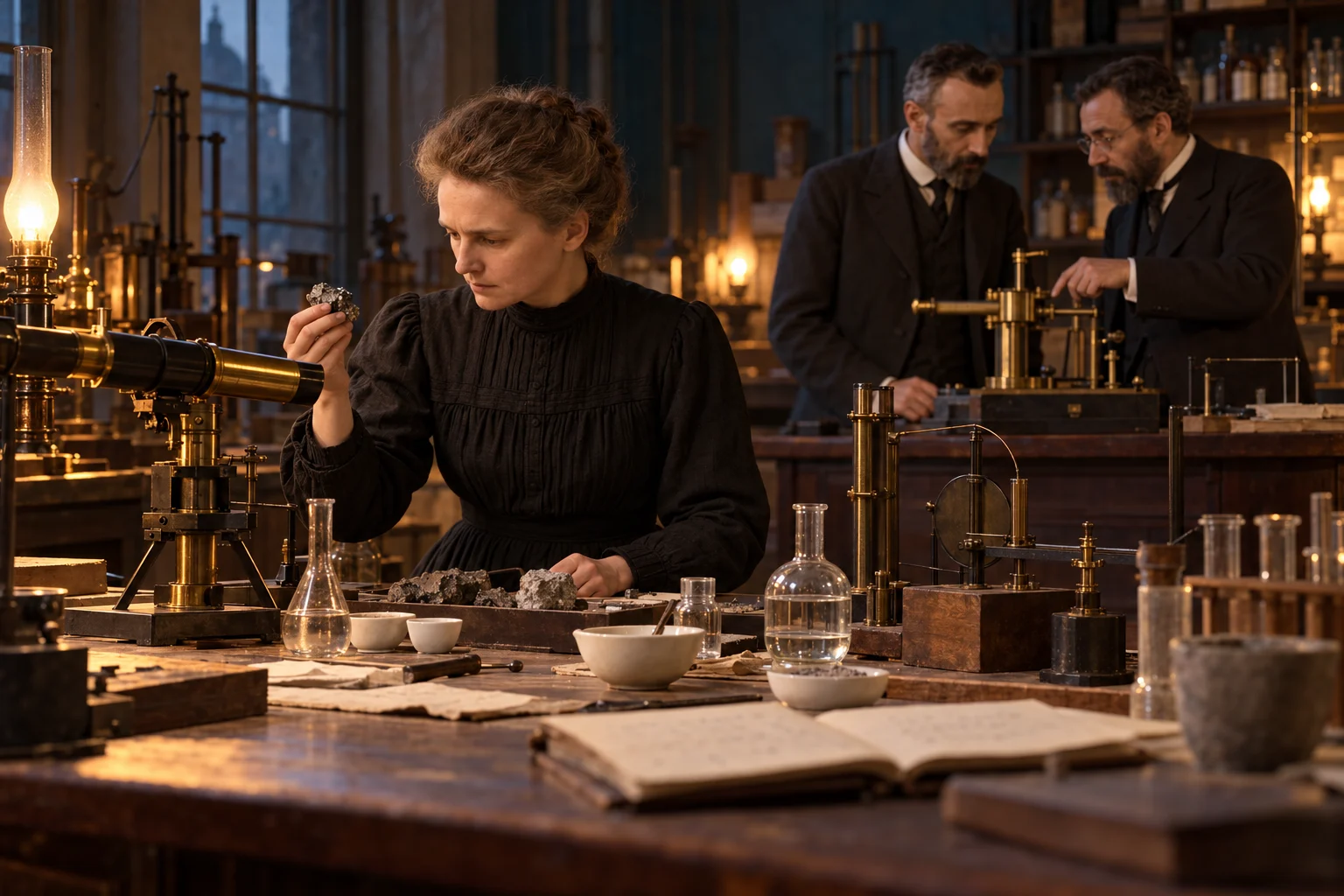
Marie Curie's study of uranium minerals found that some ores were more radioactive than their uranium content could explain. That discrepancy suggested another, strongly active substance. Working with Pierre Curie, she separated the ore chemically and measured the activity of the resulting fractions. The American Institute of Physics history describes how radiation became a way of tracing material present in quantities too small for straightforward identification by ordinary chemical examination.
The paper of 26 December
A paper dated 26 December 1898, signed by Pierre Curie, Marie Curie and Gustave Bémont, proposed a new element called radium. The material they examined largely behaved like barium, but ordinary barium was not radioactive. The paper's translated text preserves their reasoning. They were making an evidence-based claim about an unknown constituent within a mixture, rather than presenting a large, purified specimen of the new metal. That distinction is central to understanding the announcement.
A spectral signature grows stronger
The researchers asked the specialist Eugène Demarçay to examine the material's light spectrum. He found a line that did not appear to belong to a known element. As chemical fractionation produced material with stronger radioactivity, this line also became more prominent. The two observations reinforced one another: the distinctive light signal appeared to follow the unknown radioactive component. Spectroscopy supplied an identifying clue, while measurements of activity guided the difficult work of concentrating that component from the surrounding compounds.
Announcement followed by prolonged work
The discovery paper acknowledged that barium still made up most of the sample. Further separation and measurement were needed to characterize radium more fully. The Musée Curie chronology distinguishes the 1898 announcement from later determinations, including the atomic-weight work reported in 1902. The episode shows how a discovery can begin with converging indirect evidence and develop through years of purification. The accompanying workshop illustration is an interpretation, not a record of the paper's presentation or of a specific experiment on 26 December.
Fauré: Pavane in F-sharp minor, Op. 50 — piano arrangement
Vadim Chaimovich
Chaimovich's later piano recording of Fauré's Pavane evokes French musical culture around the period of the 1898 announcement. It is a cultural association, not music documented as accompanying the research.
Listen on SoundCloud ↗Follow the evidence.
- AIP: The original radium discovery paper, translated ↗
- AIP: Marie Curie's research breakthroughs ↗
- Musée Curie: Historical exhibition chronology ↗
- SoundCloud: recording and performer credits ↗
AI-assisted writing, with institutional and primary sources. Illustration is a reconstruction, not an archival photograph. Published October 31, 2026; updated October 31, 2026. Our approach