The hose-prank comedy in the Lumières’ first paying Paris programme
On 28 December 1895, the Lumières’ paying Paris programme included a staged joke about a gardener and a hose. Alongside views of everyday life, this short comedy showed how moving pictures could organize a setup, surprise and response.
A programme in a café basement
On 28 December 1895, the Lumière Cinématographe was presented to a paying public in the Salon Indien of the Grand Café in Paris. The programme included short views of everyday activity as well as a staged comic scene. The Institut Lumière’s educational dossier explicitly lists Arroseur et arrosé among the films shown. The date marks this commercial Paris presentation, not the day the comedy was filmed or its first screening in any setting.
A joke that needs no dialogue
A gardener waters a garden. A boy places his foot on the hose, stopping the flow. When the gardener examines the nozzle, the boy removes his foot and water shoots into the man’s face. The gardener then pursues the prankster. The audience can see the cause before the victim understands it. That difference in knowledge gives the brief sequence its anticipation and comic release, without requiring a spoken explanation or written title.
Several versions, one recognizable idea
The surviving Lumière catalogue distinguishes multiple versions of the scene. Its entry for the first identifies François Clerc as the gardener and Benoît Duval as the boy, and places that version in 1895. Later versions altered details, so modern reproductions should not automatically be treated as the exact print shown in December. The securely documented connection is the programme’s inclusion of the hose-prank comedy; the original filming date is not known to a single day.
A beginning within a wider history
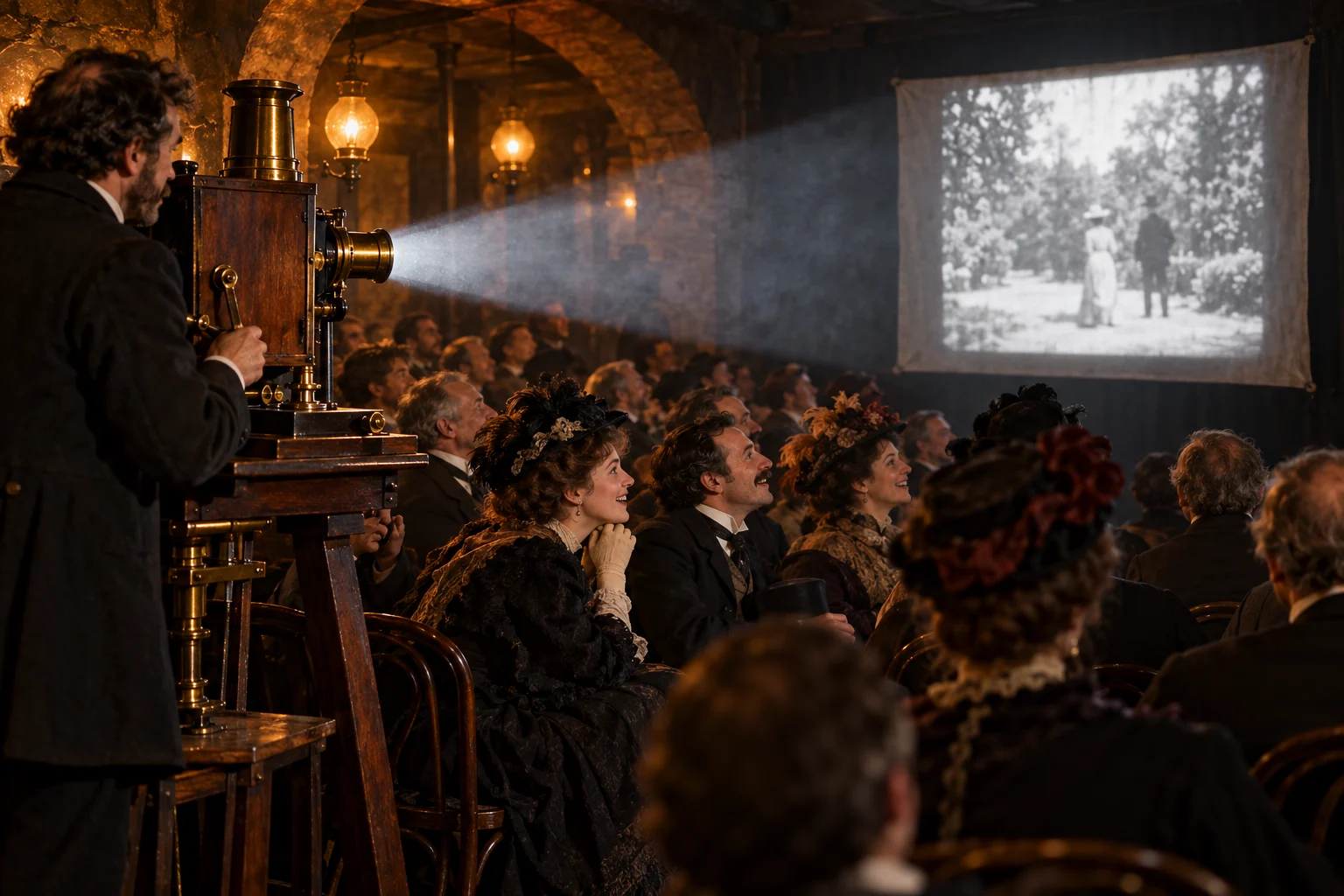
The Paris screenings became a landmark in the growth of commercial cinema, but moving-image experiments and public demonstrations had other pioneers. Calling this moment the sole invention of film would flatten that wider history. What the comedy demonstrates especially well is deliberate staging for a camera: a complete little action is arranged to be understood visually. The accompanying illustration reconstructs an early screening and leaves the screen indistinct; it does not reproduce a documented view of the audience or projection room.
Gymnopédie No. 1 — Erik Satie
Serge Smulders
A later piano performance of Satie’s 1888 work evokes the Parisian musical world around the emergence of cinema. It is atmospheric accompaniment, not a documented score for the 1895 screening.
Listen on SoundCloud ↗Follow the evidence.
- Institut Lumière: Lumière, l’aventure continue educational dossier ↗
- Catalogue Lumière: Arroseur et arrosé, first version ↗
- Institut Lumière: The Lumière films ↗
- Serge Smulders: Gymnopédie No. 1 ↗
AI-assisted writing, with institutional and primary sources. Illustration is a reconstruction, not an archival photograph. Published October 31, 2026; updated October 31, 2026. Our approach