Josephine Cochrane’s 1886 dishwasher patent
On 28 December 1886, Josephine G. Cochran received a patent for an improved dishwashing machine. Its combination of water pressure and secure dish racks helped turn an irritating domestic problem into a practical commercial invention.
A problem with precious dishes
Josephine Cochrane, whose patent used the spelling Cochran, lived in Shelbyville, Illinois. The United States Patent and Trademark Office recounts that chipped heirloom china helped motivate her search for a better way to wash dishes. Washing them herself was tedious, while rough handling damaged valued objects. After her husband’s death, developing a marketable machine also became a financial necessity. The project joined a domestic irritation to a serious effort to earn an independent income.
What the patent protected
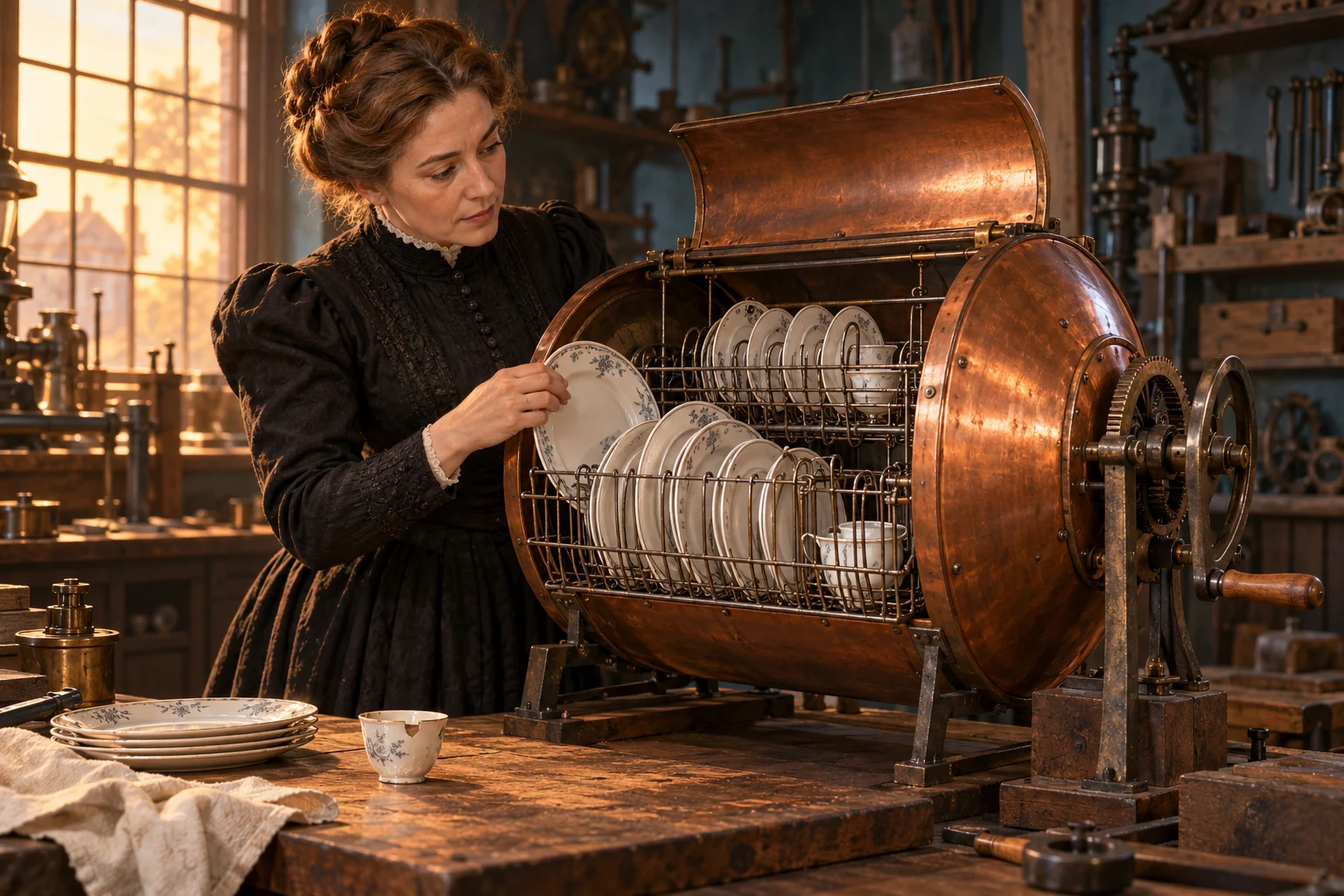
U.S. patent 355,139 was granted on 28 December 1886. It described a machine in which pumps supplied washing or rinsing water while a crate holding fitted racks rotated. Those racks supported plates, cups and cutlery, keeping the objects positioned for cleaning. The machine used the force of water rather than relying on mechanical scrubbing. Reading the patent reveals a coordinated system of holders, pumps and movement, rather than simply a container into which hot water was poured.
From prototype to customers
Cochrane worked with mechanic George Butters to develop her invention. She was not the first person to attempt a dishwashing machine, but her practical improvements helped distinguish it from earlier approaches. Hotels and restaurants proved more promising customers than ordinary households, where cost and hot-water supply could be obstacles. The 1893 Chicago exposition brought publicity, recognition and further orders. Building the business required selling and manufacturing skills as well as an inventive design.
A domestic invention with a long adoption curve
The history illustrates why a useful machine need not become common immediately. Businesses could justify equipment that saved repeated labor across large quantities of dishes, while families faced different budgets and plumbing arrangements. Widespread household adoption came much later. Cochrane’s contribution was therefore both technical and entrepreneurial. The copper machine in the accompanying illustration represents early dishwasher technology; it is not an exact engineering rendering of every component in the 1886 patent, nor a documented portrait of the inventor at work.
Aquarium, from The Carnival of the Animals
4 Girls 4 Harps; arranged by Eleanor Turner
Saint-Saëns composed The Carnival of the Animals in 1886, the patent’s year. This later four-harp arrangement comes from Fireworks and Fables; the link is the shared year, with no documented association between the composer and Cochrane.
Listen on SoundCloud ↗Follow the evidence.
- U.S. patent 355,139: Dish-washing machine ↗
- United States Patent and Trademark Office: I’ll do it myself ↗
- 4 Girls 4 Harps: Aquarium ↗
- Society of the Four Arts: Carnival of the Animals teaching guide ↗
AI-assisted writing, with institutional and primary sources. Illustration is a reconstruction, not an archival photograph. Published October 31, 2026; updated October 31, 2026. Our approach