Dom Pedro II and Bell’s telephone demonstration on 25 June 1876
At Philadelphia’s Centennial Exhibition on 25 June 1876, Brazil’s emperor helped draw tired judges to Alexander Graham Bell’s telephone. Bell later remembered the encounter as a crucial moment in making the invention known.
An exhibit at the end of the day
Alexander Graham Bell did not arrive at the Centennial Exhibition as a celebrated industrialist. He was occupied with teaching in Boston, and his financial backers had pressed him to demonstrate his telephone in Philadelphia. Sunday, 25 June 1876, offered an opportunity to examine sound apparatus in quieter surroundings. In his 1911 historical address, preserved by the Library of Congress, Bell recalled following the judges as they inspected other exhibits until they announced that they were too tired to continue.
A familiar face with unusual influence
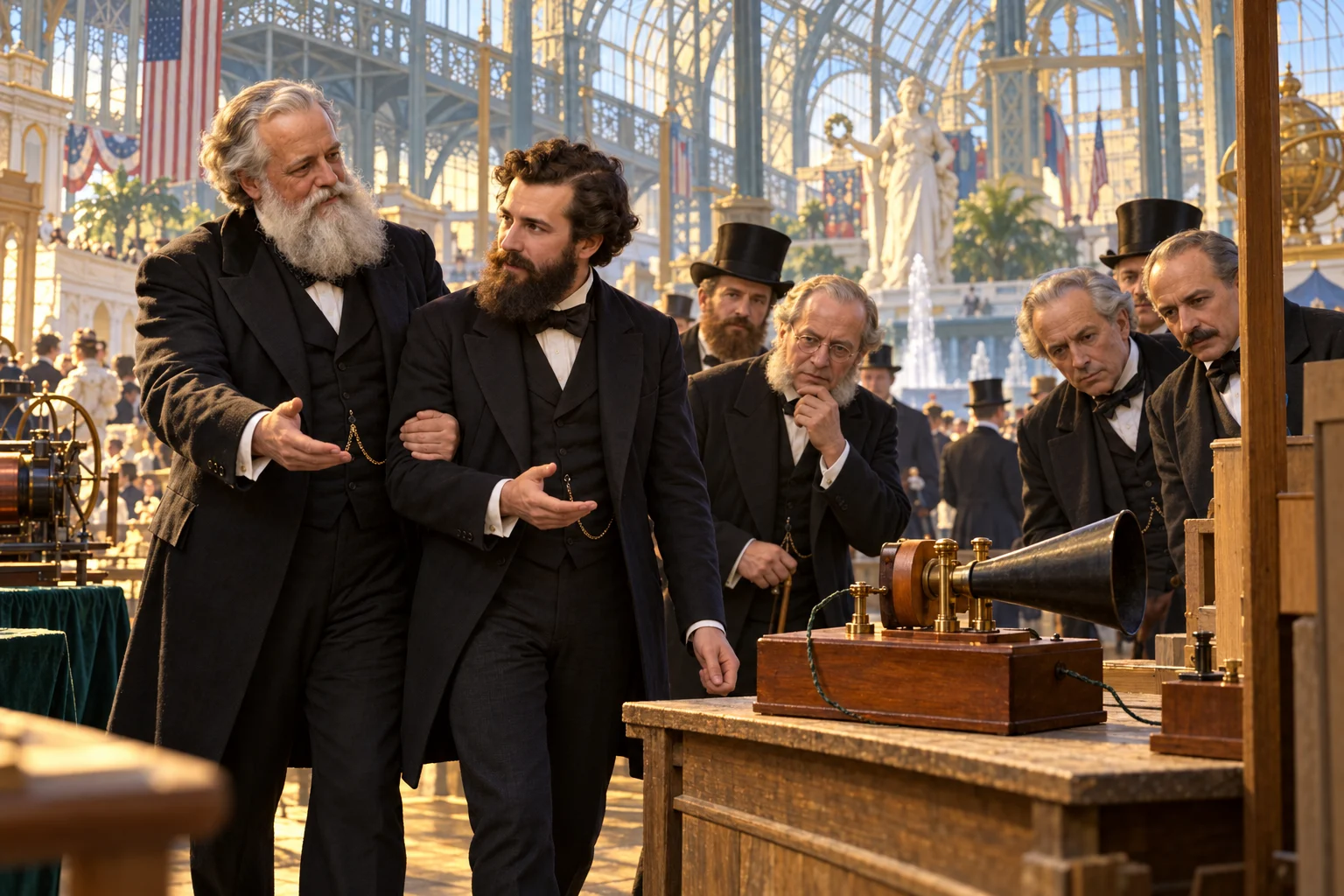
Dom Pedro II, emperor of Brazil, recognised Bell from an earlier visit involving education for deaf people in Boston. When Bell explained that his apparatus was next, the emperor took his arm and led the way. The judges followed. The memorable detail is the practical effect of personal recognition: an invention could benefit from the social authority of someone prepared to stop and listen. The encounter connected teaching, international travel and technical curiosity in a single exhibition visit.
Hearing speech through electricity
Bell then went to the transmitting instrument elsewhere in the building and spoke continuously. At the receiving end, the emperor and the scientist William Thomson listened. The demonstration showed that electrical apparatus could carry recognisable speech, rather than merely coded signals. That distinction made the device startling. Bell's address recounts an excited exclamation attributed to the emperor, but Bell explicitly says he learned about it afterwards because he was at the other end of the connection.
Memory and the invention’s public life
The account was delivered thirty-five years after the exhibition, so its dramatic dialogue belongs to retrospective testimony. Its exact quotations should not be confused with a recording made in 1876. Nevertheless, Bell gives the date, explains why he attended and describes the emperor's intervention directly. The episode illuminates the difference between developing an apparatus and persuading an audience of its value. The illustration evokes that meeting without claiming to reproduce an archival photograph or every feature of the display.
Hino Nacional Brasileiro - Piano Improvisation
Jef de Roode
Jef de Roode's later piano improvisation combines the Brazilian national anthem with Aquarela do Brasil. It provides a Brazilian cultural connection to Dom Pedro II; the medley is not music performed at Bell's demonstration.
Listen on SoundCloud ↗Follow the evidence.
AI-assisted writing, with institutional and primary sources. Illustration is a reconstruction, not an archival photograph. Published October 31, 2026; updated October 31, 2026. Our approach