Opening of Japan’s Shimbashi–Yokohama railway in 1872
Formally opened on October 14, 1872, Japan’s first railway linked the capital with Yokohama. Its sea embankment reveals how land access and political resistance shaped the engineering.
A route between capital and port
Japan's first railway was planned between Tokyo and Yokohama, one of the ports open to international trade. The roughly 29-kilometre route would connect places central to the country's changing economy. British locomotives, equipment and engineering expertise contributed to the undertaking, while Japanese officials organized and managed the project. The railway was therefore both a new transport service and part of a broader effort to establish technical capabilities within Japan during the early Meiji period.
Why the track entered the bay
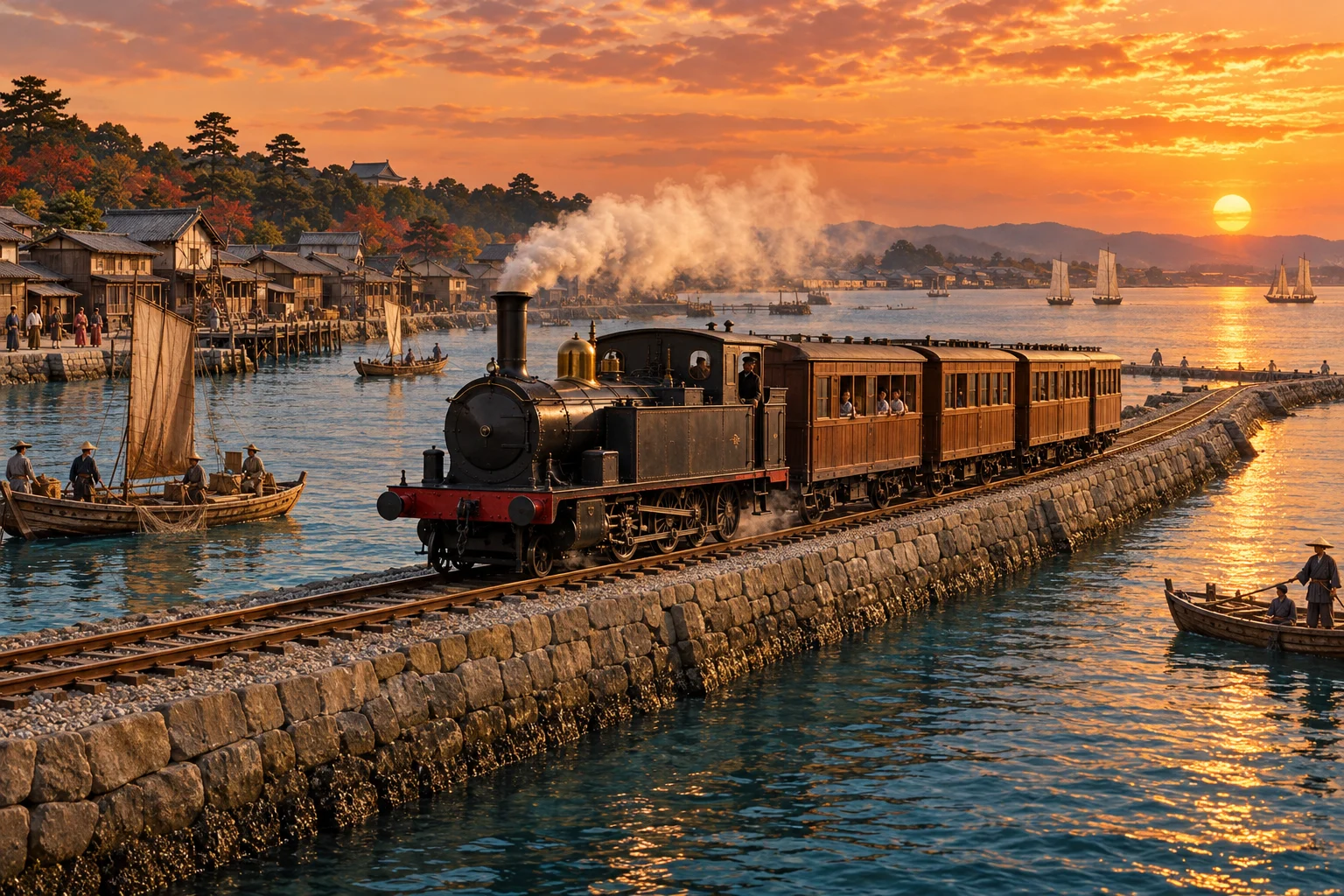
Construction did not proceed across an empty landscape. The East Japan Railway Culture Foundation's history explains that military authorities refused to allow track on their land facing Tokyo Bay. The solution was a new embankment for the railway's northern approach. This was an engineering answer to a problem of authority and land access. A direct-looking line on a map could require negotiation, realignment and substantial extra construction before locomotives could use it.
The formal opening
The Meiji Emperor attended opening ceremonies at Shimbashi and Yokohama on October 14, 1872, travelling between the two terminals. This full-route inauguration followed earlier passenger services between Shinagawa and Yokohama. The distinction prevents the ceremony from being mistaken for the first occasion on which any Japanese passenger train moved. The transport ministry's account identifies October 14 with the railway's opening and explains its later association with Railway Day and the development of Japanese society and culture.
Technology depends on its setting
The railway's significance lay in more than obtaining steam engines. Track, stations, land, finance, staffing and public acceptance all had to work together. The foundation's study of railway sites places the Takanawa realignment within this contested process. The bay embankment makes that larger lesson visible: infrastructure reflects social decisions as well as technical possibilities. The illustration reconstructs a coastal railway scene; it does not claim to show the emperor's actual train or a documented instant during the ceremonies.
Tetsudō Shōka: revised arrangement
Rnsard yuzu113
The uploader’s 2020 arrangement of the later Japanese railway song connects with rail travel’s cultural legacy. It is a modern arrangement, not music performed at the 1872 ceremony.
Listen on SoundCloud ↗Follow the evidence.
- East Japan Railway Culture Foundation: Dawn of Japanese Railways ↗
- Japan Ministry of Transport: Railway Day and the 1872 opening ↗
- East Japan Railway Culture Foundation: Redevelopment of Railway Sites ↗
AI-assisted writing, with institutional and primary sources. Illustration is a reconstruction, not an archival photograph. Published October 31, 2026; updated October 31, 2026. Our approach