The Suez Canal opens to international shipping in 1869
The Suez Canal was inaugurated on 17 November 1869. By joining the Mediterranean and Red Sea, the Egyptian waterway altered shipping routes and strengthened the commercial advantages of steam-powered vessels.
A passage across the isthmus
The modern Suez Canal crossed the Egyptian isthmus between the Mediterranean and Red Sea. Earlier waterways had connected the Nile system with the Red Sea, but the nineteenth-century project created a direct maritime passage. Ferdinand de Lesseps secured concessions for the canal company, and construction began in 1859. Egyptian workers supplied essential labor, including work performed under coercive conditions. The achievement belongs to that workforce as well as to its celebrated promoters and engineers.
The opening procession
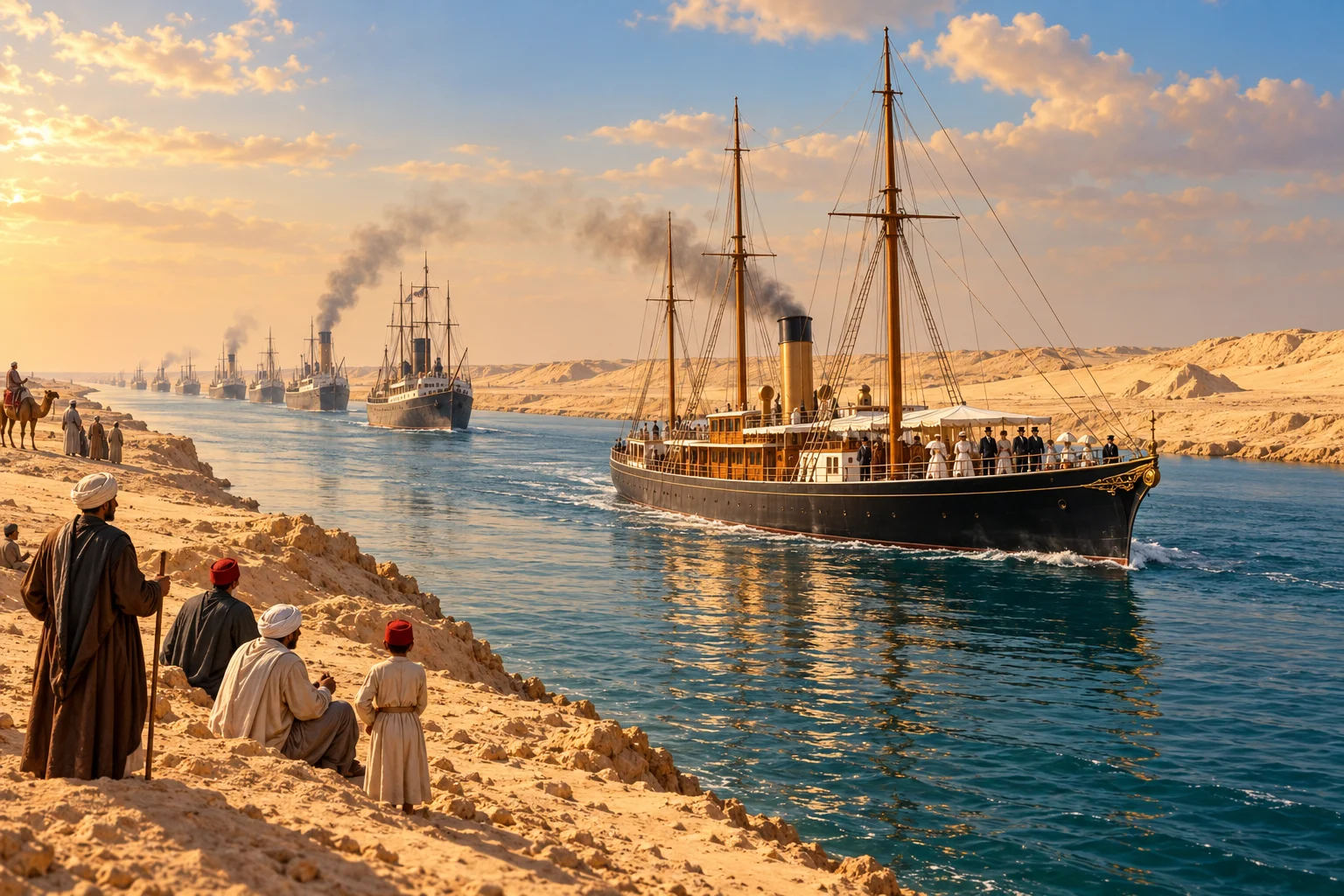
On 17 November 1869, the completed canal was formally inaugurated. According to the Suez Canal Authority, a ceremonial procession entered the waterway led by L’Aigle, the yacht carrying Empress Eugénie of France. Guests and elaborate celebrations advertised the new route’s international importance. Construction and the meeting of the waters had preceded this occasion: the November date refers to the official inauguration and opening procession, rather than to the first digging or the first physical connection of the seas.
Why steam gained an advantage
For many voyages between Europe and Asia, the canal removed the need to round southern Africa. Its narrow passage also favored vessels able to make progress independently of the wind. Royal Museums Greenwich places its opening within the broader transition from sailing clippers to steamships. More efficient engines and the new route reinforced each other: steamers could combine a shorter journey with increasingly practical fuel consumption, changing the competitive balance in long-distance trade.
Engineering and unequal power
Suez is a sea-level canal, so vessels do not climb a staircase of locks. Its dimensions have changed substantially since the original nineteenth-century works. The waterway also became entangled with foreign investment, Egyptian debt and imperial interests; its commercial value did not mean that its benefits were shared equally. Understanding the opening requires both the engineering breakthrough and that human setting. The accompanying procession is a historically informed illustration, not a surviving photograph or a precise inventory of every ship present.
Aida: Triumphal March and Ballet (02 - All Campus)
GHP All-Campus Chorus & Orchestra, conducted by Howard Hsu and Tom FitzStephens
The 2019 Georgia Governor’s Honors Program concert recording supplies a later Egyptian-themed association through Verdi’s Aida. Aida belongs to 1871; this is not music recorded at, or composed for, the canal’s 1869 opening.
Listen on SoundCloud ↗Follow the evidence.
- Suez Canal Authority: Canal history ↗
- Royal Museums Greenwich: Sail to steam ↗
- American Society of Civil Engineers: Suez Canal ↗
- GHP 2019: All-Campus concert, second track ↗
AI-assisted writing, with institutional and primary sources. Illustration is a reconstruction, not an archival photograph. Published October 31, 2026; updated October 31, 2026. Our approach