King Mongkut’s Observation of the 1868 Wa Ko Solar Eclipse
On 18 August 1868, King Mongkut of Siam observed a total solar eclipse at Wa Ko. His advance prediction made the expedition a public demonstration of mathematical astronomy, later commemorated by Thailand’s National Science Day.
A king who studied astronomy
King Mongkut, Rama IV of Siam, pursued astronomy alongside his religious and royal responsibilities. He studied mathematics and scientific instruments, and used observations of the sky in determining geographical positions. This scholarly background matters because the 1868 expedition was not simply a ruler attending a spectacle arranged by others. He had worked on the prediction that brought the observers to Wa Ko, on the coast of what is now Thailand. KMUTT Library
The expedition on 18 August
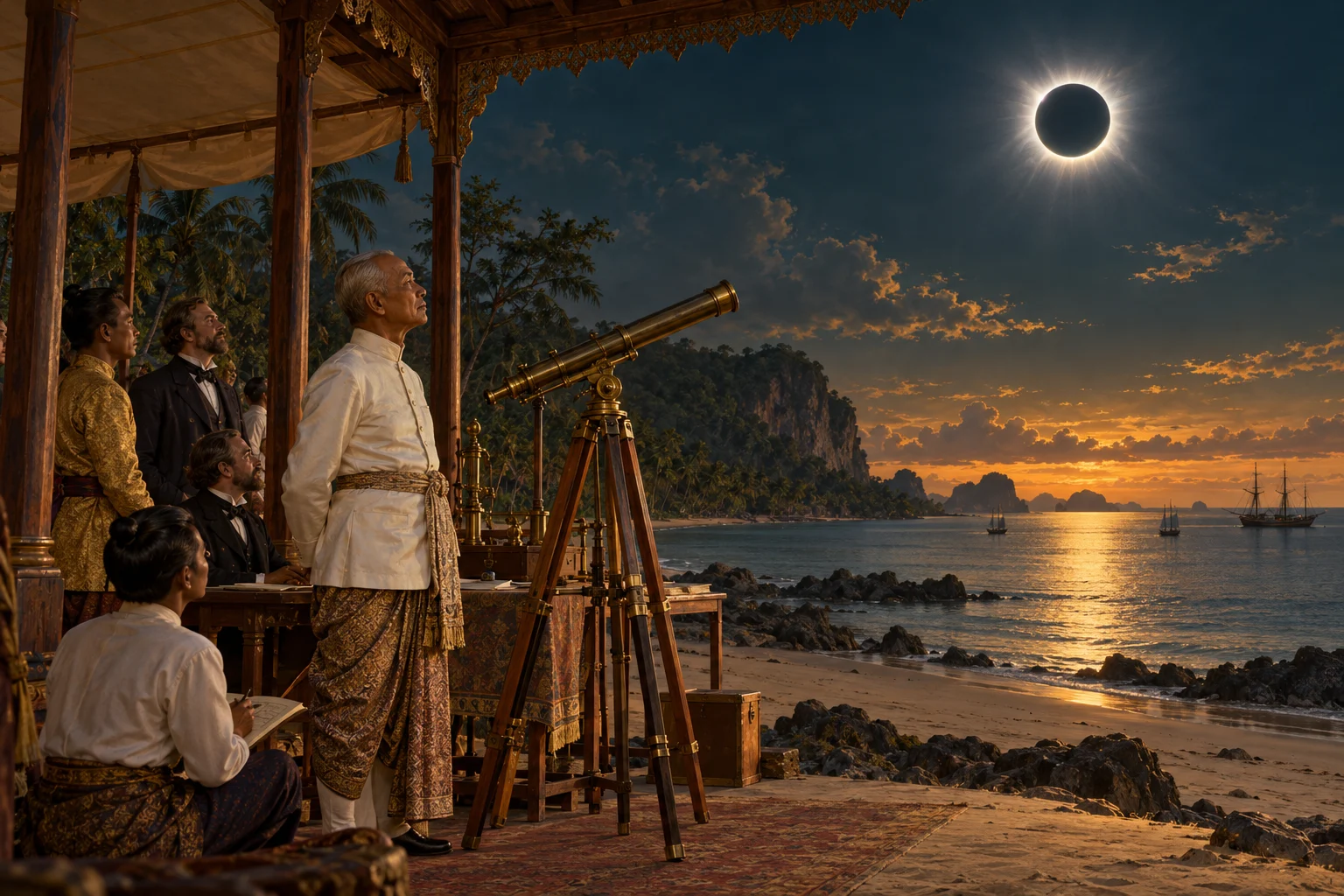
Mongkut predicted the eclipse two years before it occurred and selected a location in the path of totality. On 18 August 1868 he watched it at Wa Ko with invited guests, including foreign observers. The expedition required advance preparations for travel, accommodation and instruments. The successful observation gave the calculation a public test: an announced event could be compared with what actually happened in the sky, at an announced place and time.
Why location mattered
A total solar eclipse occurs when the Moon covers the Sun’s visible disc for observers within a narrow moving shadow. Nearby places can experience a partial eclipse while missing totality altogether. Predicting an eclipse therefore involves more than knowing that the Sun and Moon will align somewhere. NASA’s historical catalogue identifies the 18 August 1868 event and provides geographical calculations of its path. Those calculations independently establish the astronomical event, rather than every detail of later stories about the expedition. NASA
A continuing scientific commemoration
Thailand’s National Science Day falls on 18 August in recognition of the observation. The commemoration connects an individual achievement with a wider ideal: confidence in learning that can be tested through observation. Accounts celebrate Mongkut’s precision, but there is no need to turn such praise into unsupported claims that all other astronomers were wrong. The accompanying pavilion scene is an imagined illustration of the expedition, not a reproduction of its surviving photographic record. Thailand NOW
Future Sounds of Siam - Ranat [TH Instrumental Collection]
Sounds of Future Siam / Chyarop Roc Burapat
A contemporary Thai instrumental recording provides a cultural connection to Siam. This modern production is not presented as nineteenth-century court music or a recording of the eclipse expedition.
Listen on SoundCloud ↗Follow the evidence.
- KMUTT Library: King Mongkut’s science and technology ↗
- Thailand NOW: history of National Science Day ↗
- NASA: solar eclipses of historical interest ↗
- Smithsonian: the historical King Mongkut ↗
AI-assisted writing, with institutional and primary sources. Illustration is a reconstruction, not an archival photograph. Published October 31, 2026; updated October 31, 2026. Our approach