Scott de Martinville records Au clair de la lune on paper
On 9 April 1860, a phonautograph captured a voice on paper without playing it back. Modern researchers later recovered the sound.
Writing sound
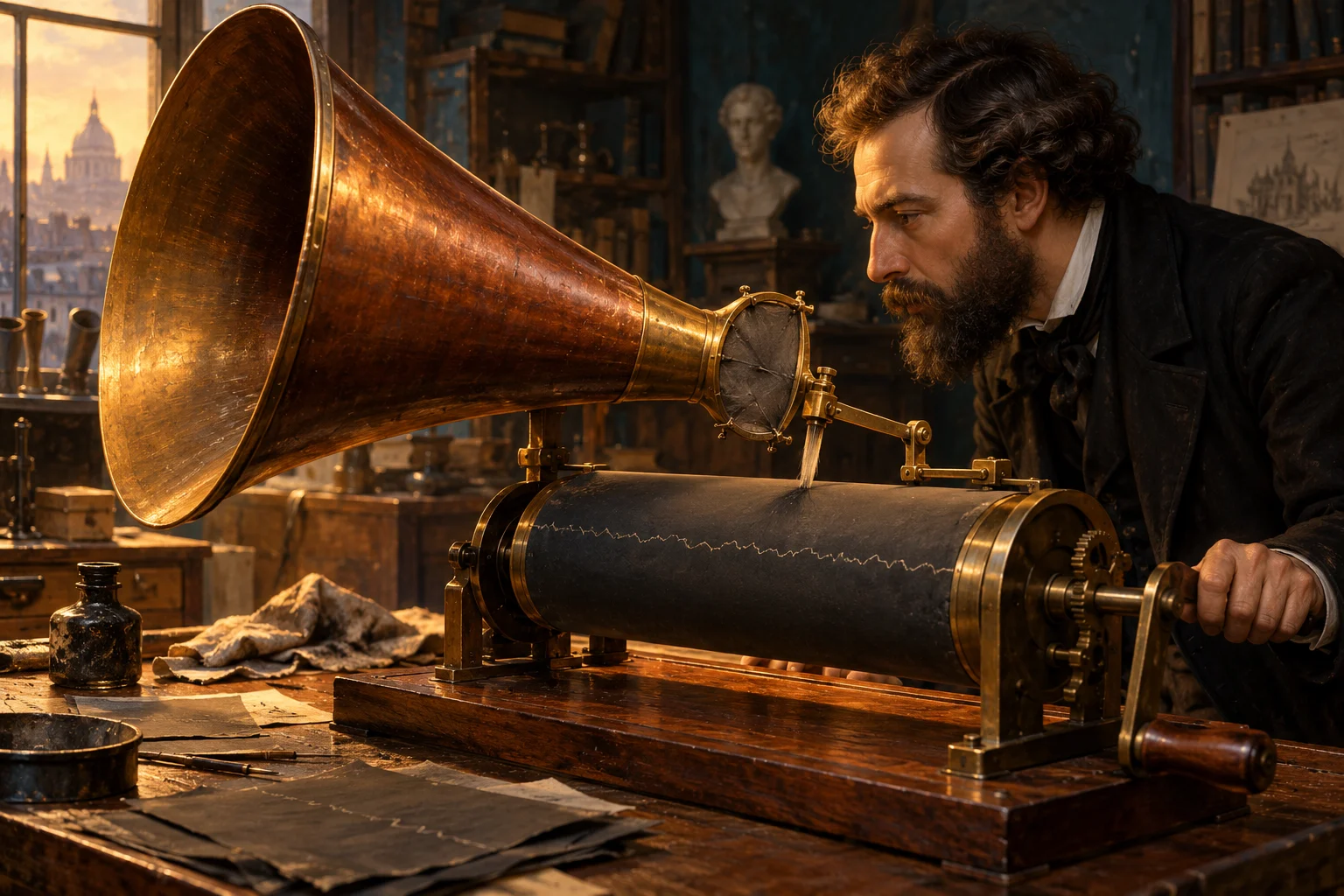
Édouard-Léon Scott de Martinville imagined an instrument that could preserve sound as a visible trace. His phonautograph channelled airborne vibrations to a membrane and stylus, which marked a moving surface. The result was a phonautogram: a drawing of sound unfolding through time. Scott hoped such traces could be studied or interpreted visually, somewhat like a form of automatic writing. Library of Congress essay
The dated song
On 9 April 1860, Scott recorded a passage from the French song Au clair de la lune. The surviving sheet bears both its date and the song’s title. First Sounds, the research collaboration that recovered the recording, identifies it as the earliest clearly recognizable human voice yet recovered. Earlier phonautograms also survive, so it should not simply be called the first occasion on which any sound was recorded. Recording and research
A recording without a player
Scott’s instrument had no mechanism for turning its marks back into audible vibrations. This was a consequence of its purpose, rather than a missing loudspeaker. His ambition was to make sound visible. Modern readers therefore need to separate recording from reproduction: the machine accomplished the former long before listeners could hear the particular evidence it preserved. The paper carried information its maker could examine but could not audition. That unfamiliar goal explains why a recording could remain silent for almost a century and a half while retaining information that later technology could recover.
Hearing the paper
In 2008, researchers used digital methods to recover audible sound from the April recording. Later work refined the playback speed and the interpretation of its words. The singer is thought likely to be Scott, although the identification is not certain. First Sounds’ newer research updates some early claims preserved in its older FAQ. The achievement joined archival preservation with signal reconstruction, allowing a visual document to become an audible historical source. The accompanying workshop scene is an illustration, not an archival photograph. Provenance FAQ
Au clair de la lune
Chronos Vocal Ensemble; music by Paul Aitken
Chronos’s 2019 recording of Paul Aitken’s contemporary choral setting uses the French text associated with Scott’s recorded song. It is a later artistic connection, not the recovered 1860 audio.
Listen on SoundCloud ↗Follow the evidence.
- First Sounds: Scott’s phonautograms ↗
- First Sounds: provenance and identification FAQ ↗
- Library of Congress: Phonautograms essay by David Giovannoni ↗
- Paul Aitken: Au clair de la lune and Chronos recording ↗
AI-assisted writing, with institutional and primary sources. Illustration is a reconstruction, not an archival photograph. Published October 31, 2026; updated October 31, 2026. Our approach