Hymen Lipman’s Pencil and Eraser Patent of 1858
On 30 March 1858, Hymen Lipman patented a wooden pencil containing an eraser core. Its rubber end could be sharpened, creating a precise erasing point as well as a writing point.
An improvement at the drawing desk
Hymen L. Lipman of Philadelphia received United States patent 19,783 on 30 March 1858. His subject was a familiar activity: making a mark, noticing a mistake and removing it. Instead of keeping a loose piece of rubber beside the pencil, he proposed securing both materials inside one wooden holder. The specification addressed practical annoyances, including an eraser becoming dirty or disappearing among the objects on a desk. Patent
Rubber inside the wood
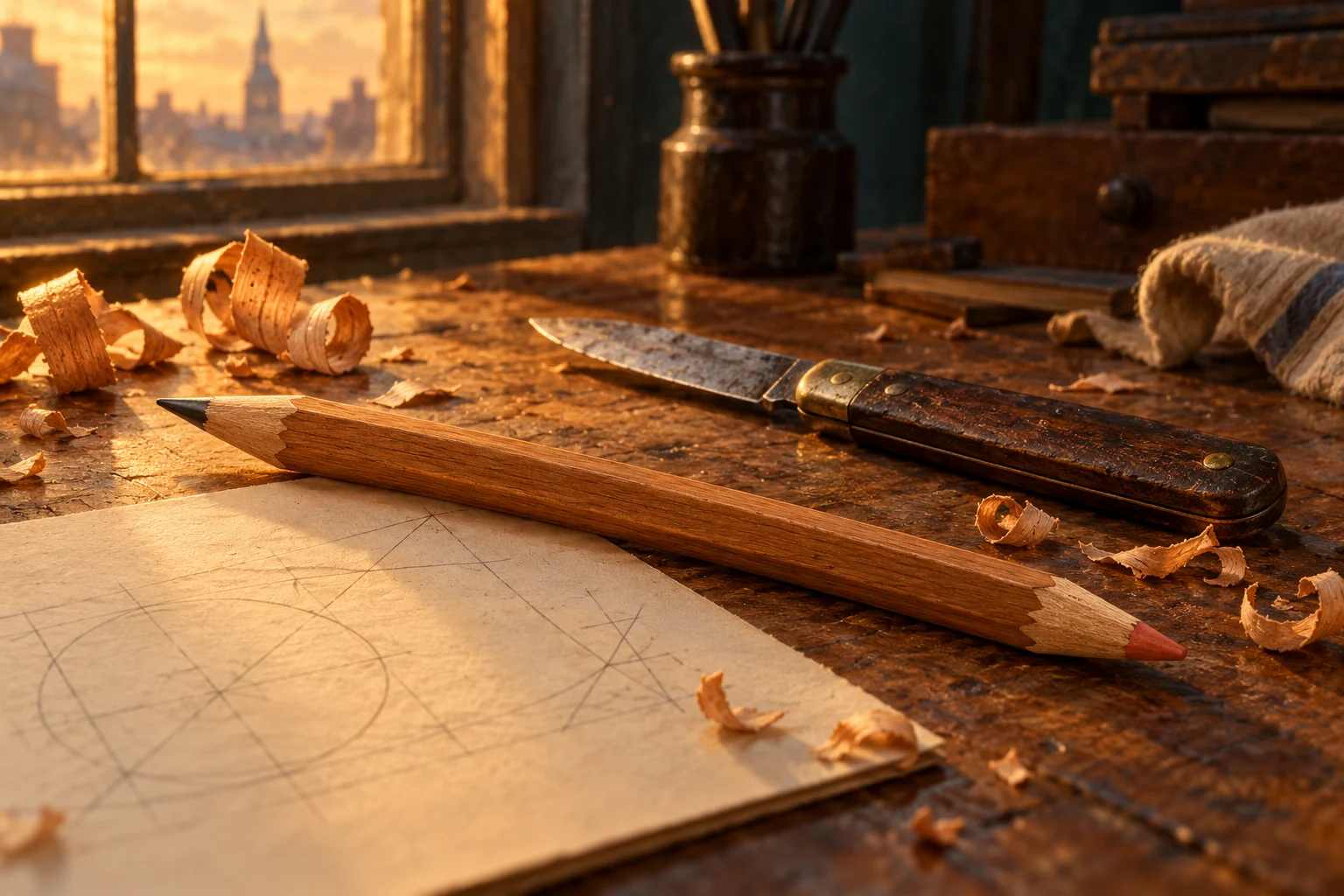
The design differed from the metal-banded eraser familiar on many later pencils. Lipman reserved roughly a quarter of the pencil’s length for a groove holding prepared india-rubber, glued along one edge. Cutting one end exposed the writing material; cutting the other exposed rubber. A user could sharpen the rubber to erase small marks between closely spaced lines, then sharpen it again when the point became soiled. Precision mattered especially in technical drawing.
A patent tested in court
The patent later became part of a dispute involving Joseph Reckendorfer and the pencil maker Faber. In its 1875 opinion, the United States Supreme Court distinguished a patentable combination from an aggregation of existing tools. The majority concluded that the pencil and eraser continued to perform their separate functions without producing a new combined result. That reasoning defeated the patent claim even though joining the objects was convenient. Court opinion
Convenience and invention
The episode makes a useful distinction between an object’s appeal and the legal protection available for it. A small improvement can be easy to understand, pleasant to use and commercially attractive without satisfying the particular patent standard applied by a court. Lipman’s specification also preserves a design that modern users might not expect: an eraser sharpened within its wooden casing. The accompanying illustration interprets that documented construction; it is not a surviving photograph of Lipman’s workshop.
Le Banjo by Louis Moreau Gottschalk
Daniel De Togni
De Togni performs Gottschalk’s 1855 piano piece. It supplies American musical context from the patent’s decade; this is a modern performance, not an 1858 recording.
Listen on SoundCloud ↗Follow the evidence.
- Lipman’s original pencil-and-eraser patent ↗
- Reckendorfer v. Faber: Supreme Court opinion ↗
- Library of Congress: Louis Moreau Gottschalk ↗
AI-assisted writing, with institutional and primary sources. Illustration is a reconstruction, not an archival photograph. Published October 31, 2026; updated October 31, 2026. Our approach