Elizabeth Blackwell graduates from Geneva Medical College
Elizabeth Blackwell’s graduation on 23 January 1849 made her the first woman to receive a medical degree in the United States.
Getting through the door
Elizabeth Blackwell sought medical training when American medical colleges treated the profession as a male domain. Born in England and raised partly in the United States, she supported herself through teaching while preparing to study. Repeated rejections made admission the first major obstacle. Geneva Medical College in New York eventually accepted her in 1847 after referring the decision to its students. A contemporary woman’s letter offers another perspective alongside Blackwell’s later recollections, allowing historians to compare the public occasion with the graduate’s memory. National Library of Medicine
The graduation ceremony
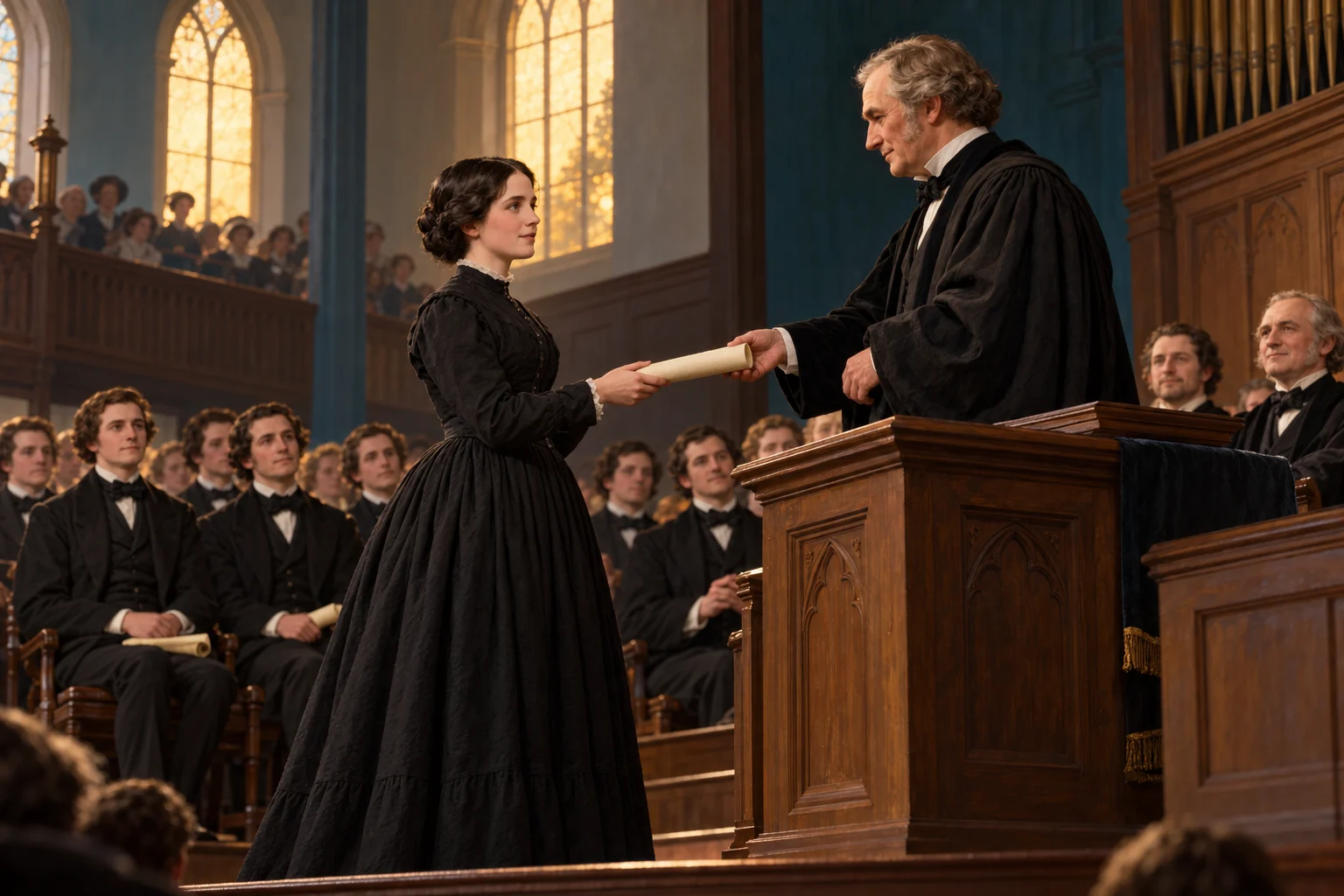
On 23 January 1849, Blackwell received her MD at exercises held in Geneva’s Presbyterian church. Hobart and William Smith Colleges preserve an account by Margaret Munro DeLancey, a woman who witnessed the occasion. Its importance reaches beyond ceremonial detail: it documents a woman receiving the same professional credential as her male classmates. Blackwell had completed the institution’s required studies rather than obtained an honorary title. Eyewitness account and introduction
A qualification and its limits
The diploma did not remove every barrier to employment or clinical training. It did make exclusion harder to defend as an absolute rule. Women had long provided healing and nursing care; Blackwell’s achievement concerned access to a recognized American medical degree. That distinction matters because describing her as the first woman ever to practise medicine would erase a much longer and more varied history.
Building opportunities for others
Blackwell subsequently helped establish the New York Infirmary for Women and Children and promoted medical education for women on both sides of the Atlantic. Her career connected individual access with institution building: new students needed places to learn, gain experience and treat patients. The colleges’ history traces this wider work alongside her graduation. Their account treats the students’ supposed joking motives for admitting her as competing recollections, rather than a single certain explanation. The accompanying ceremony scene is an original illustration based on the documented setting. College biography
Clara Schumann: Romance, Op. 22 No. 3 — Leidenschaftlich schnell
Nancy Oliveros, violin; Mary Ellen Haupert, piano
This 2011 performance of Clara Schumann’s later, 1853 composition provides a thematic link to women pursuing professional work in Blackwell’s century. It was not performed at her graduation.
Listen on SoundCloud ↗Follow the evidence.
- Hobart and William Smith: Blackwell’s graduation eyewitness account ↗
- National Library of Medicine: Elizabeth Blackwell, Part I ↗
- Hobart and William Smith: Elizabeth Blackwell biography ↗
AI-assisted writing, with institutional and primary sources. Illustration is a reconstruction, not an archival photograph. Published October 31, 2026; updated October 31, 2026. Our approach