Maria Mitchell’s comet discovery on 1 October 1847
Maria Mitchell found a faint comet while observing from Nantucket on 1 October 1847. The discovery brought international recognition to a skilled observer whose subsequent teaching helped expand women’s participation in professional astronomy.
Training beyond a university
Maria Mitchell learned astronomy in a household where her father, William, combined teaching with a serious interest in observing the heavens. She also educated herself through books while working at the Nantucket Atheneum. Her nightly observations belonged to a sustained practice, rather than an isolated lucky glance. The University of St Andrews biography describes a librarian studying mathematics, languages and science alongside her paid work.
An unfamiliar object near Polaris
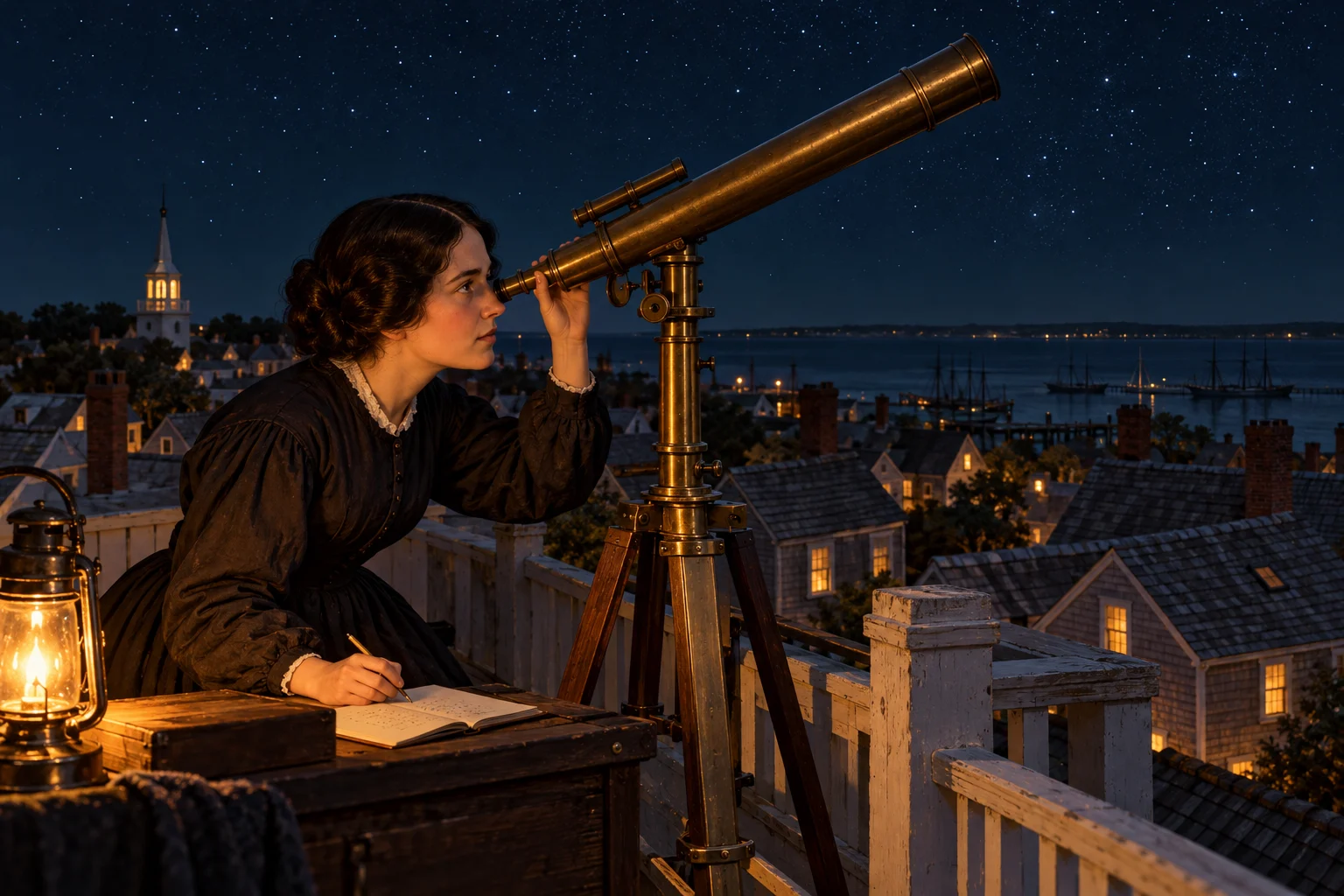
On the evening of 1 October 1847, Mitchell detected a faint object through the family telescope. William's journal, reproduced by the Maria Mitchell Association, places the discovery near Polaris. He stressed that a previously unrecorded nebula was unlikely in that position. Movement against background stars provides another distinction: a comet belongs to the moving population of the solar system, while a distant nebula maintains essentially the same place among the stars over such short observations. Such careful logs turned fleeting impressions into observations that other astronomers could compare.
Recognition required communication
Mitchell asked her father to check the object. Establishing priority also required reporting the observation and comparing it with discoveries made elsewhere. Other astronomers saw the comet in the following days, but her earlier observation was recognised. A Danish medal brought international attention. This was a telescopic discovery: the object was too faint to be an obvious spectacle to unaided observers. The illustration therefore shows the work of observing rather than an enormous comet hanging above the town.
A discovery becomes an opportunity
Mitchell became the first woman elected to the American Academy of Arts and Sciences in 1848. In 1865 she began teaching astronomy at Vassar College and directing its observatory. The National Park Service records both her scientific work and her efforts to obtain fairer pay. Her career shows how recognised observational skill could create institutional opportunities, while leaving substantial barriers for women to challenge. Students who worked with her carried that influence into later astronomical careers.
Fanny Mendelssohn-Hensel - Nocturne in G minor (Notturno)
Laurence Manning
Laurence Manning performs Fanny Mendelssohn-Hensel's Nocturne in G minor. This later recording pairs Mitchell's night work with music by a woman of the same nineteenth-century generation; it is a thematic association, not music linked to the observation itself.
Listen on SoundCloud ↗Follow the evidence.
- Maria Mitchell Association: Her father’s discovery record ↗
- MacTutor, University of St Andrews: Maria Mitchell ↗
- U.S. National Park Service: Maria Mitchell, Astronomer ↗
AI-assisted writing, with institutional and primary sources. Illustration is a reconstruction, not an archival photograph. Published October 31, 2026; updated October 31, 2026. Our approach