Public disclosure of the daguerreotype process in Paris
The daguerreotype process was publicly explained in Paris on 19 August 1839. Its detailed images formed on silver-plated copper, and the disclosure helped turn a guarded experimental method into a widely practised photographic technique.
Making a camera image permanent
A camera obscura could project a view long before photography, but preserving that image required a workable chemical method. Louis Daguerre pursued the problem with Nicéphore Niépce, whose earlier experiments had already produced permanent images. After Niépce’s death, Daguerre continued developing a process that could yield exceptionally fine detail. The history therefore involves collaboration and accumulated experimentation, rather than a camera appearing fully formed through a single isolated act of invention. The Metropolitan Museum’s history
The disclosure on 19 August 1839
Selected audiences had already seen examples earlier in 1839. The distinct event on 19 August was the public, step-by-step explanation before a joint session of the Académie des Sciences and Académie des Beaux-Arts in Paris. François Arago had helped secure government support and pensions in exchange for disclosure. The announcement of the results and the release of practical instructions were separate stages. Making the method known allowed others to attempt and develop the new photographic practice. The public presentation The Library of Congress chronology
A metal plate with an image
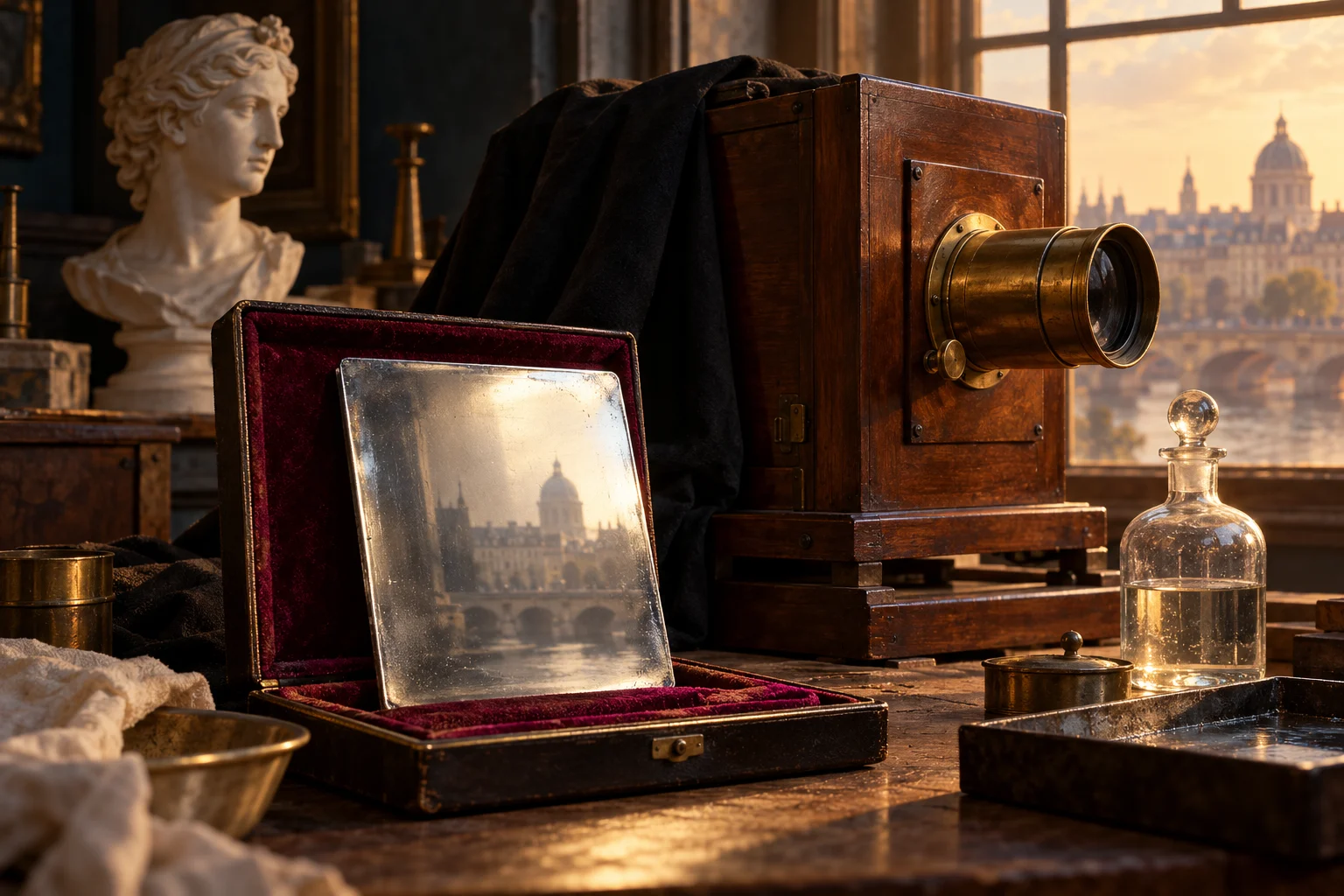
The light-sensitive surface was a highly polished sheet of silver-plated copper. Iodine vapour sensitised the plate, exposure took place inside a box camera, and mercury vapour developed the image before it was fixed. The resulting object could show remarkable detail but was a unique image rather than a reusable negative. Its reflective appearance also depended on the viewing angle. Those physical characteristics explain why a daguerreotype feels different from a modern paper print. Huis Marseille on the process
Promise, limits and wider use
Long exposure times made early portraiture demanding, and the process’s toxic chemicals required care. Nevertheless, the new method attracted practitioners and customers beyond France. The Enschedé family’s surviving Dutch portraits illustrate how rapidly such images entered private life. The technique belonged to a broader history that also includes other photographic inventors and later methods of reproduction. The accompanying still life is a modern illustration of early photographic materials; its reflected view is not a surviving Daguerre plate. Huis Marseille’s collection history
Prelude in D-flat major, Op. 28 No. 15, Raindrop
Michał Kruczkowski (Kruk)
Kruk’s modern piano performance of Chopin’s prelude evokes the Romantic musical culture surrounding photography’s emergence in 1839. It is a later performance, not audio from the Paris presentation.
Listen on SoundCloud ↗Follow the evidence.
- Metropolitan Museum of Art — Daguerre and photography ↗
- Huis Marseille — In the Full Light of Day ↗
- Library of Congress — Daguerreotype research ↗
- Kruk — Chopin’s Raindrop Prelude ↗
AI-assisted writing, with institutional and primary sources. Illustration is a reconstruction, not an archival photograph. Published October 31, 2026; updated October 31, 2026. Our approach