The giraffe's arrival in Paris on 30 June 1827
A female giraffe reached the Jardin des Plantes on 30 June 1827 after walking from Marseille. Sent as a diplomatic gift by Egypt's ruler, she became France's first living giraffe and the focus of an extraordinary wave of public curiosity.
A gift crossing the Mediterranean
The giraffe came from Sudan and was sent by Egypt's ruler, Muhammad Ali, as a gift to France's King Charles X. She travelled through Alexandria and landed at Marseille in October 1826. The Muséum national d'Histoire naturelle identifies her as the first living giraffe seen in France. Transporting such an animal required extended care and planning, rather than simply placing a diplomatic present aboard a ship and forwarding it to the royal court.
The long journey north
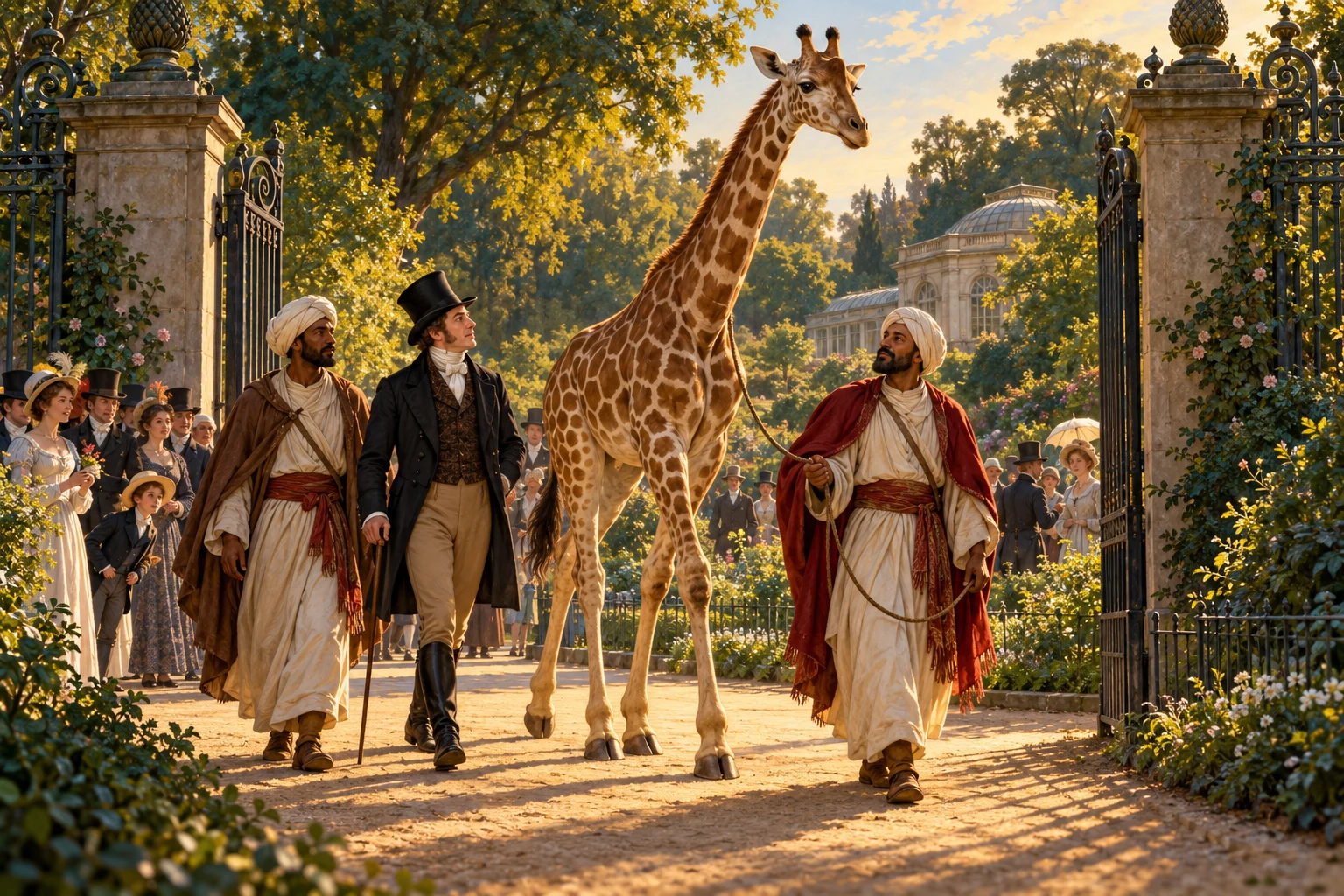
After wintering in Marseille, the giraffe continued toward Paris on foot. The journey across France lasted more than forty days, accompanied by keepers and the naturalist Étienne Geoffroy Saint-Hilaire, professor of zoology and director of the Ménagerie. A historical study drawing on museum archives describes the attention given to her care and her earlier daily walks in Marseille. The walking animal, rather than a special wagon, was the remarkable transport solution behind the arrival.
A celebrity at the Ménagerie
On 30 June 1827, the giraffe arrived at the Ménagerie of the Jardin des Plantes. Newspaper attention helped make her a leading attraction, and the museum describes the enthusiasm as giraffomania. She remained there until her death in 1845. The name Zarafa, now commonly attached to her, was applied much later; it should not be assumed to have been the name used by the crowds at the gate. The dated event is her arrival in Paris, not the earlier sea landing.
Reading an animal spectacle historically
The episode joins diplomacy, zoological collecting, animal care and popular entertainment. The Ménagerie's institutional setting helps explain why a royal gift became accessible to an urban public. The giraffe's journey also depended on the practical labour of the people accompanying her, whose work can disappear behind the celebrity animal. The illustration interprets an arrival with attentive keepers and fascinated visitors. Its gate, crowd and individual poses are imagined, and it should not be mistaken for a contemporary picture documenting the exact procession.
The Swan — Carnival of the Animals
Dennis Karmazyn; arrangement and production by Maxwell Karmazyn
This modern cello recording comes from Saint-Saëns's later French animal suite. It offers a thematic association with animals in French cultural imagination, rather than music documented at the giraffe's 1827 arrival.
Listen on SoundCloud ↗Follow the evidence.
- Muséum national d'Histoire naturelle: La Première Girafe de France ↗
- Persée: Historical study of the giraffe's arrival, using museum archives ↗
- Muséum national d'Histoire naturelle: Ménagerie du Jardin des Plantes ↗
- SoundCloud: recording and performer credits ↗
AI-assisted writing, with institutional and primary sources. Illustration is a reconstruction, not an archival photograph. Published October 31, 2026; updated October 31, 2026. Our approach