Champollion presents his hieroglyphic decipherment in 1822
Jean-François Champollion presented his Lettre à Monsieur Dacier on 27 September 1822. It marked a crucial public stage in understanding the relationship between Egyptian signs, sounds and language.
More than mysterious pictures
Ancient Egyptian hieroglyphs had long attracted interpretations that treated them chiefly as symbols for ideas. Decipherment required understanding writing as a system connected to spoken language. The problem involved several Egyptian scripts and comparisons among surviving inscriptions. Champollion assembled evidence through copies, tables of signs and earlier scholarship. Egyptian objects were not merely decorative sources of inspiration: their written records could potentially provide access to the language and historical knowledge of the people who had made them.
The public presentation
On 27 September 1822, Champollion presented his Lettre à Monsieur Dacier before the Académie des inscriptions et belles-lettres in Paris. The letter’s preparation had occupied the preceding weeks, and its publication followed. The dated meeting was therefore a public communication of research rather than the entire discovery compressed into one day. France’s National Archives identifies the presentation as a major announcement, while also noting that subsequent work was needed to establish and develop the approach. Archives nationales: Champollion’s archives.
Names, sounds and Coptic
Comparing royal names supplied useful tests. Signs recurring in names such as Ptolemy and Cleopatra could be related to recurring sounds. Champollion also drew on Coptic, a later form of the Egyptian language, to extend interpretation beyond foreign royal names. The emerging understanding was a mixed writing system: signs could represent sounds, convey meanings or help classify words. A simple picture-for-word scheme could not explain that complexity. Nor was the script merely an alphabet identical in operation to a European one. INHA: Jean-François Champollion.
An achievement with a longer history
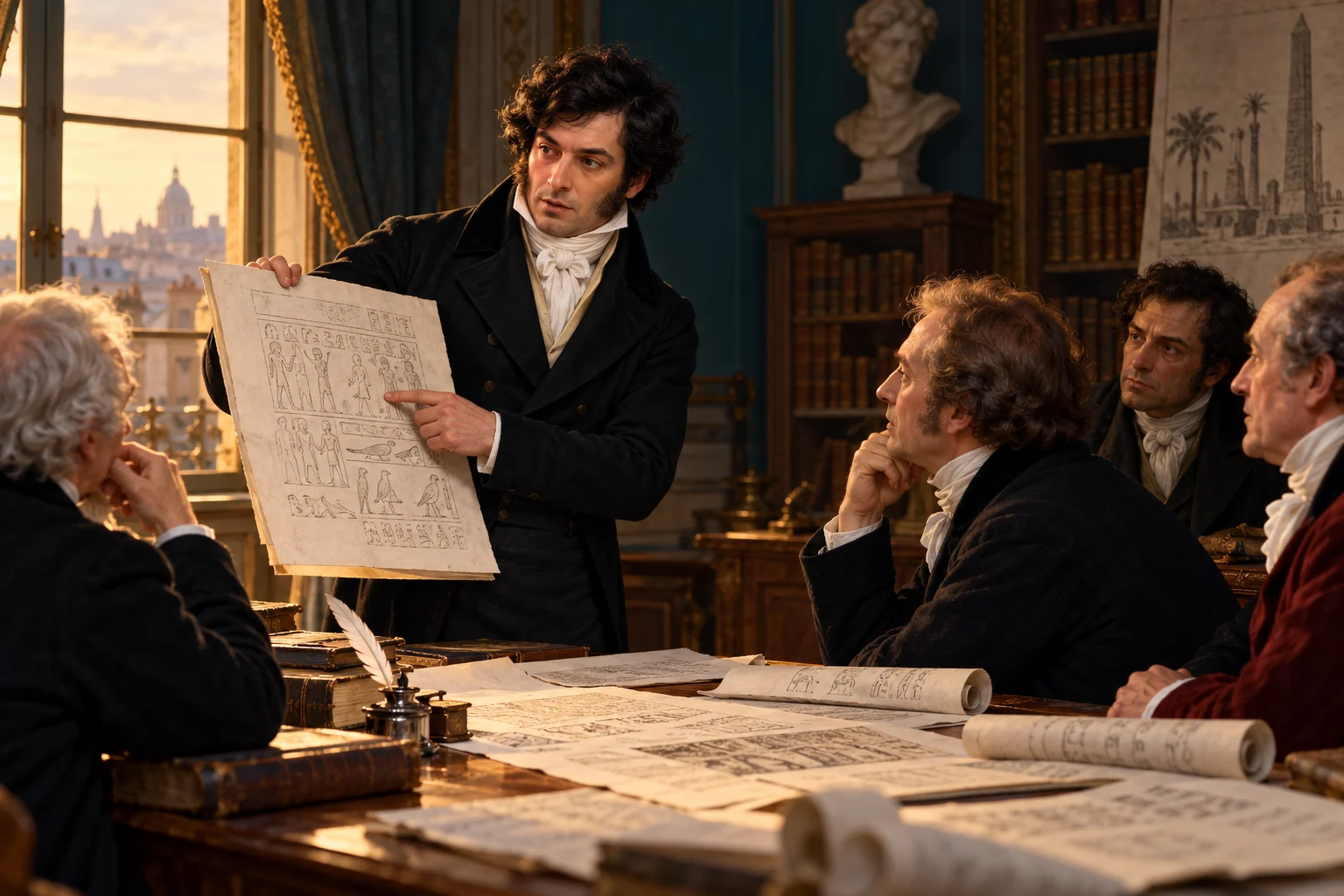
Thomas Young and other scholars made contributions to the decipherment problem, and Champollion’s own reasoning included reversals as well as advances. Celebrating the 1822 presentation need not erase that cumulative history. His later publications and museum work helped establish Egyptology as a discipline capable of reading Egyptian sources. The illustration shows paper copies in a scholarly setting. It does not place the actual Rosetta Stone in Paris or claim to preserve the meeting’s exact appearance.
Egyptian March
Williamson County Symphony Orchestra
An uploader-identified March 2015 performance in Georgetown, Texas, of Johann Strauss II’s later nineteenth-century Egyptian March. It reflects European musical fascination with Egypt, not ancient Egyptian music or music heard at the 1822 presentation.
Listen on SoundCloud ↗Follow the evidence.
- Archives nationales: Champollion’s archives ↗
- INHA: Jean-François Champollion ↗
- Louvre: Champollion and decipherment ↗
AI-assisted writing, with institutional and primary sources. Illustration is a reconstruction, not an archival photograph. Published October 31, 2026; updated October 31, 2026. Our approach