San Martín's decree creates the National Library of Peru
On 28 August 1821, José de San Martín decreed the creation of Peru's National Library. The project connected independence with public knowledge, although the institution required further organization before its inauguration in September 1822.
Books in a newly independent state
Peru's declaration of independence in July 1821 did not end the work of creating institutions. José de San Martín's administration also considered how knowledge might support the new political order. A national library would preserve collections and make learning part of public life. The library's institutional history records that San Martín understood enlightenment as a stronger support for independence than military power alone. His statement expressed an aspiration for the institution, rather than proof that public access was immediately universal.
The decree of 28 August
San Martín signed the founding decree on 28 August 1821, one month after the declaration of independence. This is the library's legal creation date. It was not the day on which a fully organized reading service opened. Distinguishing those stages prevents an attractive founding story from compressing months of practical work into a single ceremony. The library's account of Bernardo de Monteagudo's role explicitly separates the decree from the later inauguration and identifies Monteagudo as an organizer.
Turning the decree into an institution
The library was inaugurated on 17 September 1822 with 11,256 volumes, according to its institutional chronology. These included material from earlier religious collections and private gifts; San Martín himself contributed hundreds of books. Mariano José de Arce is remembered as the first librarian. Scholarship published in the library's journal, Fénix, examines the administrative work behind the institution and emphasizes Monteagudo's contribution. Founding authority, practical organization and librarianship were connected tasks, but they should not automatically be treated as identical roles.
A durable idea with a difficult history
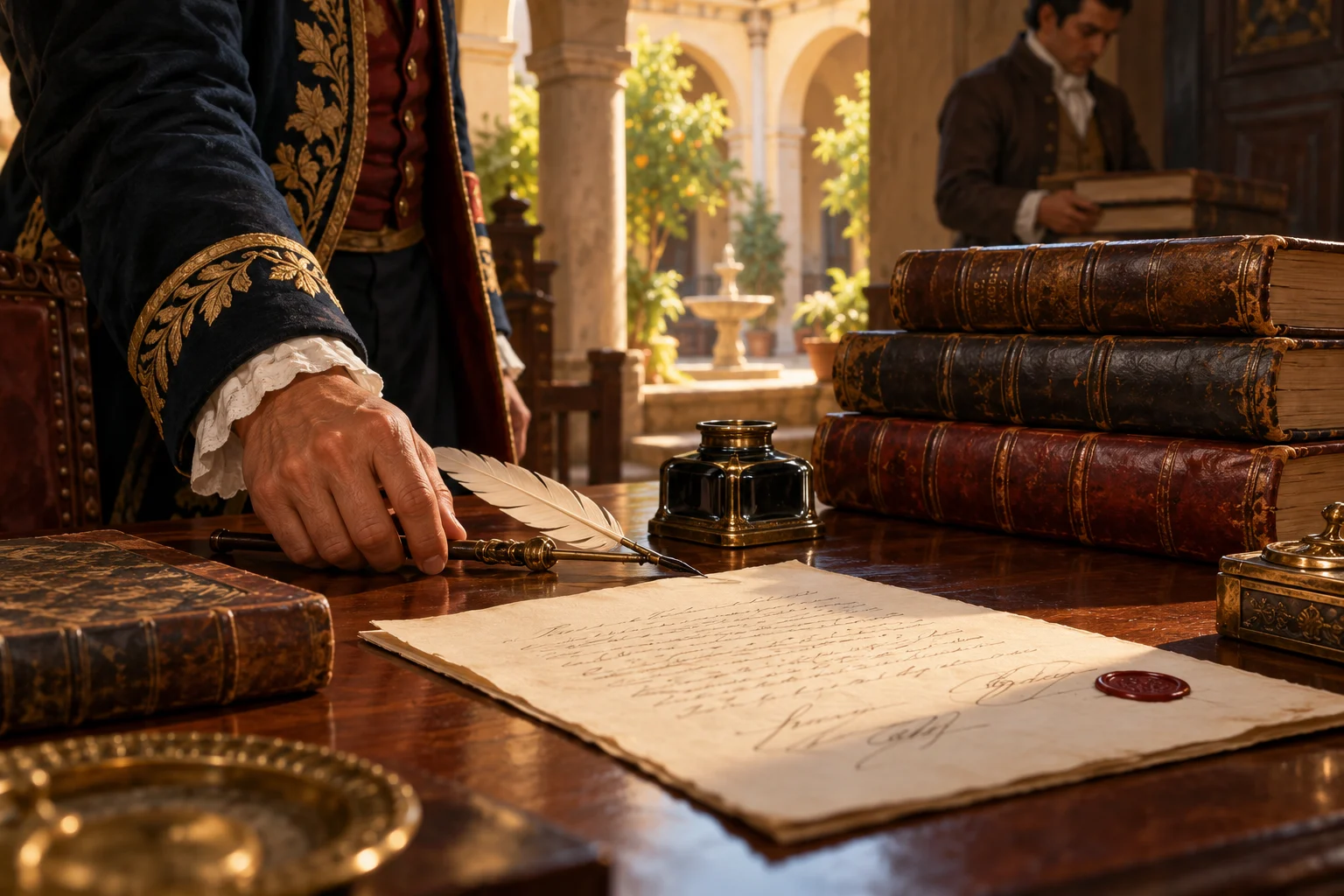
The collection subsequently endured losses during conflict and a devastating fire in 1943. Rebuilding required renewed collecting, organization and professional effort. That history demonstrates the difference between declaring a cultural ambition and maintaining the material conditions that let it survive. The 1821 decree remains significant because it placed public knowledge among the institutions imagined for an independent Peru. The accompanying illustration presents books and paperwork as symbols of that project; it is not a facsimile of the decree or an eyewitness image of its signing.
El Condor Pasa (Siku pan flute and Quena)
Quoc-Huy; accompaniment arranged by Bùi Phạm-Thắng
Quoc-Huy's modern interpretation of Daniel Alomía Robles's twentieth-century Peruvian work supplies a later Andean cultural association. It was not composed or performed for the library's 1821 founding.
Listen on SoundCloud ↗Follow the evidence.
- Biblioteca Nacional del Perú: Institutional history ↗
- Biblioteca Nacional del Perú: Monteagudo as library organizer ↗
- Fénix: Bernardo Monteagudo and the National Library of Peru ↗
AI-assisted writing, with institutional and primary sources. Illustration is a reconstruction, not an archival photograph. Published October 31, 2026; updated October 31, 2026. Our approach