The first performance of Silent Night on 24 December 1818
Silent Night was first performed in Oberndorf on Christmas Eve 1818. Joseph Mohr supplied a poem written in 1816, Franz Xaver Gruber composed the melody, and the two introduced the carol that same evening.
A poem before a melody
Joseph Mohr wrote the words that became Silent Night in 1816, while serving as an assistant priest in Mariapfarr. He later moved to Oberndorf, where he met teacher and organist Franz Xaver Gruber. Their collaboration grew from a friendship between two local musicians. The Silent Night Association's manuscript survey distinguishes the dates of the text and music, an important correction to the idea that every element of the song appeared at once.
A Christmas Eve collaboration
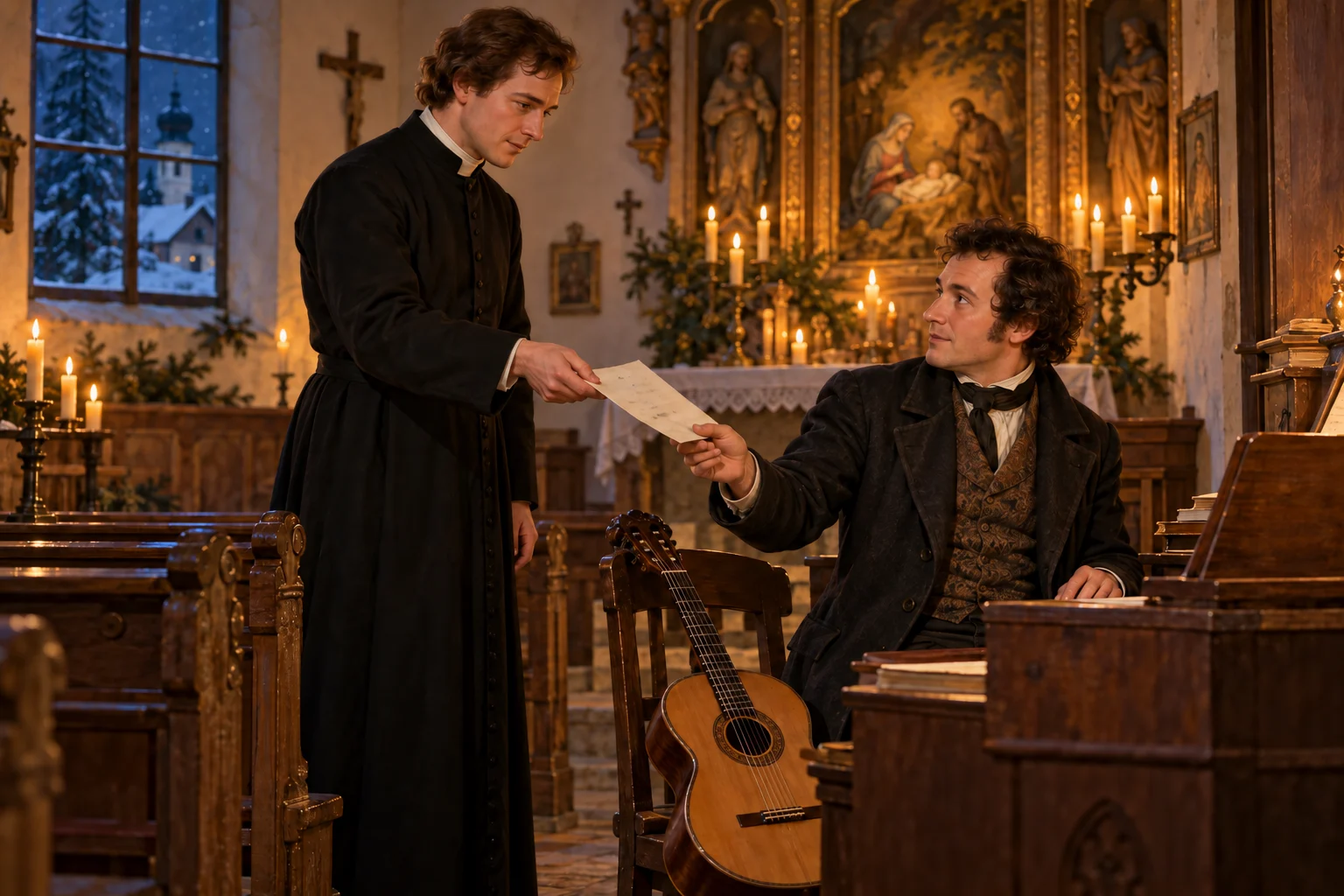
On 24 December 1818, Mohr handed Gruber the poem and asked for a suitable setting. Gruber composed for two solo voices, choir and guitar accompaniment. The work was ready for performance that evening in the church of St Nicholas in Oberndorf. Mohr sang tenor and played guitar, while Gruber sang bass. According to the Association's account of the song's origins, the first congregation included people connected with the local river and boatbuilding trades and their families.
The evidence behind the familiar story
A central source is Gruber's account written in 1854, decades after the event. It describes the request and collaboration but does not explain precisely why a new guitar-accompanied song was required. The popular story of an unusable organ is therefore a supposition, not an equally secure part of the record. A surviving manuscript in Mohr's handwriting, identified in 1995, separately strengthens the attribution of the words to Mohr and the melody to Gruber. The original 1818 score itself is lost.
A local church and a lasting memory
The Oberndorf historical account distinguishes the old parish church from the memorial chapel now associated with the song. St Nicholas was demolished after the community relocated in response to repeated damage in the old riverside settlement. The later chapel commemorates the first performance; it is not its original interior. The accompanying illustration accordingly imagines a modest early nineteenth-century church scene. Its folded paper and guitar evoke the collaboration without pretending to preserve the composers' exact positions that evening.
Silent Night (Piano Solo)
David Hollandsworth
David Hollandsworth performs a later solo-piano arrangement of the carol introduced in 1818. It preserves the musical connection while differing from the original combination of voices, choir and guitar.
Listen on SoundCloud ↗Follow the evidence.
- Silent Night Association: History and Gruber’s account ↗
- Silent Night Association: Manuscripts, text and music ↗
- Silent Night Association: Oberndorf and the first performance ↗
AI-assisted writing, with institutional and primary sources. Illustration is a reconstruction, not an archival photograph. Published October 31, 2026; updated October 31, 2026. Our approach