The Gazeta do Rio de Janeiro launches under royal censorship
The Gazeta do Rio de Janeiro first appeared on 10 September 1808. Its launch established newspaper production within Brazil, while the royal printing office's control showed that expanding print technology did not automatically bring editorial freedom.
The court changes Rio's institutions
The Portuguese monarchy's transfer to Brazil during the Napoleonic crisis brought new administrative institutions to Rio de Janeiro. Among them was the Impressão Régia, established in 1808 to serve the relocated government and its printing needs. Brazil's National Archives describes its role in producing ministerial and diplomatic documents as well as approved publications. A local newspaper emerged within this institutional expansion, linking a technological change to the practical demands of governing from across the Atlantic.
The first issue appears
The first number of the Gazeta do Rio de Janeiro was published on 10 September 1808. MultiRio's historical account describes a four-page opening issue and its close attention to royal affairs. The newspaper is distinguished as the first printed within Brazil. That geographical qualification matters: the Correio Braziliense, directed by Hipólito José da Costa, had already begun appearing in London earlier in 1808 and belonged to the emerging Brazilian press despite being produced abroad. The Imprensa Nacional records that the opening issue sold for 80 réis at bookseller Paulo Martin Filho's premises on Rua da Quitanda.
Printing and permission
The new printing office did more than operate presses. Its governing board examined proposed material and was charged with preventing publication against religion, government and accepted morals. Officials also selected and edited foreign news. The Gazeta therefore offered a controlled channel of information rather than an independent arena for criticism. The National Archives documents the close relationship between editing, translation, administration and censorship. Machinery made local production possible, while institutions determined which voices and subjects could reach the printed page.
A beginning with important limits
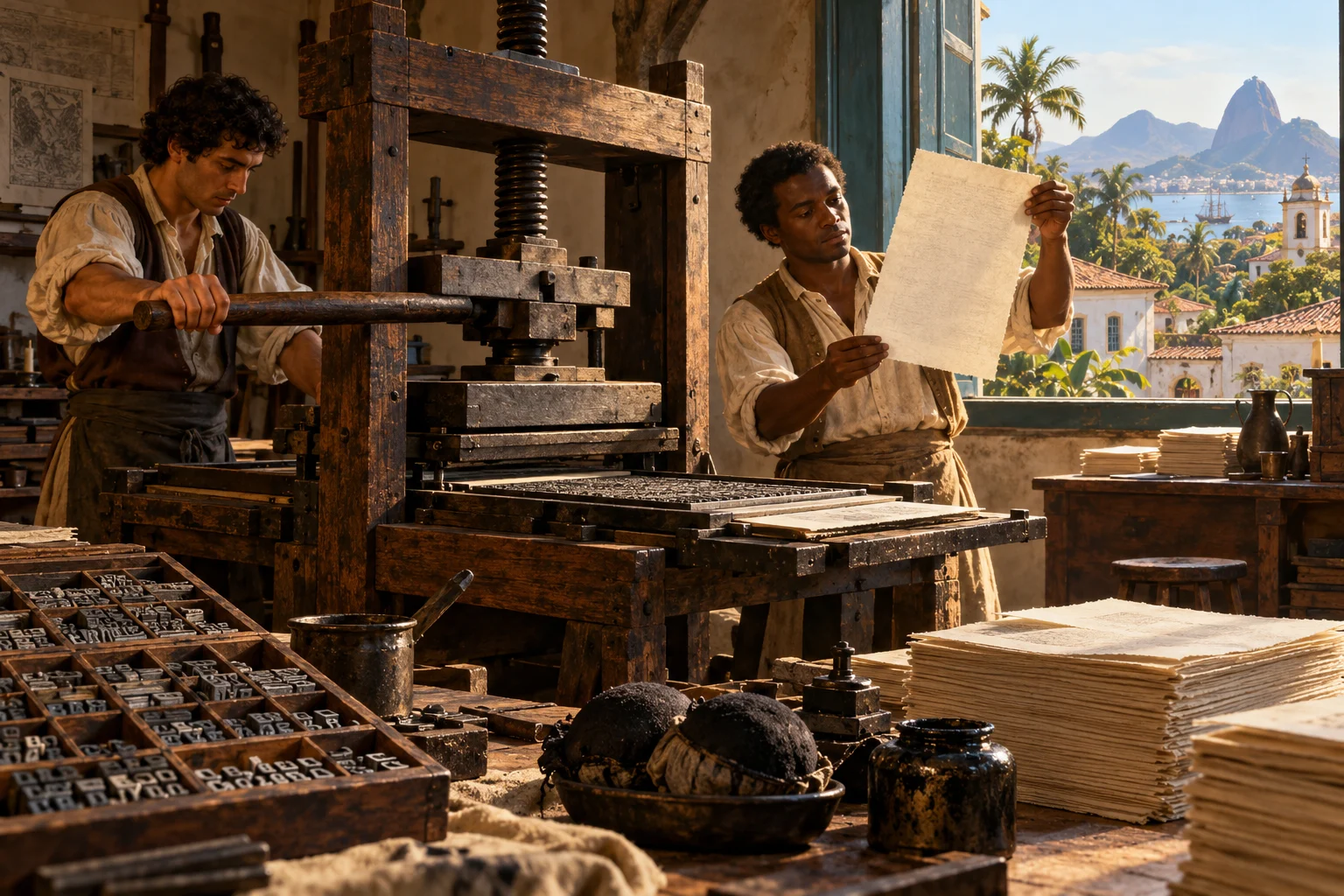
The Gazeta's launch is a landmark in the infrastructure of Brazilian news, but it should not be described as the arrival of unrestricted press freedom. Official publications and critical writing produced overseas occupied different positions within the same Atlantic information network. Reading them together reveals both innovation and constraint. The illustration interprets a hand-press workshop in early nineteenth-century Rio. Its workers and arrangement of equipment are imagined, and the blank-facing sheet deliberately avoids pretending to reproduce the documented first issue.
Marcos Portugal: Recordare, from the Requiem
Carolina Faria; UFRJ Choir and Symphony Orchestra; Ricardo Rocha
This 2008 performance presents music by Marcos Portugal, who joined the Portuguese court in Rio in 1811. It evokes the court culture surrounding the new press, rather than music documented at the newspaper's 1808 launch.
Listen on SoundCloud ↗Follow the evidence.
- MultiRio: The Portuguese court and institutions in Rio ↗
- Arquivo Nacional: Imprensa, jornais e pasquins ↗
- Imprensa Nacional: A Gazeta do Rio de Janeiro ↗
- Biblioteca Nacional de Portugal biography of Marcos Portugal ↗
- SoundCloud: recording and performer credits ↗
AI-assisted writing, with institutional and primary sources. Illustration is a reconstruction, not an archival photograph. Published October 31, 2026; updated October 31, 2026. Our approach