Rio de Janeiro Botanical Garden's foundation and acclimatisation mission
Founded on 13 June 1808, Rio de Janeiro's Botanical Garden began with a practical mission: adapting valuable imported plants to Brazilian conditions. Its early experiments connected botany, trade and colonial economic ambitions.
A foundation in the royal capital
The Botanical Garden of Rio de Janeiro dates its foundation to 13 June 1808. Portuguese prince regent João established the project in the setting of a court newly based in Brazil. The institutional history connects the site with a gunpowder factory and a garden for acclimatising plants from other parts of the world. This was the beginning of an evolving institution, rather than the instant appearance of the mature avenues and visitor landscape associated with the garden today. Institutional history.
What acclimatisation required
The original ambition included establishing useful plants and spices brought from overseas, particularly from Asia. A shipment of seeds or seedlings was only one stage of the process. Plants had to survive long sea journeys, germinate in nurseries and then be tested in different growing conditions. Soil, water, sunlight and shade could determine whether a promising introduction became a viable crop. The garden therefore joined practical gardening with systematic observation, within an economy that valued plants as potential sources of marketable goods. Institutional history.
Experiments beyond ornamental planting
The 1935 history in Rodriguésia describes early collections that included tea, nutmeg, cinnamon, avocado and lychee. These arrivals accumulated over time; they should not all be assigned to the founding day. The later effort to grow tea also depended on Chinese expertise in cultivation and processing. Such details show why the institution cannot be understood simply as a decorative royal park. It participated in wider movements of plants, skilled knowledge and agricultural ambitions between continents, shaped by unequal imperial relationships. Rodriguésia history.
From useful collections to scientific heritage
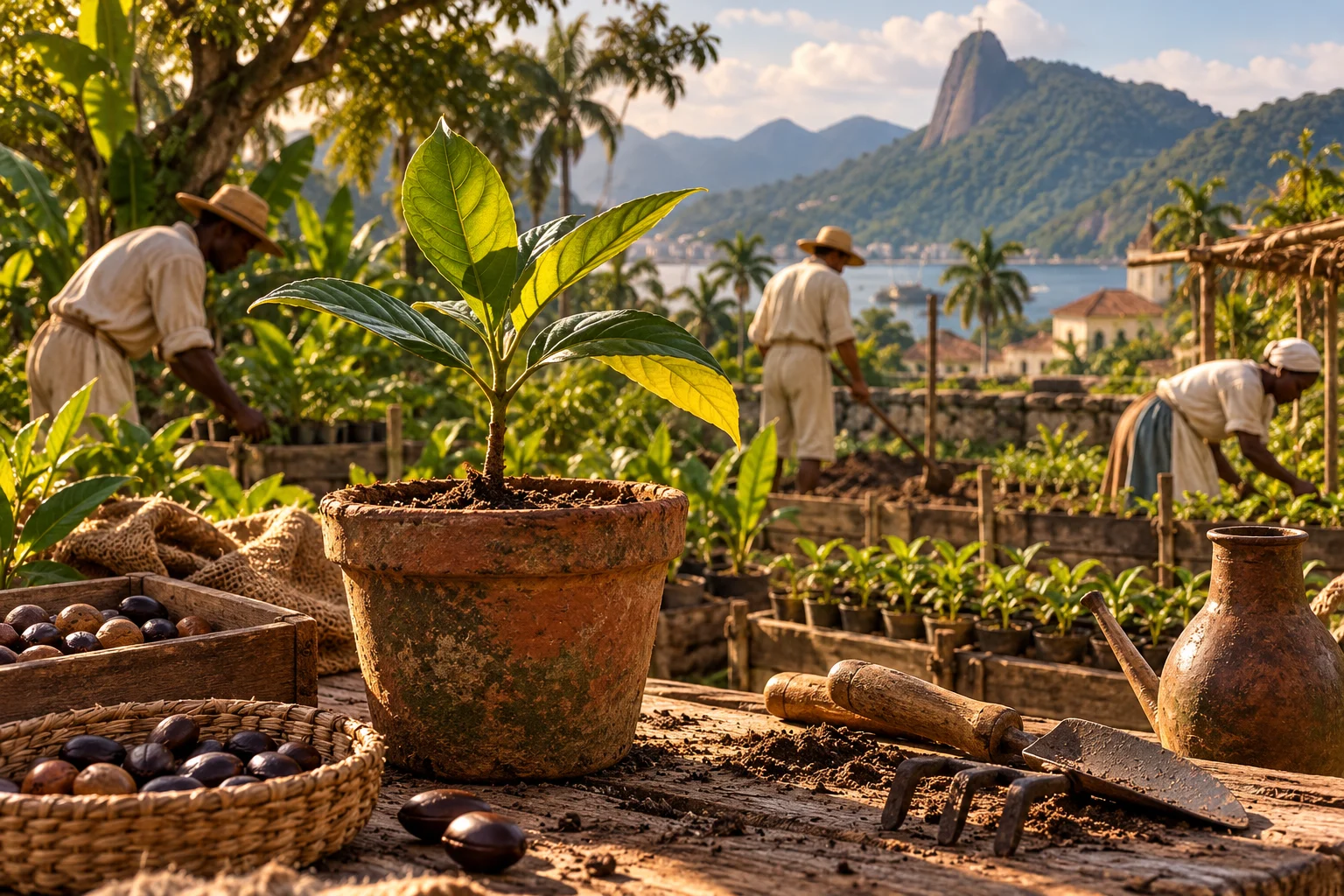
Research, teaching, collecting and public enjoyment became interwoven as the garden developed. Its later scientific identity grew from work with living specimens and from questions about how plants could be cultivated and understood. The foundation date identifies an institutional beginning, not a claim that every later scientific function already existed in June 1808. The illustration uses an imagined nursery and young plants to emphasize that experimental purpose. Its pots, workers and arrangement are interpretive details, rather than an archival record of the first day's work. Rodriguésia history.
Carinhoso — Pixinguinha
Standard Duo
Standard Duo's later violin-and-guitar performance evokes Rio's choro culture through Pixinguinha's much later composition. It supplies Brazilian cultural context, not music from the garden's 1808 foundation.
Listen on SoundCloud ↗Follow the evidence.
- Rio de Janeiro Botanical Garden: Institutional history ↗
- Rodriguésia, 1935: O Jardim Botanico do Rio de Janeiro ↗
AI-assisted writing, with institutional and primary sources. Illustration is a reconstruction, not an archival photograph. Published October 31, 2026; updated October 31, 2026. Our approach