Franklin describes his glass armonica to Beccaria
In a letter dated 13 July 1762, Benjamin Franklin explained a musical invention built around rotating glass bowls. His armonica reorganized an existing way of making glass sing into a compact instrument that could sustain several notes.
A musical letter from London
On 13 July 1762, Benjamin Franklin wrote from London to the Italian scientist Giambattista Beccaria about his glass armonica. The letter described an instrument already developed, rather than marking the moment of its invention. The Linda Hall Library preserves an early printed edition of the account. Franklin's correspondent belonged to the scientific network through which ideas, observations and practical instructions travelled across eighteenth-century Europe and the Atlantic.
From separate glasses to one spindle
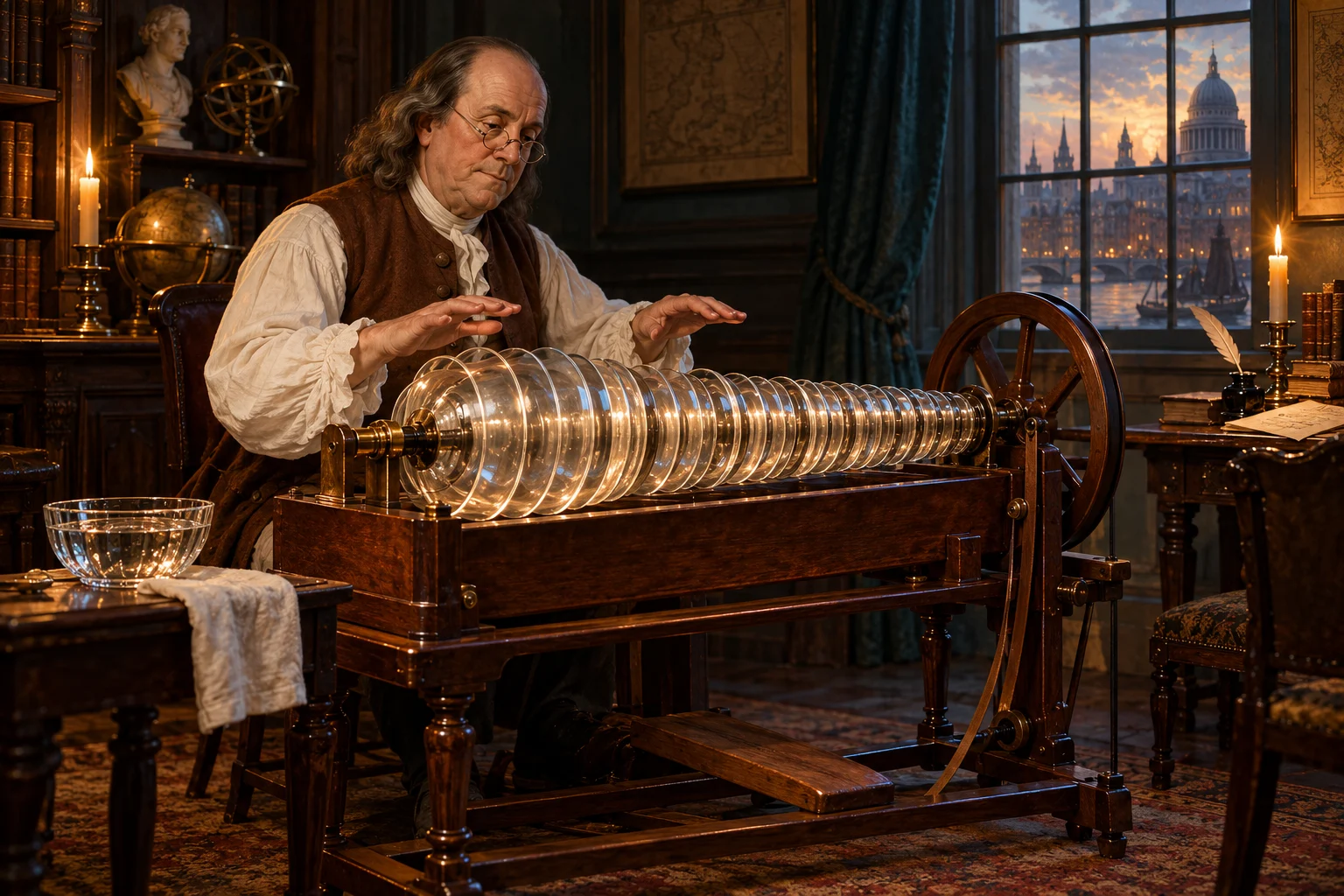
Musical glasses were familiar before Franklin's design. Rubbing a damp finger around the rim of a glass could produce a sustained tone, while different sizes or water levels provided different pitches. Franklin rearranged the sounding surfaces into graduated bowls without stems, nested together along a horizontal shaft. A foot treadle kept them rotating. This brought many rims within reach of the performer's hands and reduced the awkward movement required by a spread-out collection of separate drinking glasses. Bringing the surfaces together addressed a problem of coordination as well as one of tuning.
Friction becomes music
The player touched the revolving rims with moistened fingers. Friction set the glass vibrating, creating the instrument's characteristic sustained tones. Since several fingers could contact different bowls together, the design allowed combinations of notes. The Library of Congress explains the spindle and treadle mechanism and its bell-like result. Finger pressure helped shape the sound. The instrument's name, armonica, should not be confused with the later mouth-blown harmonica, which operates by an entirely different principle.
An invention enters musical life
The armonica attracted European interest, and Mozart and Beethoven wrote for it. Monticello's account of musical glasses also shows how such instruments interested figures beyond professional musicians, including Thomas Jefferson. Franklin's contribution was a mechanical reorganization of a known acoustic effect: the invention made existing sounds easier to combine and control. The illustration interprets the instrument and its London context. It does not reproduce the appearance of Beccaria's letter or document a particular demonstration on the day it was written.
Mozart: Adagio for Glass Harmonica in C Major
Ron Lussier
Lussier's later realization of Mozart's music for Franklin's instrument uses deliberately glass-like sounds. It is a modern interpretation, not a recording from 1762.
Listen on SoundCloud ↗Follow the evidence.
- Linda Hall Library: Franklin's letter of 13 July 1762 ↗
- Library of Congress: Franklin's Armonica ↗
- Monticello: Musical Glasses ↗
- SoundCloud: recording and performer credits ↗
AI-assisted writing, with institutional and primary sources. Illustration is a reconstruction, not an archival photograph. Published October 31, 2026; updated October 31, 2026. Our approach