Handel’s Messiah premieres at a Dublin charity concert
Messiah received its first public performance in Dublin on 13 April 1742. The premiere joined ambitious music with a practical civic purpose: raising funds for medical charities and the relief of imprisoned debtors.
A new work travels to Dublin
George Frideric Handel composed Messiah in 1741 to a text assembled by Charles Jennens from biblical and liturgical sources. The German-born composer had established his career in London, particularly through opera and English-language vocal works. He travelled to Dublin for a concert season and prepared the new oratorio there. Its first performance drew on the city’s own musical institutions, rather than simply transplanting a complete London company to Ireland. Jennens’s text moves through prophecy, suffering and resurrection rather than presenting a conventional theatrical plot.
The concert on Fishamble Street
On 13 April 1742, Messiah was performed at the New Musick Hall in Fishamble Street. Its advertised beneficiaries included relief for prisoners in debtors’ gaols, Mercer’s Hospital and the Charitable Infirmary. Demand was sufficiently strong that notices asked women to leave off the hoops supporting wide skirts and men to come without swords, creating more room. Such details connect the celebrated premiere with the practical business of accommodating an audience and raising charitable income.
Voices shaped the music
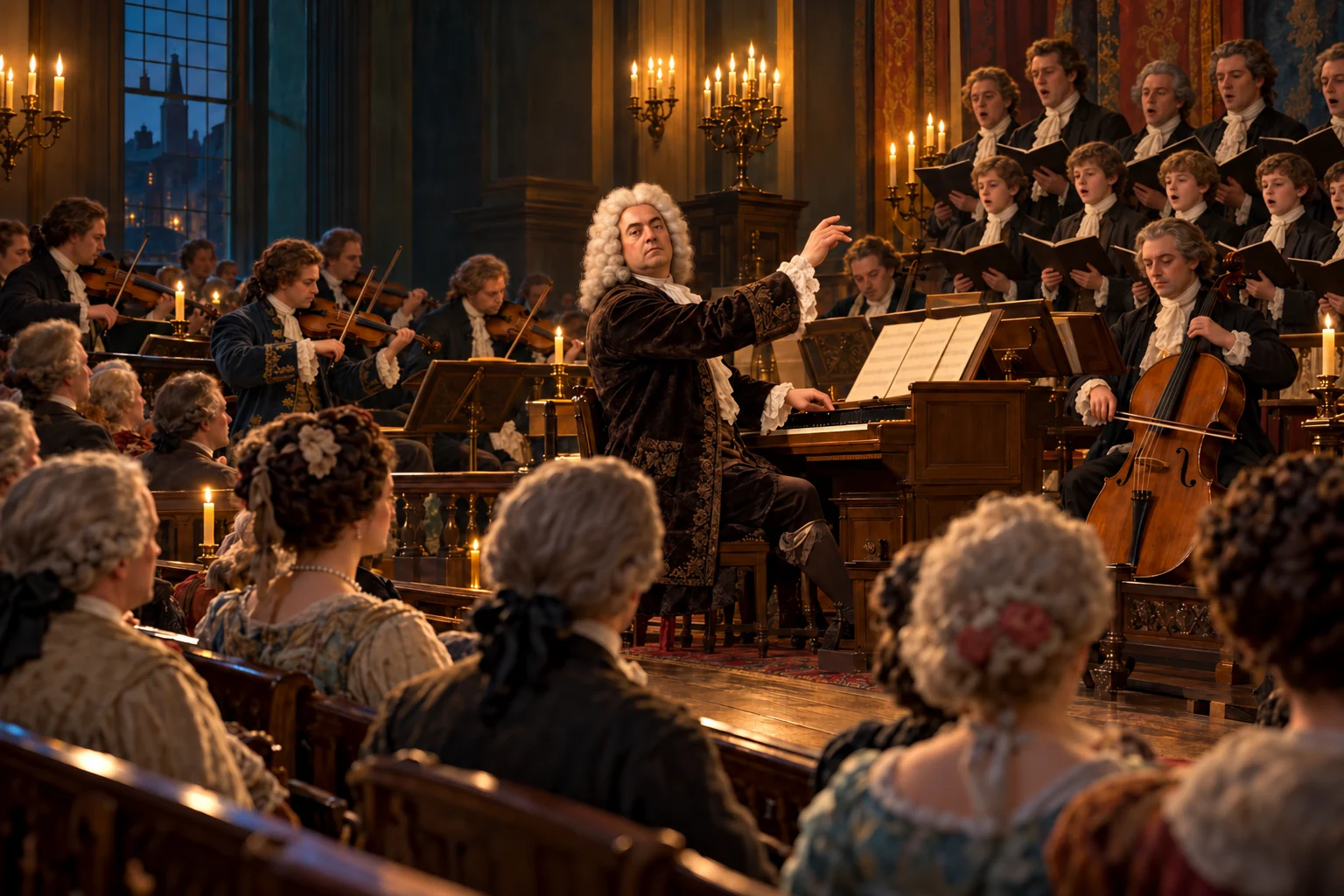
The cathedral choirs of Saint Patrick’s and Christ Church supplied men and boy choristers, with female soloists also taking part. Handel adapted music to the available performers, including the expressive contralto Susannah Cibber. Dunedin Consort’s research stresses that reconstructing the Dublin version involves uncertainties and that Handel continued revising the work for later occasions. There is consequently no single timeless performance format that can be assumed to reproduce every detail of the premiere.
A lasting relationship with charity
Messiah is an oratorio: voices and instruments present sacred material without the full scenery, costumes and acted staging associated with opera. Its subsequent history includes both intimate and very large performances, with charitable concerts remaining important to its reception. The Dublin event shows how a work’s social purpose can be part of its musical history. The accompanying scene reconstructs a period concert; the room, arrangement and individual faces are illustrative, rather than a documentary record of the premiere.
Handel: Hallelujah Chorus from Messiah (Glover, September 2021)
Music of the Baroque Chorus & Orchestra and Strong Voices Chorus; Jane Glover
This complete chorus performance was recorded at Baroque in the Park on 10 September 2021. It brings the premiered work into the game through a modern performance, not an imagined recording from 1742.
Listen on SoundCloud ↗Follow the evidence.
- Goethe-Institut: The premiere of Handel’s Messiah ↗
- Handel’s Messiah Sydney: The story of Messiah ↗
- Dunedin Consort: Extended notes on the Dublin version ↗
- Music of the Baroque: Hallelujah Chorus, live in 2021 ↗
AI-assisted writing, with institutional and primary sources. Illustration is a reconstruction, not an archival photograph. Published October 31, 2026; updated October 31, 2026. Our approach