Handel's Water Music and the royal Thames concert of 1717
On 17 July 1717, Handel's music accompanied George I's evening journey on the Thames. Contemporary accounts describe about fifty musicians, crowds of boats and a king pleased enough to request repeated performances.
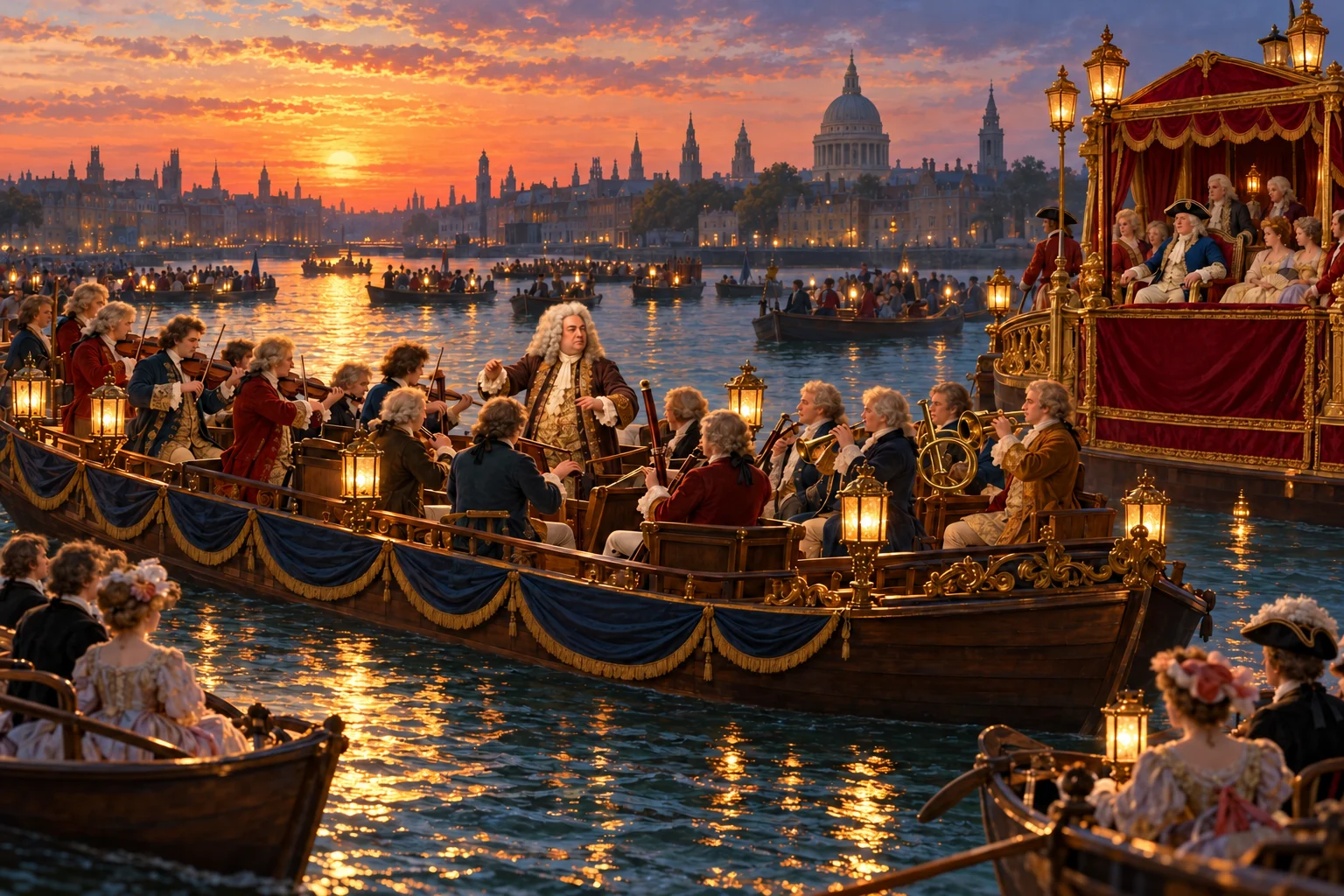
A river becomes a concert venue
On the evening of 17 July 1717, George I and members of his court boarded a barge at Whitehall and travelled toward Chelsea. A neighbouring vessel carried the musicians. The Thames also filled with boats whose occupants wanted to see the royal party and hear the performance. Contemporary reports collected in Stanford's Handel Reference Database establish the date and describe the scale of the gathering. The setting combined elite entertainment with a conspicuously public spectacle. Listeners outside the royal party could share in music commissioned for the court.
Music worth hearing again
Reports describe about fifty musicians playing trumpets, horns, oboes, bassoons, flutes, violins and bass instruments, without singers. Handel had supplied music for the occasion. George's enthusiasm prompted repetitions: a diplomatic account describes three performances in all, twice before supper and once afterward, each lasting about an hour. The repetition is the memorable human detail in an otherwise elaborate royal outing. The musicians' work continued through an evening that extended far beyond a short journey upriver.
What survives as Water Music
The event is securely documented, but the music's precise original sequence is less straightforward. Handel's own manuscript has not survived, and later sources arranged the movements differently. ABC Classic explains the familiar grouping into suites and the evidence of an early manuscript copy. Christopher Hogwood's Cambridge study distinguishes the well-attested 1717 performance from earlier river outings. Modern concert selections need not reproduce every detail of that evening's order.
Royal entertainment and later stories
A popular later story casts the concert as Handel's reconciliation with a king angry about his absence from Hanover. The documented support George had already given the composer makes that simple rescue narrative doubtful. The river party was also a display of royal presence in London, not merely a private musical treat. The accompanying illustration interprets the barges, players and evening atmosphere; it is not a contemporary view, and its placement of individual musicians and listeners is imagined.
Handel: Alla Hornpipe from Water Music
Godolphin and Latymer Year 8 Instrumental Ensemble
This later school-ensemble performance presents a complete movement from Water Music, uploaded in 2021. It connects directly with the river concert's repertoire, without claiming to recreate the 1717 orchestration or performance.
Listen on SoundCloud ↗Follow the evidence.
- Stanford: Handel Reference Database, 1717 primary reports ↗
- ABC Classic: Handel's Water Music, historical listening guide ↗
- Cambridge University Press: Christopher Hogwood on Water Music ↗
- SoundCloud: recording and performer credits ↗
AI-assisted writing, with institutional and primary sources. Illustration is a reconstruction, not an archival photograph. Published October 31, 2026; updated October 31, 2026. Our approach