Elena Cornaro Piscopia’s Philosophy Doctorate at Padua
Elena Cornaro Piscopia received her philosophy doctorate on 25 June 1678. Her achievement exposed both the possibilities of women’s scholarship and the institutional barriers that remained in place.
A scholar formed in Venice
Elena Lucrezia Cornaro Piscopia grew up in Venice in a household that invested heavily in her education. Her studies included languages, music, theology and philosophy. Tutors introduced her to Latin, Greek and Hebrew, while Carlo Rinaldini helped develop her philosophical learning. Her family’s position provided unusual opportunities, but her accomplishments required sustained intellectual work. The University of Padua identifies her as the first woman to graduate from a university. Padua
A doctorate with a boundary
In 1677 Cornaro sought a doctorate in theology. Gregorio Barbarigo, bishop of Padua and chancellor of its university, opposed awarding that qualification to a woman. Supporters continued to press her case, and a different route became possible. On 25 June 1678 she received a doctorate in philosophy. The change of discipline was therefore part of the institutional accommodation that allowed the award, rather than evidence that she had simply abandoned her earlier scholarly interests.
A public academic occasion
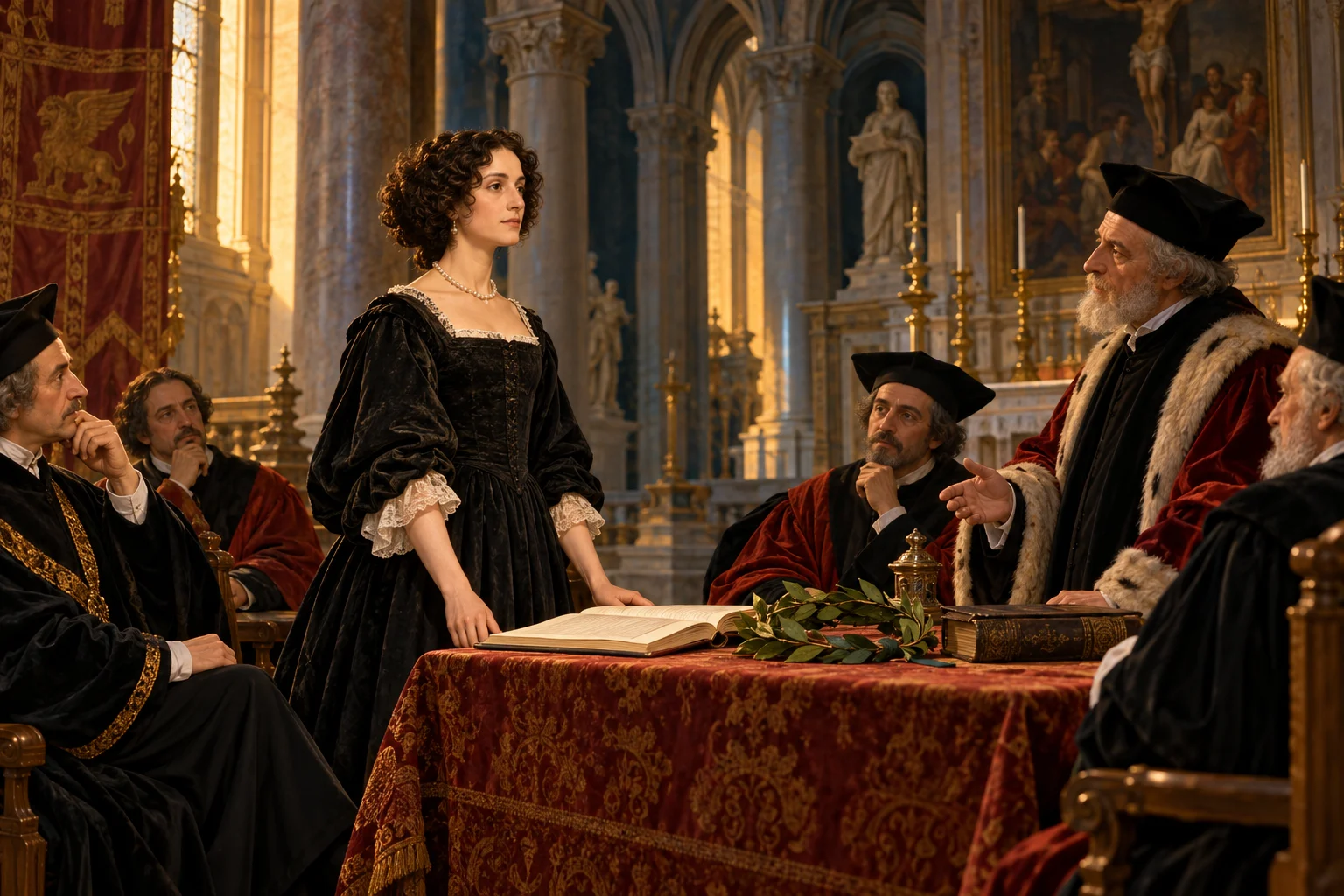
The ceremony took place in Padua’s cathedral before an audience of scholars and other distinguished visitors. Cornaro’s degree later became a powerful image of women’s intellectual achievement. A large stained-glass window in Vassar College’s library commemorates her examination, carrying the story from early-modern Italy into a college associated with women’s higher education in the United States. The window is a later historical representation, rather than an eyewitness depiction of the ceremony. Vassar study
An exception rather than general access
Cornaro’s success did not establish equal admission or an ordinary academic career path for women. Its importance lies partly in that tension: an institution could recognize one woman’s exceptional learning while maintaining a wider structure of exclusion. Later commemorations understandably emphasize the breakthrough, but the refusal of the theology degree belongs in the story too. Our illustration imagines the academic occasion without claiming to reproduce a documented arrangement of people, clothing or ceremonial objects.
Che si può fare — Barbara Strozzi
Mariana Flores
Flores’s modern performance of a song by Venetian composer Barbara Strozzi connects with Cornaro’s seventeenth-century Venetian cultural world. It is not music documented at the graduation.
Listen on SoundCloud ↗Follow the evidence.
- University of Padua: Elena Lucrezia Cornaro Piscopia ↗
- Vassar: Cornaro’s degree and commemoration ↗
- Vassar: history of the Cornaro Window ↗
AI-assisted writing, with institutional and primary sources. Illustration is a reconstruction, not an archival photograph. Published October 31, 2026; updated October 31, 2026. Our approach