Leeuwenhoek’s 1676 letter on microscopic life in water
On 9 October 1676, Antoni van Leeuwenhoek dated a detailed letter describing living organisms in water and spice infusions, bringing an unseen world into scientific correspondence.
A merchant’s powerful instrument
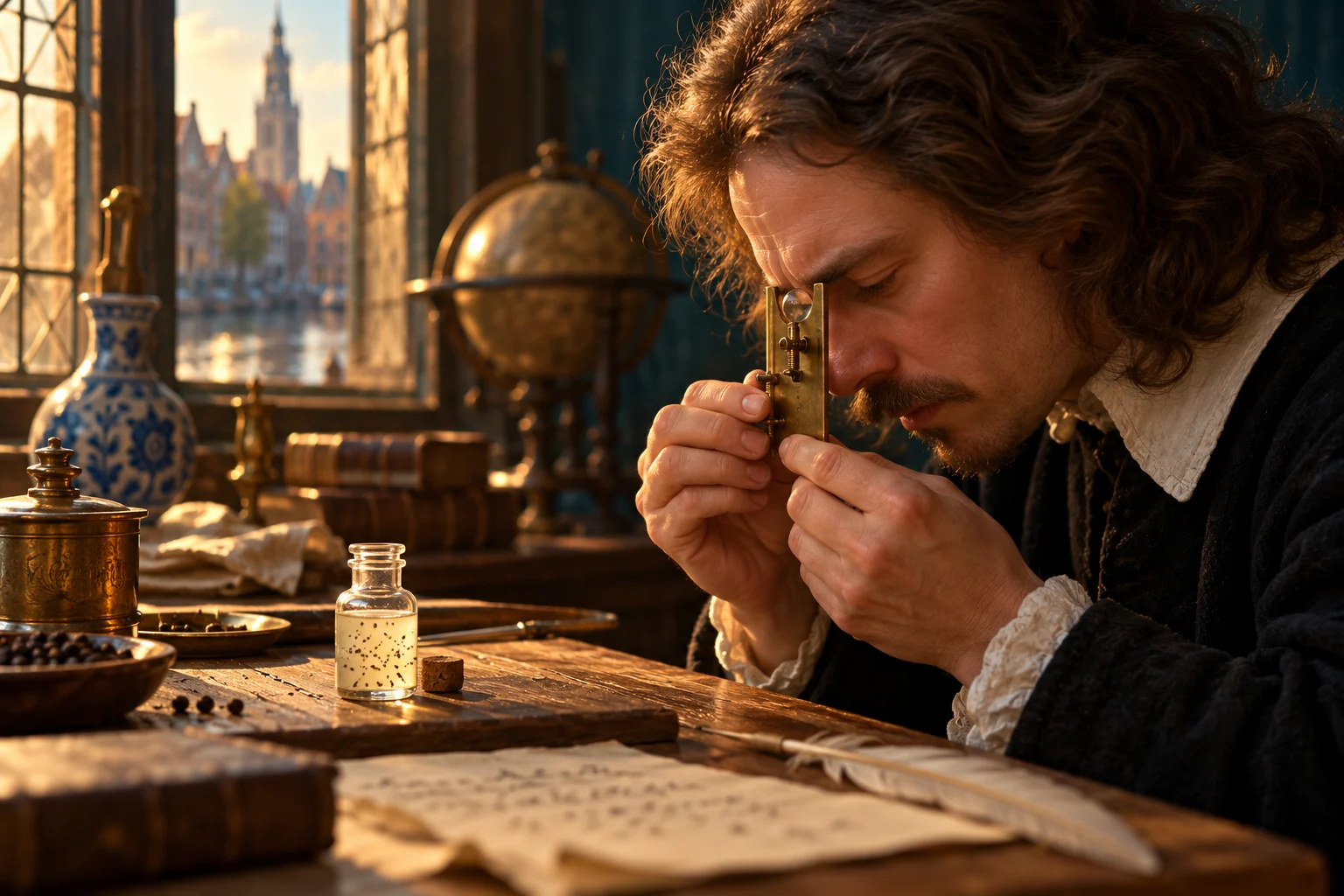
Antoni van Leeuwenhoek worked in Delft and came to lenses through the world of trade and close inspection. His microscopes were small instruments built around a single glass lens held between metal plates. A screw mechanism adjusted the specimen’s position. Their appearance was modest beside later laboratory microscopes, but the optical performance was remarkable. Rijksmuseum Boerhaave explains how these simple devices allowed their maker to examine structures and organisms far beyond ordinary unaided vision. Rijksmuseum Boerhaave: Leeuwenhoek’s microscopes.
What the dated letter records
The letter to Henry Oldenburg, secretary of the Royal Society, bears the date 9 October 1676. It describes observations of rainwater and other waters, along with infusions containing pepper and other spices. Its many entries document a continuing investigation rather than a single glance through a lens. Some observations reached back into the previous year. The exact historical event commemorated here is the written report, not a claim that microscopic life was first seen on that particular day. DBNL: Leeuwenhoek’s letter of 9 October 1676.
Learning to describe an unseen world
Leeuwenhoek compared the creatures’ movement, shape and relative size. His descriptions provided readers with ways to imagine organisms that they could not see unaided. Modern identifications of every organism he described are not equally secure; retrospective classification requires caution. The essential observation was nevertheless clear: apparently ordinary water could contain diverse living things. Neither a modern account of bacteria nor a complete theory of infectious disease should be read back into this seventeenth-century report. Lens on Leeuwenhoek: letter L-040.
From Delft to a scientific audience
The surviving manuscript was written by another hand and signed by Leeuwenhoek. Translation, discussion and publication took time, with an English extract appearing in Philosophical Transactions in 1677. Correspondence was therefore part of the discovery’s public life: observations needed to become descriptions that distant readers could inspect and question. The illustration evokes his working method with a single-lens instrument and a liquid specimen. Its room, pose and arrangement are interpretive, not a record of the letter’s composition.
VAN EYCK Daphne
flûte seule
A 7 June 2015 flute performance of Jacob van Eyck’s Doen Daphne d’over schoone maeght evokes the seventeenth-century Dutch musical world. Van Eyck’s music predates the letter; this recording is modern.
Listen on SoundCloud ↗Follow the evidence.
- DBNL: Leeuwenhoek’s letter of 9 October 1676 ↗
- Rijksmuseum Boerhaave: Leeuwenhoek’s microscopes ↗
- Lens on Leeuwenhoek: letter L-040 ↗
AI-assisted writing, with institutional and primary sources. Illustration is a reconstruction, not an archival photograph. Published October 31, 2026; updated October 31, 2026. Our approach