Galileo's first observations of lights beside Jupiter
On 7 January 1610, Galileo recorded three small lights near Jupiter and initially interpreted them as stars. Repeated observations revealed a system of orbiting moons, challenging the assumption that every celestial body revolved around Earth.
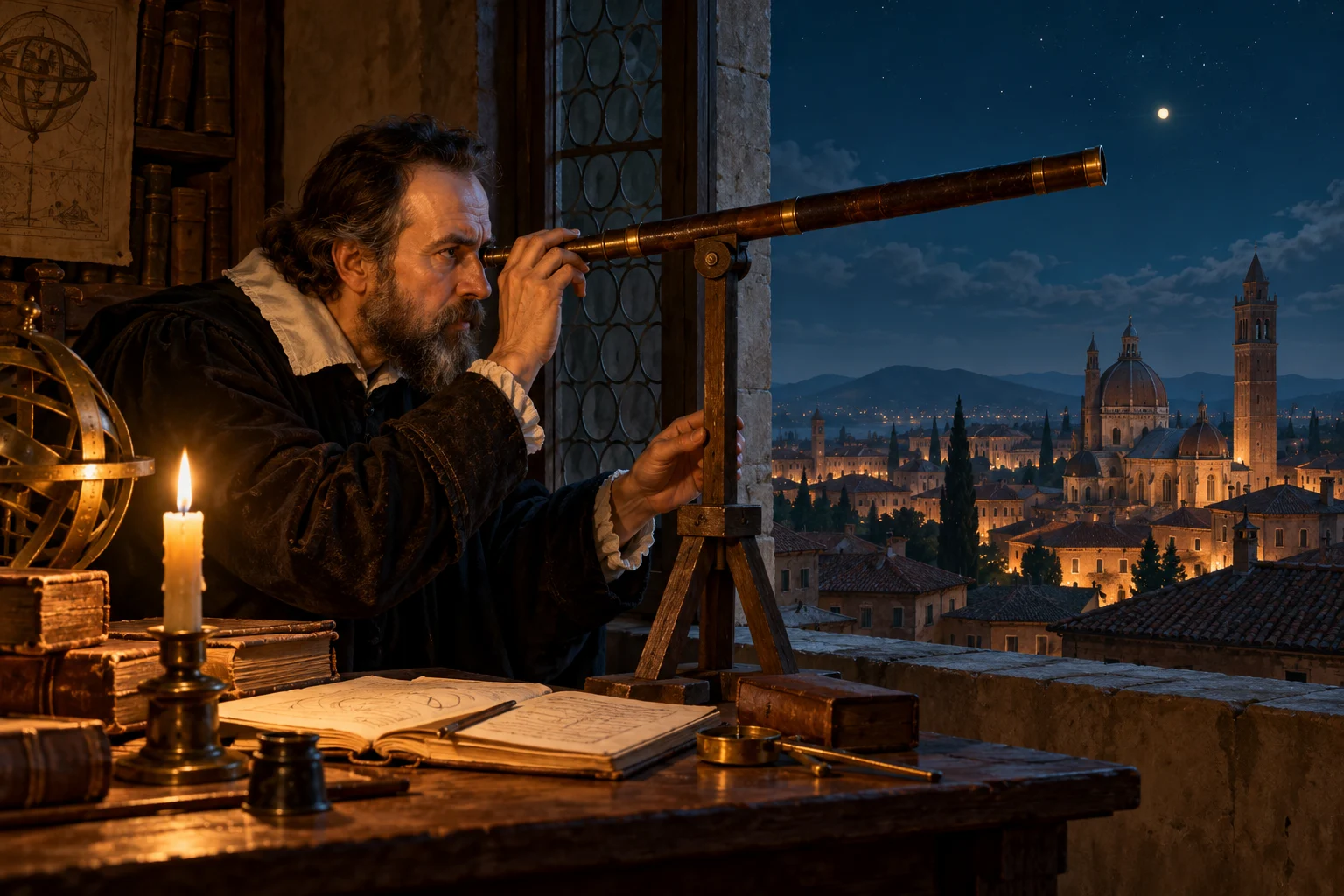
A telescope changes the view
By the beginning of 1610, Galileo Galilei had improved the telescope sufficiently to examine objects invisible to unaided eyes. On 7 January, working in Padua, he turned an instrument of about twentyfold magnification toward Jupiter. He noticed three small, bright points close to the planet. Their arrangement attracted his attention, but he initially regarded them as background stars. NASA's historical account documents that first observation and distinguishes it from the conclusions he reached later.
The importance of returning
Galileo's own published account describes how the lights seemed aligned and how a return observation showed a different arrangement. The decisive evidence accumulated across nights: the points stayed near Jupiter while changing positions relative to it. Another light became visible, bringing the eventual total to four. The JPL reproduction of Galileo's account preserves the progression from an initial interpretation to a different explanation. The discovery was therefore a developing investigation, not a complete conclusion reached in one glance.
A system beyond Earth
These observations identified moons orbiting another planet. That finding undermined the universal claim that celestial bodies must all circle Earth. It supported the larger reassessment associated with Copernicus, although Jupiter's moons alone did not demonstrate every feature of a Sun-centred planetary system. Other observations and mathematical arguments also mattered. NASA's history of planetary motion places the discovery alongside the work of Copernicus, Kepler and later Newton, showing how changes in astronomy depended on several kinds of evidence.
Recording and communicating discovery
Galileo published his observations in Sidereus Nuncius in March 1610. He initially associated the satellites with his Medici patrons; they are now commonly called the Galilean moons. The January record is especially revealing because it preserves uncertainty before the interpretation settled. Distinguishing what an observer saw from what the observer first believed is central to reading scientific history. The illustration depicts an imagined observing scene. Its sky and notebook are visual interpretation, not a facsimile of Galileo's dated notes.
Vincenzo Galilei: Contrapunto
Thomas C. Boysen
Boysen's later performance of music by Vincenzo Galilei, Galileo's father, connects the observation with the astronomer's musical family. It is not a recording from 1610.
Listen on SoundCloud ↗Follow the evidence.
- NASA: 415 Years Ago, Galileo Discovers Jupiter's Moons ↗
- NASA JPL: Galileo's account of the January observations ↗
- NASA Earth Observatory: Planetary Motion ↗
AI-assisted writing, with institutional and primary sources. Illustration is a reconstruction, not an archival photograph. Published October 31, 2026; updated October 31, 2026. Our approach