Hans Lippershey applies to patent an early telescope
On 2 October 1608, Hans Lippershey sought a Dutch patent for an instrument that made distant objects appear nearby. The application anchors the early history of the telescope in a document, while leaving broader questions of invention open.
An invention from the spectacle trade
Hans Lippershey, also spelled Lipperhey, was a spectacle maker working in Middelburg in the Netherlands. The craft already required the shaping, grinding and polishing of lenses. Combining lenses in a tube created a new application for skills developed to help people see. The history of optical instruments therefore depends on workshops and materials as well as on famous astronomers. A Whipple Museum study traces the movement of this knowledge through European trades and networks. Optical glass history
The application of 2 October 1608
On 2 October 1608, Lippershey applied to the States General for a patent on his distance-viewing instrument. Its advertised purpose was to make faraway things appear close. This is the secure dated event: an application for protection, rather than a documented instant when someone first thought of combining lenses. The request gives historians an identifiable maker, a governmental audience and a practical claim for the instrument’s usefulness. Its language emphasizes ordinary viewing rather than announcing a specific astronomical discovery. Astronomy history
Why priority remains complicated
Lippershey did not receive the exclusive patent he sought. Other makers could produce similar devices, and rival claims to the invention soon appeared. A legal-historical account discusses the application and the difficulties of protecting an instrument whose construction could be copied. Distinguishing the earliest secure surviving record from absolute invention priority is essential. The document establishes that Lippershey presented the device on that date; it cannot prove that no other craftsperson had experimented with a comparable arrangement beforehand. Nottingham Law Journal
From a terrestrial view to the heavens
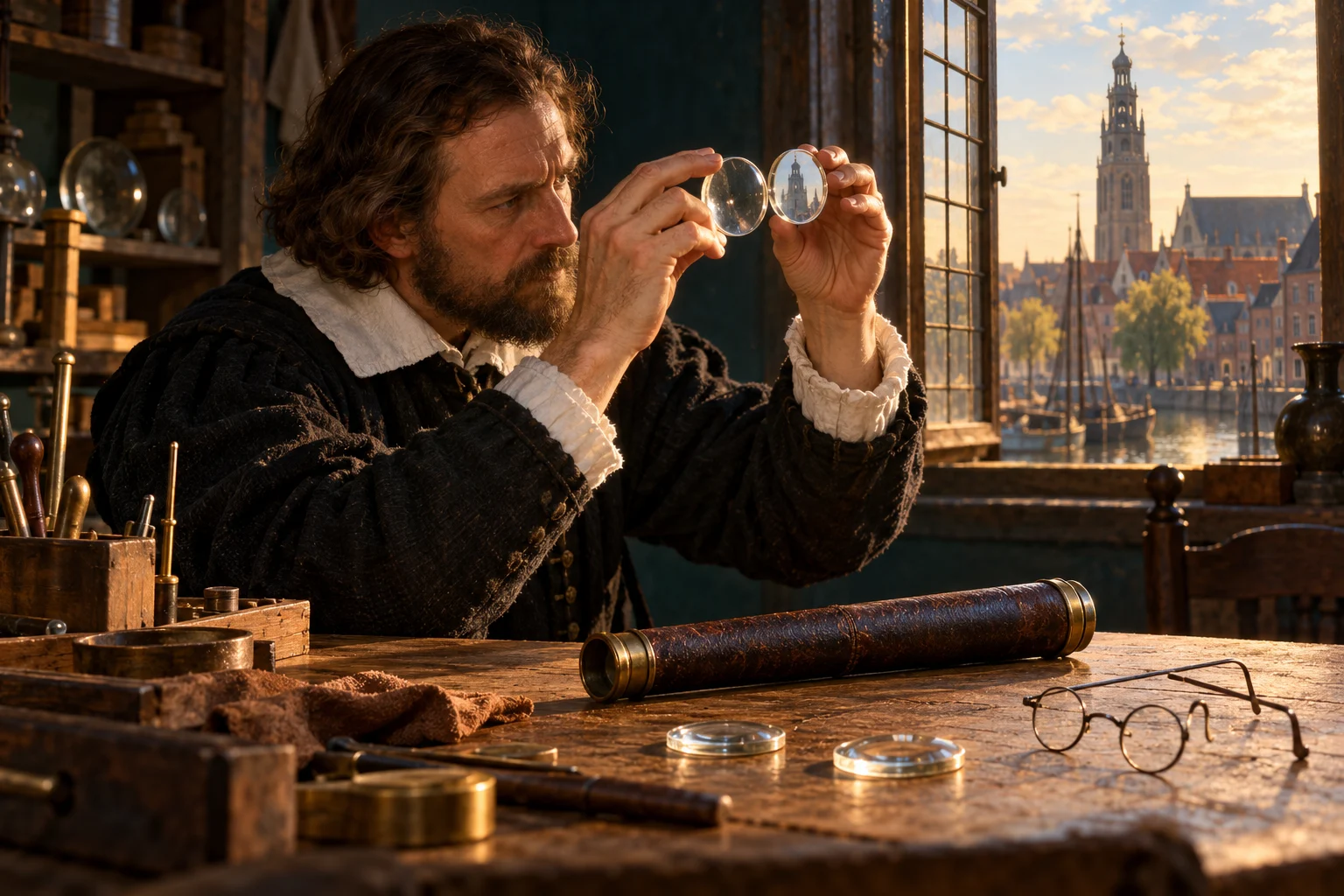
News of the new instrument spread through Europe. Improved versions were soon used to examine the Moon, planets and stars, producing observations that challenged inherited ideas about the heavens. That scientific transformation followed the initial practical device; it should not be compressed into the patent application itself. The telescope’s history demonstrates how a workshop invention can acquire purposes its first official description did not exhaust. The illustration imagines a lens-maker’s working environment and does not claim to reproduce Lippershey’s shop or a scene witnessed on the application date. Early telescope development; craft networks
John Dowland - Lachrimae Pavan
Myles Payne
Myles Payne’s later performance, recorded by Arthur Turner in 2016, provides music from the European generation in which the spyglass emerged. It is not music documented at the patent application.
Listen on SoundCloud ↗Follow the evidence.
- International Year of Astronomy: The genesis of the telescope ↗
- Whipple Museum: Optical glass-working networks, hosted by UCL ↗
- Nottingham Law Journal: Lippershey and the telescope patent ↗
- SoundCloud: John Dowland - Lachrimae Pavan ↗
AI-assisted writing, with institutional and primary sources. Illustration is a reconstruction, not an archival photograph. Published October 31, 2026; updated October 31, 2026. Our approach